Most people think routines are boring prisons—rigid schedules that crush spontaneity and creativity. The world's highest performers know the truth: routines are liberation machines. They free mental energy for what actually matters by eliminating decision fatigue on the trivial.
Here's the paradox that changes everything: maximum structure in your foundation creates maximum freedom in your execution. When you automate the mundane, you unlock capacity for the magnificent.
The Decision Fatigue Tax You're Paying Daily
Every decision you make—no matter how small—costs mental energy. Should I work out now or later? What should I eat for breakfast? When should I check email? These micro-decisions seem harmless, but they're silently draining the cognitive fuel you need for strategic decisions that actually move your business forward.
Research by Roy Baumeister revealed that decision-making depletes a finite resource. By the end of the day, you're making worse choices not because you're less intelligent, but because you've exhausted your decision-making capacity on trivial matters. This is why judges grant parole more frequently in the morning than afternoon—their mental energy is depleted.
Pro Tip
Conduct a decision audit: Track every choice you make for one day. You'll be shocked by how many decisions are repetitive and could be automated through routine.
Routines eliminate this tax. When you decide once—"I work out at 6 AM every day"—you never waste energy on that decision again. The mental bandwidth you save compounds into strategic advantage. This is how you maintain mental clarity when others are drowning in decision fatigue.
The Creativity Myth: Why Artists Need Structure
There's a romantic notion that creativity requires chaos—that rigid routines kill inspiration. The data tells a different story. History's most creative minds had the most structured routines.
Picasso painted every day from 2 PM to sunset. Maya Angelou rented a hotel room every morning at 6:30 AM and wrote until 2 PM. Steve Jobs wore the same outfit daily to eliminate clothing decisions. Barack Obama only wears blue or gray suits for the same reason. These aren't coincidences—they're strategic choices.
When you need wisdom on building sustainable habits, sometimes it helps to learn from those who mastered the art. Benjamin Franklin's famous daily routine—structured down to the hour—enabled his extraordinary productivity across multiple fields.
Case Study: Elon Musk's Time Blocking
Musk schedules his entire day in 5-minute blocks. This extreme routine allows him to run multiple companies simultaneously. The structure doesn't limit him—it multiplies his capacity by eliminating wasted time and decision-making overhead.
The pattern is clear: creativity doesn't emerge from chaos. It emerges when you've eliminated chaos from everything else, creating space for deep, focused work on what matters.
The Three-Layer Routine System
Not all routines are created equal. The most effective approach uses three distinct layers, each serving a different purpose:
Layer 1: Foundation (Non-Negotiable)
These are the biological and physical routines that keep your machine running optimally:
- Sleep schedule: Same bedtime and wake time, even weekends
- Exercise window: Fixed time for physical activity
- Nutrition rhythm: Consistent meal timing and composition
- Recovery practices: Meditation, stretching, or other restoration
This foundation layer is about maintaining the physical and mental energy required for everything else. When this layer is solid, you have the capacity for sustained high performance.
Layer 2: Production (Structured Flexibility)
This is where your core work happens:
- Deep work blocks: 2-4 hour windows for focused, creative work
- Meeting windows: Batched communication time
- Administrative blocks: Email, planning, organization
- Learning time: Reading, courses, skill development
The key is consistency in timing but flexibility in content. Your deep work block is always 9 AM-12 PM, but what you work on can vary based on priorities. This structure enables the kind of strategic thinking that moves businesses forward.
Layer 3: Flexibility (Controlled Chaos)
This layer is deliberately unstructured:
- Exploration time: Following curiosity without agenda
- Social spontaneity: Unplanned interactions and connections
- Creative play: Experimentation without pressure
- Strategic breaks: Intentional disruption of patterns
This layer prevents routine from becoming rut. It's where serendipity happens, where unexpected connections form. When you need guidance on balancing structure with flexibility, AI-powered coaching can help you design a system tailored to your specific situation.
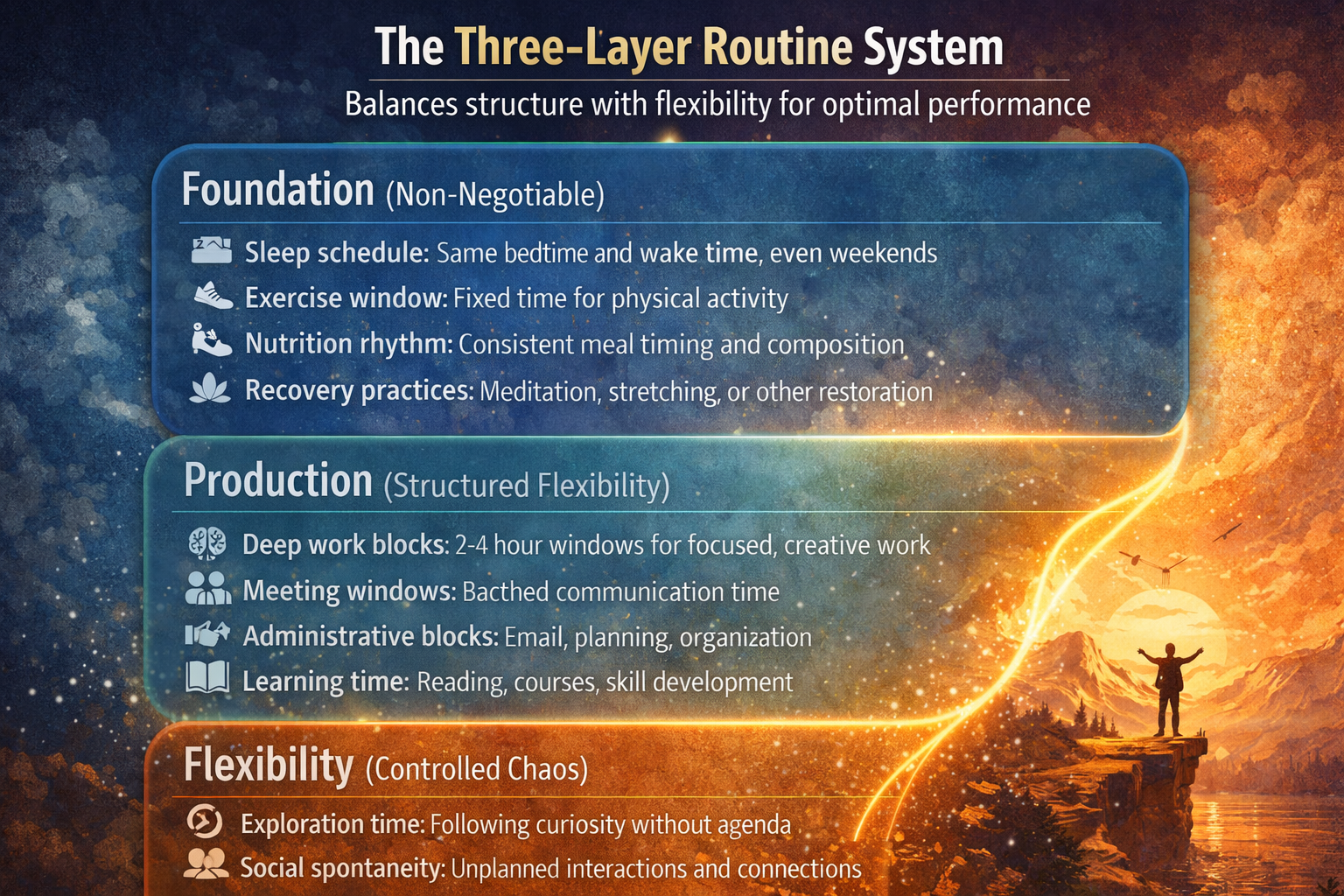
The three-layer routine system balances structure with flexibility for optimal performance.
Routine as Compound Interest: The 1% Rule
Here's where routines become exponentially powerful: they're the delivery mechanism for compound growth. Small improvements, repeated consistently, create extraordinary results over time.
The mathematics are simple but profound. If you improve by just 1% each day, you're 37 times better after one year. If you decline by 1% each day, you decline to nearly zero. The difference between these trajectories isn't talent or luck—it's consistent daily action.
Routines are how you guarantee that 1% improvement happens. Without routine, improvement is random and inconsistent. With routine, it's systematic and inevitable.
The Writing Routine Example:
Write 500 words every morning before checking email. Seems small. But that's 182,500 words per year—two full books. Most aspiring authors never finish one book because they wait for inspiration. Professional authors have routines that make inspiration irrelevant.
This principle applies to everything: leadership development, customer relationships, team building, financial growth. Routines transform aspirations into achievements through the power of compounding.
The Anti-Routine: When to Break the Pattern
Here's the counterintuitive truth: the best routines include planned disruption. Without periodic chaos, routines calcify into ruts. You need strategic pattern interruption.
Quarterly Chaos Weeks
Every 90 days, deliberately break your routine for one week:
- Travel to a new environment
- Work at completely different hours
- Explore new activities and experiences
- Meet people outside your usual circles
- Read books in unfamiliar domains
These chaos weeks serve multiple purposes. They prevent burnout by providing novelty. They spark creativity through new inputs. They help you evaluate whether your routines still serve you or have become mindless habits. This kind of strategic disruption keeps you adaptable.
The Sabbatical Principle
Even within your routine, build in complete breaks. One day per week with no agenda. One week per quarter completely off. These aren't violations of your routine—they're part of it. The rhythm of intense structure followed by complete release creates sustainable high performance.
This is where strategic rest becomes a competitive advantage. While others burn out from relentless grinding, you're building a sustainable system that compounds over decades.
Building Routines That Actually Stick
Most routines fail not because they're bad ideas, but because they're implemented poorly. Here's how to build routines that become automatic:
1. Start Absurdly Small
Want to start exercising? Don't commit to an hour at the gym. Commit to putting on workout clothes. That's it. The barrier to entry must be so low that you can't fail. Once you're in workout clothes, you'll probably exercise. But even if you don't, you've maintained the routine.
This principle applies to everything. Want to write daily? Commit to one sentence. Want to meditate? Commit to one breath. The goal isn't the activity—it's establishing the pattern. Scale comes later.
2. Link to Existing Habits
Don't create routines in a vacuum. Attach them to things you already do automatically. "After I pour my morning coffee, I'll write for 10 minutes." The existing habit (coffee) becomes the trigger for the new routine (writing).
This is called habit stacking, and it's how you build complex routines without overwhelming yourself. Each new habit piggybacks on an established one, creating a chain of automatic behaviors.
3. Make It Easier to Do Than Not Do
Design your environment to support your routines. Want to work out in the morning? Sleep in your workout clothes. Want to eat healthy? Don't keep junk food in the house. Want to read more? Put books everywhere and hide your phone.
The path of least resistance should lead to your desired behavior. When you need to design systems that support your goals, tools like our business plan generator can help you create structured frameworks for success.
Pro Tip
Use the 2-minute rule: If a routine takes less than 2 minutes, do it immediately. This prevents small tasks from accumulating and creates momentum for larger routines.
4. Track Without Judgment
Measure your routine adherence, but don't beat yourself up over misses. The goal is data, not perfection. Track your routines for 30 days and look for patterns. When do you succeed? When do you fail? What triggers each?
This data reveals the truth about your behavior and helps you design better systems. Maybe you can't work out at 6 AM because you're not a morning person. Fine—move it to lunch. The routine matters more than the specific timing.
The Routine Mindset Shift
The ultimate insight about routines isn't tactical—it's philosophical. Routines aren't about control. They're about freedom. They're not about rigidity. They're about flexibility. They're not about limiting your options. They're about expanding your capacity.
When you eliminate decision fatigue on the trivial, you gain decision power on the critical. When you automate the mundane, you create space for the meaningful. When you structure your foundation, you enable creativity in your execution.
This is how you build a life and business that compounds over time. Not through sporadic bursts of motivation, but through consistent, systematic action. Not through grinding harder, but through eliminating waste and focusing energy.
The most successful people aren't more talented or more motivated. They've simply built better routines. They've automated the foundation so they can focus on the frontier. They've created systems that make success inevitable rather than hoping for it to happen.
Your Next Steps
Don't try to overhaul your entire life overnight. That's a recipe for failure. Instead, start with one routine in one layer:
Foundation Layer: Pick one—consistent wake time, daily exercise, or regular meals. Master it for 30 days before adding another.
Production Layer: Block one 2-hour window for deep work. Protect it ruthlessly. Let everything else flex around it.
Flexibility Layer: Schedule one hour per week for unstructured exploration. No agenda, no goals, just curiosity.
Start there. Build slowly. Let the compound effect work its magic. And remember: the goal isn't to become a robot. It's to free yourself from being one. When you need personalized guidance on building routines that fit your specific situation, get AI-powered coaching tailored to your goals.
The paradox resolves itself: structure creates freedom. Routine enables creativity. Consistency compounds into extraordinary. This is how you build a life and business that doesn't just survive—it thrives, systematically and inevitably, one routine at a time.

About Marcus Williams
After building and selling two successful tech startups, Marcus now dedicates his time to coaching the next generation of business leaders. His practical approach combines cutting-edge leadership theory with real-world experience.
More articles by this author