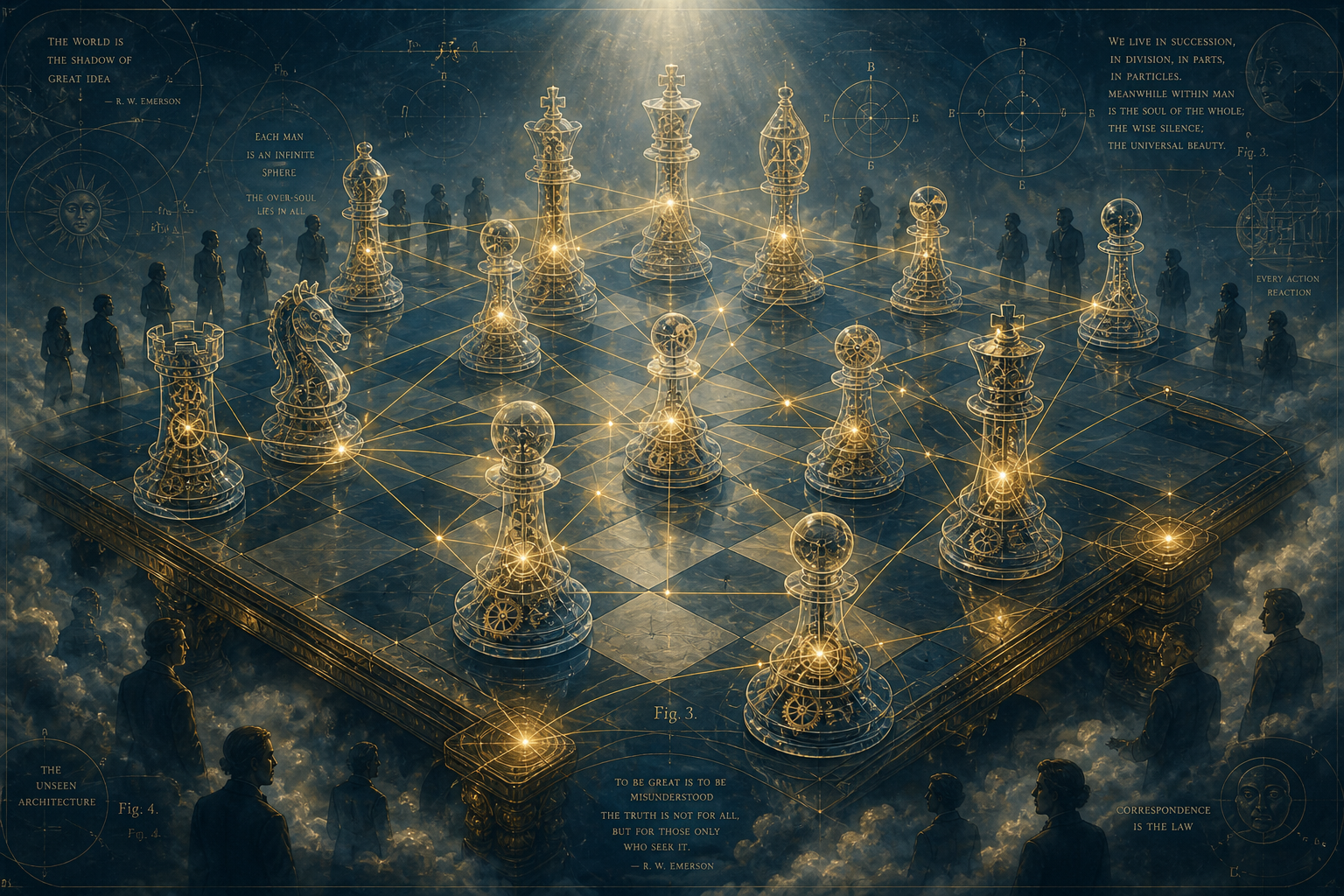

In the commerce of minds, as in the exchange of goods, there is ever a silent arithmetic at work, though few confess its presence. Each man, standing at the threshold of action, consults not only his own desire, but the imagined will of another. Thus society is not a mere congregation of individuals, but a field of reciprocal expectations—an invisible chessboard upon which each piece moves with an awareness, dim or acute, of the others.
The Doubled Decision
We are accustomed to praise independence, yet no act is solitary. The farmer who sows his field sows also into the expectations of the market; the merchant who sets his price listens inwardly to the anticipated refusal or consent of his buyer. Even the recluse, who boasts of self-reliance, constructs his solitude in opposition to a world he has already measured. In this way, each decision is doubled: first as an inward impulse, and second as a response to the imagined responses of others.
This mutual regard forms a delicate equilibrium. When men distrust one another, they arm themselves with caution, and by their very defenses call forth the hostility they feared. When they trust, they disarm, and their openness invites cooperation. Thus, the condition of society reflects not merely the actions taken, but the expectations that precede them. We live, therefore, not only in a world of deeds, but in a world of anticipations.
The Paradox of Advantage
There is a tendency in the human mind to seek advantage, to secure a greater portion of the common good. Yet the pursuit of private gain, when guided by narrow vision, often defeats itself. Two men, each striving to outwit the other, may both descend into loss; while two who act with a broader intelligence—perceiving their interdependence—may rise together. Here lies a paradox: that the surest path to personal benefit often passes through regard for the benefit of another.
Insight
The deepest law at work is not cunning, but correspondence. The soul, in its integrity, refuses to thrive in contradiction to itself.
But let us not mistake this for mere calculation. When a man acts in harmony with his higher perception—seeing others not as adversaries but as participants in a shared unfolding—his actions carry a force that transcends strategy. He aligns, as it were, with a current larger than his private will, and is borne forward with less resistance.
The Contracted Universe
Yet many persist in a narrower game, measuring each encounter as a contest, each relation as a negotiation of advantage. They live in a contracted universe, where every gain is another's loss, and every interaction is shadowed by suspicion. Such a life, though it may yield momentary triumphs, is impoverished in spirit. It mistakes the surface for the substance, and overlooks the deeper unity that underlies all exchange.
For beneath the apparent multiplicity of actors, there is a profound continuity. Each mind mirrors another; each expectation calls forth its counterpart. Society, then, is not a battleground of isolated wills, but a fabric woven of mutual influence. To understand this is to perceive that the "game" we imagine ourselves to play is, in truth, a living system of relations, responsive to the quality of our thought as much as to the form of our action.
The Question of the Wise
The wise man, therefore, does not merely ask, "What shall I do?" but "What world do I affirm by this choice?" For every act declares a principle, and every principle shapes the field in which future acts will unfold. If he acts from fear, he strengthens a world governed by fear; if from trust, he enlarges the domain of trust. In this manner, each individual participates in the authorship of the common reality.
Consider: When you enter a negotiation expecting betrayal, you create defensive behaviors that often produce the very betrayal you feared. When you enter expecting mutual benefit, you create space for cooperation to emerge.
Co-Creation, Not Competition
Let us then proceed with a larger understanding. Not as players seeking to outmaneuver one another, but as co-creators in a shared design. Let us recognize that the highest advantage is not secured by domination, but by alignment; not by isolating oneself from others, but by perceiving the deeper unity that binds all action together.
For in the end, the truest success is not to win against another, but to move in such a way that all participants are elevated—and that the invisible harmony, which sustains both self and society, is made more manifest.