
There is a sentence that has killed more deals than any competitor, any pricing objection, and any bad product ever will. It sounds polite. It sounds reasonable. It even sounds like progress. It is four words long: "I'll think about it."
If you sell anything — a service, a product, your own time — you have heard it. And if you are like most people who sell, you said "of course, take your time," hung up, and never heard from them again. The deal didn't die on that call. It died three days later, in a silence you were told to respect.
I have spent fifteen years on the side of the table that has to hear a "yes" or the number doesn't move. Here is the single most useful thing I know: "I'll think about it" is almost never about thinking, and it is almost never about the price. It is an objection you failed to surface, wearing a costume so you'd let it leave the room.
The polite lie both sides agree to tell
Here is what makes it so dangerous: it is comfortable for everyone. The buyer avoids saying an awkward "no." You avoid hearing one. You both get to walk away feeling like the conversation ended well. It didn't. It ended unresolved, which is the worst possible outcome — worse than a clean "no," because a "no" you can learn from, and an "I'll think about it" just leaves you refreshing your inbox.
A clean "no" is a gift. It closes a loop. It tells you to spend your energy somewhere else. "I'll think about it" gives you neither the deal nor the closure — it gives you hope, which is the most expensive thing a seller can carry.
What it actually means
When someone says they need to think about it, one of three things is almost always true. Your job in the next thirty seconds is to find out which:
1. They don't see enough value yet. The price isn't too high — the value is too low. In their head, what you're offering and what you're asking haven't balanced. This is the most common one, and the most fixable. You didn't lose on price. You lost on clarity.
2. There's an objection they haven't voiced. Something is nagging at them — a risk, a past bad experience, a question they're slightly embarrassed to ask ("what if this doesn't work for a business my size?"). They'd rather retreat than raise it. If you don't draw it out now, it will win by default.
3. You're talking to the wrong person, or not all of them. They genuinely can't decide alone — there's a partner, a spouse, a budget they don't control. That's real. But you need to know it, because "I'll think about it" and "I need to run this past my partner" require completely different follow-ups.
Notice what's not on that list: "I need quiet time to reflect on your offer." Almost nobody does that. People decide with information and confidence, not with solitude. If they leave to "think," they're usually leaving to forget — because the urgency you built evaporates the moment they're back in their own day.
What to do the moment you hear it
Do not fight it. Do not push harder — pushing confirms their fear that this was a hard sell. Instead, do the one thing most sellers are too nervous to do: ask a calm, honest question that gives them permission to tell you the truth.
My favorite, almost word for word: "That's completely fair. Just so I don't follow up at the wrong time — is it the offer itself you're unsure about, or is it more about timing?"
Look at what that does. It's not pressure. It's not "what's holding you back" — which sounds like an accusation. It hands them two easy doors, and whichever one they walk through tells you exactly which of the three problems you're dealing with. If it's the offer, you have a value conversation to finish. If it's timing, you have a real reason to schedule a specific next step instead of drifting into silence.
Because that's the other half of the discipline: a deal without a next step and a date is not a deal. It's a wish. "I'll follow up sometime" is how deals die politely. "Can I call you Thursday at 10 once you've had a chance to talk to your partner?" is how they stay alive. Vague endings kill. Specific ones keep the door open.
The reframe that changes everything
Stop hearing "I'll think about it" as rejection. It isn't. It's an unfinished sentence. The buyer stopped talking before they told you the real thing. Your job isn't to accept the pause — it's to gently finish the sentence with them.
The best sales conversations don't feel like selling at all. They feel like two people getting to the truth of whether this is a fit. When you treat "I'll think about it" as the beginning of that truth instead of the end of the conversation, you stop losing deals to silence — and you start closing the ones that were always going to say yes, if only someone had asked one more honest question.
Nobody buys because you pushed harder. They buy because you understood them faster than the last person who tried. "I'll think about it" is your invitation to understand. Take it.
The book behind this
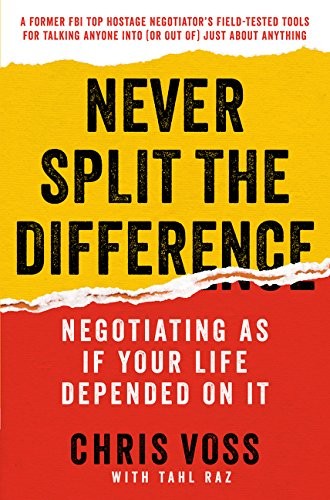
The playbook I go back to before every hard call. Voss reframes negotiation as tactical empathy over pressure — it's where most of my thinking on 'I'll think about it' comes from.