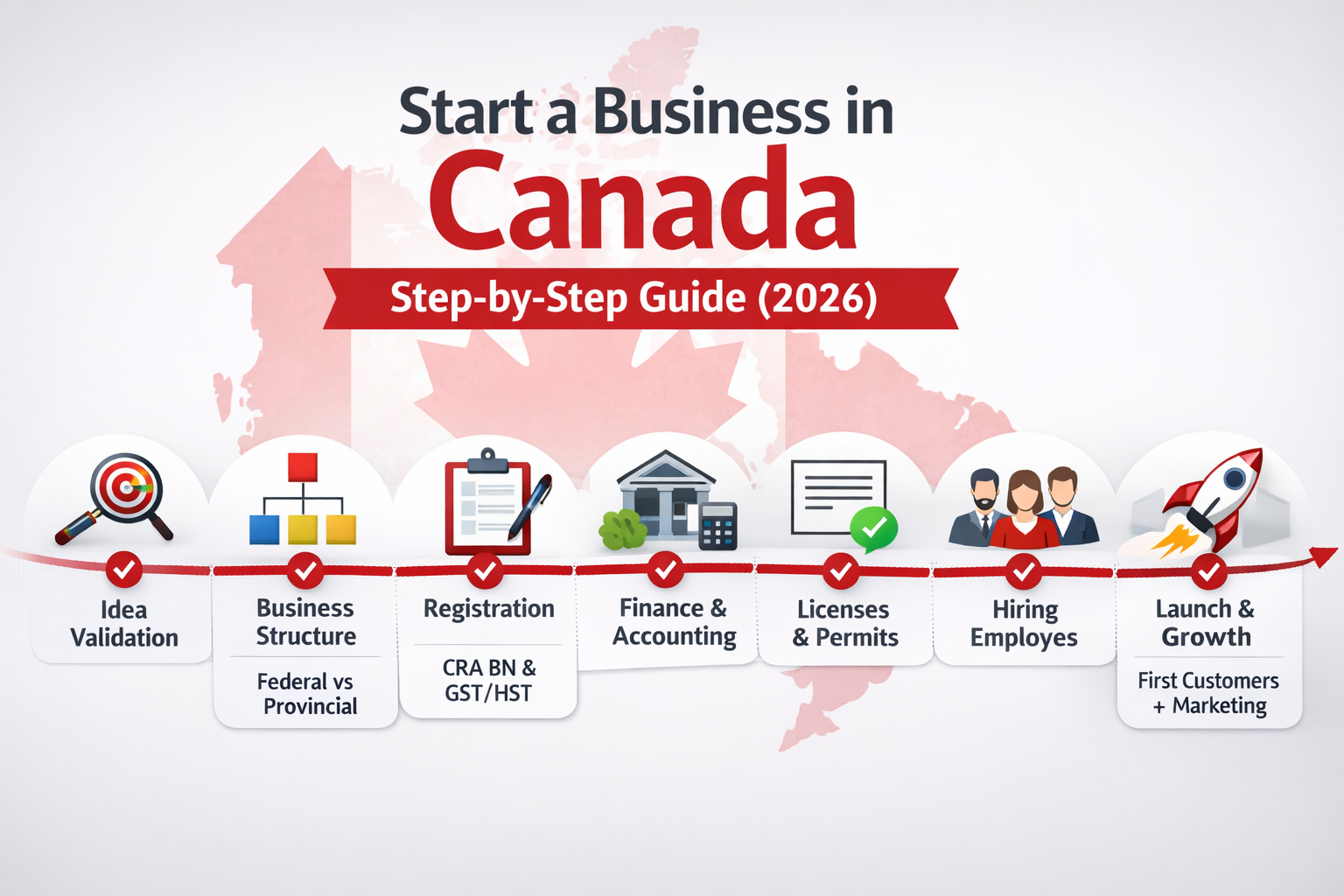

Starting a business in Canada requires navigating federal incorporation, provincial registration, CRA requirements, and industry permits. This complete guide covers every step from business idea validation to your first sale, with exact costs, timelines, and government resources for 2026.
Whether you're launching an online business, opening a retail store, or starting a service company, the process involves seven critical steps. Each step has specific requirements, costs, and timelines. Understanding this process before you begin can save you months of delays and thousands of dollars in mistakes.
Before diving into paperwork, you need to validate your business idea and ensure there's actual demand for what you're offering. Many founders skip this step and end up with a registered business but no customers.
Step 1: Validate Your Business Idea in Canada
The first step in starting a business in Canada isn't registration—it's validation. You need to confirm that your business idea solves a real problem for Canadian customers who are willing to pay for your solution.

Validating your business idea with real market research prevents costly mistakes and ensures customer demand exists.
Research the Canadian Market
Canada's market has unique characteristics. With a population of 39 million spread across vast geography, regional differences matter. What works in Toronto might not work in Calgary. What sells in Montreal requires different positioning than Vancouver.
Start by understanding market fundamentals specific to your industry and region. Use Statistics Canada data, industry reports, and competitor analysis to understand market size, growth trends, and customer demographics.
Identify Your Target Customers
Who exactly will buy from you? Define your ideal customer by demographics (age, income, location), psychographics (values, interests, pain points), and behavior (where they shop, how they make decisions).
Talk to potential customers before you invest in registration. Conduct interviews, run surveys, or test your concept with a landing page. The goal is to confirm demand before spending money on incorporation.
Analyze Your Competition
Research existing businesses serving your target market. What are they doing well? Where are the gaps? How will you differentiate? Competition isn't necessarily bad—it proves market demand. But you need a clear reason why customers should choose you.
If you're unsure how to position yourself, learn from successful entrepreneurs who've built businesses in competitive markets. Understanding their strategies can help you find your unique angle.
Test Your Concept
Before full commitment, test your idea with minimal investment. This could mean:
- Selling to your first 10 customers without formal registration (you can operate as a sole proprietor using your personal name)
- Creating a minimum viable product or service
- Running a small pilot program
- Pre-selling to validate demand
Once you've validated demand, you're ready to formalize your business structure. This is where creating a business plan becomes essential—it forces you to think through your model, finances, and growth strategy.
Step 2: Choose Your Business Structure in Canada
Your business structure determines your taxes, liability, and administrative requirements. This is one of the most important decisions you'll make, and it's difficult to change later without significant cost and complexity. We break down this decision in detail in our sole proprietorship vs corporation guide.
Sole Proprietorship
A sole proprietorship is the simplest structure. You and your business are legally the same entity. You report business income on your personal tax return.
Advantages:
- Easy and inexpensive to set up (often just a business name registration)
- Simple tax filing (business income on personal return)
- Full control over all decisions
- Minimal ongoing compliance requirements
Disadvantages:
- Unlimited personal liability (your personal assets are at risk)
- Harder to raise investment capital
- Business ends if you die or become incapacitated
- Less tax planning flexibility
Best for: Low-risk service businesses, freelancers, consultants, and businesses testing an idea before full commitment.
Partnership
A partnership involves two or more people sharing ownership. Partnerships can be general (all partners share liability) or limited (some partners have limited liability).
Advantages:
- Shared startup costs and responsibilities
- Complementary skills and expertise
- Relatively simple to establish
- Pass-through taxation (income flows to partners' personal returns)
Disadvantages:
- Unlimited personal liability in general partnerships
- Partners are liable for each other's business actions
- Potential for disputes and disagreements
- Requires clear partnership agreement
Best for: Professional practices (law, accounting), businesses with complementary co-founders, and family businesses.
Corporation
A corporation is a separate legal entity from its owners (shareholders). It can be incorporated federally (Corporations Canada) or provincially.
Advantages:
- Limited liability protection (personal assets protected)
- Tax planning opportunities (small business deduction, income splitting)
- Easier to raise investment capital
- Perpetual existence (continues beyond founders)
- Enhanced credibility with customers and partners
Disadvantages:
- More expensive to set up ($200 federal, $300-500 provincial)
- Ongoing compliance requirements (annual filings, corporate records)
- More complex tax filing (corporate and personal returns)
- Formal governance requirements (directors, shareholders meetings)
Best for: Businesses with liability risk, companies seeking investment, businesses planning significant growth, and situations where tax planning is important.
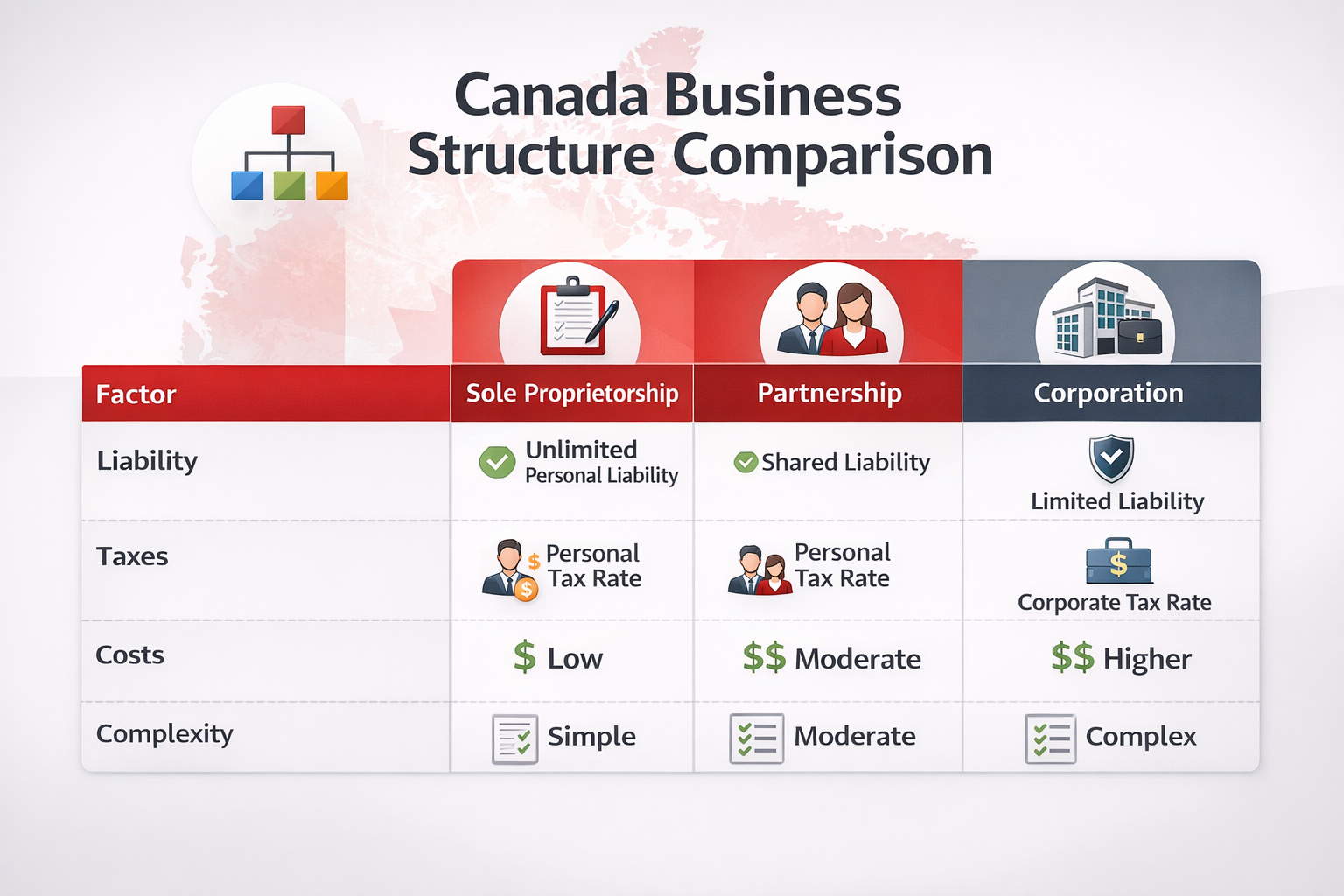
Choosing the right business structure affects your taxes, liability, and growth potential—make this decision carefully.
Federal vs Provincial Incorporation
If you choose to incorporate, you must decide between federal and provincial incorporation.
Federal Incorporation:
- Name protection across all of Canada
- Operate in any province without extra-provincial registration
- Cost: $200 online, $250 by mail
- Processing time: 2-3 weeks online, 4-6 weeks by mail
- Best for businesses operating in multiple provinces
Provincial Incorporation:
- Name protection only in that province
- Lower initial cost ($300-500 depending on province)
- Faster processing (often 5-7 business days)
- Must register extra-provincially to operate in other provinces
- Best for businesses operating in one province
For most small businesses starting in one province, provincial incorporation makes sense. If you plan to operate nationally from day one, federal incorporation provides broader protection.
Understanding the financial strategy behind your structure choice is crucial. The right structure can save you thousands in taxes annually while protecting your personal assets.
Step 3: Register Your Business in Canada
Once you've chosen your structure, it's time to officially register your business. The registration process varies by structure and province, but follows a general pattern.
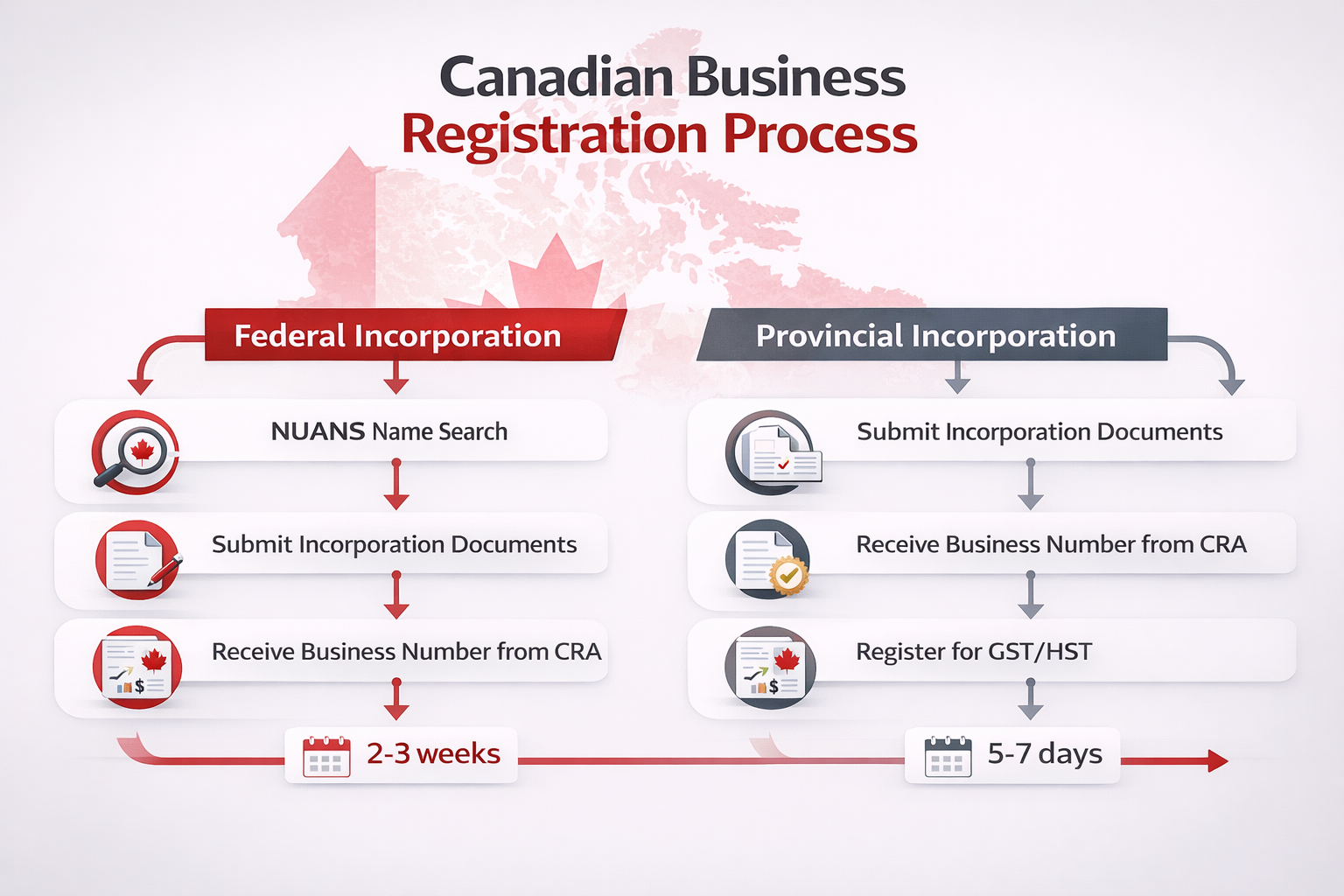
Understanding the registration timeline and choosing between federal and provincial incorporation determines your business setup speed.
Register Your Business Name
Before registering, you need to ensure your business name is available and complies with naming rules.
For Sole Proprietorships and Partnerships:
- Register your business name with your provincial government
- Cost: $60-150 depending on province
- Renewal: Every 5 years in most provinces
- You can operate under your personal name without registration
For Corporations:
- Conduct a NUANS name search ($75-100) to ensure name availability
- Name must include a legal element (Inc., Ltd., Corp.)
- Name must be distinctive and not confusingly similar to existing businesses
- Alternatively, use a numbered company (e.g., "1234567 Ontario Inc.")
Get Your Business Number (BN) from CRA
Your Business Number is a unique 9-digit identifier assigned by the Canada Revenue Agency. You need this for taxes, payroll, and importing/exporting.
Register for your BN online through the CRA's Business Registration Online service. This is free and takes about 15 minutes. You'll receive your BN immediately online.
When registering, you can also register for:
- GST/HST account (required if revenue exceeds $30,000 annually)
- Payroll deductions account (if you have employees)
- Import/export account (if applicable)
Register for GST/HST
If your business revenue exceeds $30,000 in any 12-month period, you must register for GST/HST. You can voluntarily register even if under this threshold.
GST/HST Rates by Province (2026):
- Alberta: 5% GST
- British Columbia: 5% GST + 7% PST = 12% total
- Ontario: 13% HST
- Quebec: 5% GST + 9.975% QST = 14.975% total
- Atlantic provinces: 15% HST
Once registered, you collect GST/HST on sales and remit it to CRA quarterly or annually, depending on your revenue. You can claim input tax credits for GST/HST paid on business expenses. Once operational, make sure you're claiming every tax deduction available to Canadian small businesses—most founders miss thousands in legitimate write-offs.
Provincial Business Registration
Depending on your province and business structure, you may need additional provincial registrations:
Ontario: Register with ServiceOntario for sole proprietorships and partnerships. Corporations register through Ontario Business Registry.
British Columbia: Register through BC Registry Services. All business structures register here.
Alberta: Register with Alberta Corporate Registry (Corporations) or Service Alberta (sole proprietorships/partnerships).
Quebec: Register with Registraire des entreprises. All businesses operating in Quebec must register, even if incorporated federally.
Each province has its own fees, forms, and processing times. Check your provincial government website for specific requirements.
Consider Trademark Registration
While not required, registering a trademark with the Canadian Intellectual Property Office (CIPO) provides exclusive rights to your business name, logo, or slogan across Canada.
Trademark registration costs $330-450 per class of goods/services and takes 12-18 months to complete. It's worth considering if brand protection is important to your business strategy.
Having a solid business planning framework helps you make these registration decisions strategically rather than reactively.
Step 4: Set Up Business Banking and Accounting
With your business registered, you need to establish financial systems. Proper financial infrastructure from day one prevents headaches later and ensures compliance with CRA requirements.

Separating business and personal finances from day one prevents accounting headaches and ensures tax compliance.
Open a Canadian Business Bank Account
Separate your business and personal finances immediately. This is legally required for corporations and strongly recommended for sole proprietorships and partnerships.
What You'll Need:
- Business registration documents (articles of incorporation or business name registration)
- Business Number from CRA
- Personal identification (driver's license, passport)
- Initial deposit (varies by bank, typically $100-1,000)
Choosing a Bank: Compare business account fees, transaction limits, online banking features, and integration with accounting software. Major Canadian banks (RBC, TD, Scotiabank, BMO, CIBC) offer similar services. Credit unions often have lower fees for small businesses.
Many banks offer free business banking for the first 12 months. Take advantage of these promotions but understand the ongoing costs after the promotional period.
Set Up Accounting Software
Proper bookkeeping is essential for tax compliance, financial planning, and business decisions. Choose accounting software that fits your business size and complexity.
Popular Options for Canadian Businesses:
- QuickBooks Online: $20-70/month, comprehensive features, CRA-compliant, integrates with Canadian banks
- Xero: $15-65/month, user-friendly, good for small businesses, Canadian payroll available
- FreshBooks: $19-60/month, excellent for service businesses and freelancers, Canadian-specific features
- Wave: Free for basic accounting, paid add-ons for payroll and payments, good for startups
Your accounting software should track income, expenses, GST/HST collected and paid, and generate financial reports. This makes tax filing easier and provides insights into your business performance.
Understand GST/HST Collection and Remittance
If you're registered for GST/HST, you must collect it on taxable sales and remit it to CRA. Your remittance frequency depends on your annual revenue:
Annual Filing: Revenue under $1.5 million - file once per year
Quarterly Filing: Revenue $1.5-6 million - file four times per year
Monthly Filing: Revenue over $6 million - file twelve times per year
You can claim Input Tax Credits (ITCs) for GST/HST paid on business expenses. Keep all receipts and invoices to support your ITC claims.
Set Up Payroll Systems
Even if you're not hiring immediately, set up payroll infrastructure if you plan to have employees. This includes:
- Payroll deductions account with CRA
- Payroll software or service
- Understanding CPP, EI, and income tax deduction requirements
- Provincial payroll tax registration (where applicable)
Proper financial planning from the start sets you up for sustainable growth. Many businesses fail not because of bad ideas, but because of poor financial management.
If you're starting with limited capital, understanding how to build wealth through business can help you make strategic financial decisions that compound over time.
Step 5: Get Required Licenses and Permits in Canada
Most businesses need licenses or permits beyond basic registration. Requirements vary by industry, location, and business activities. Operating without required licenses can result in fines, business closure, or legal liability.
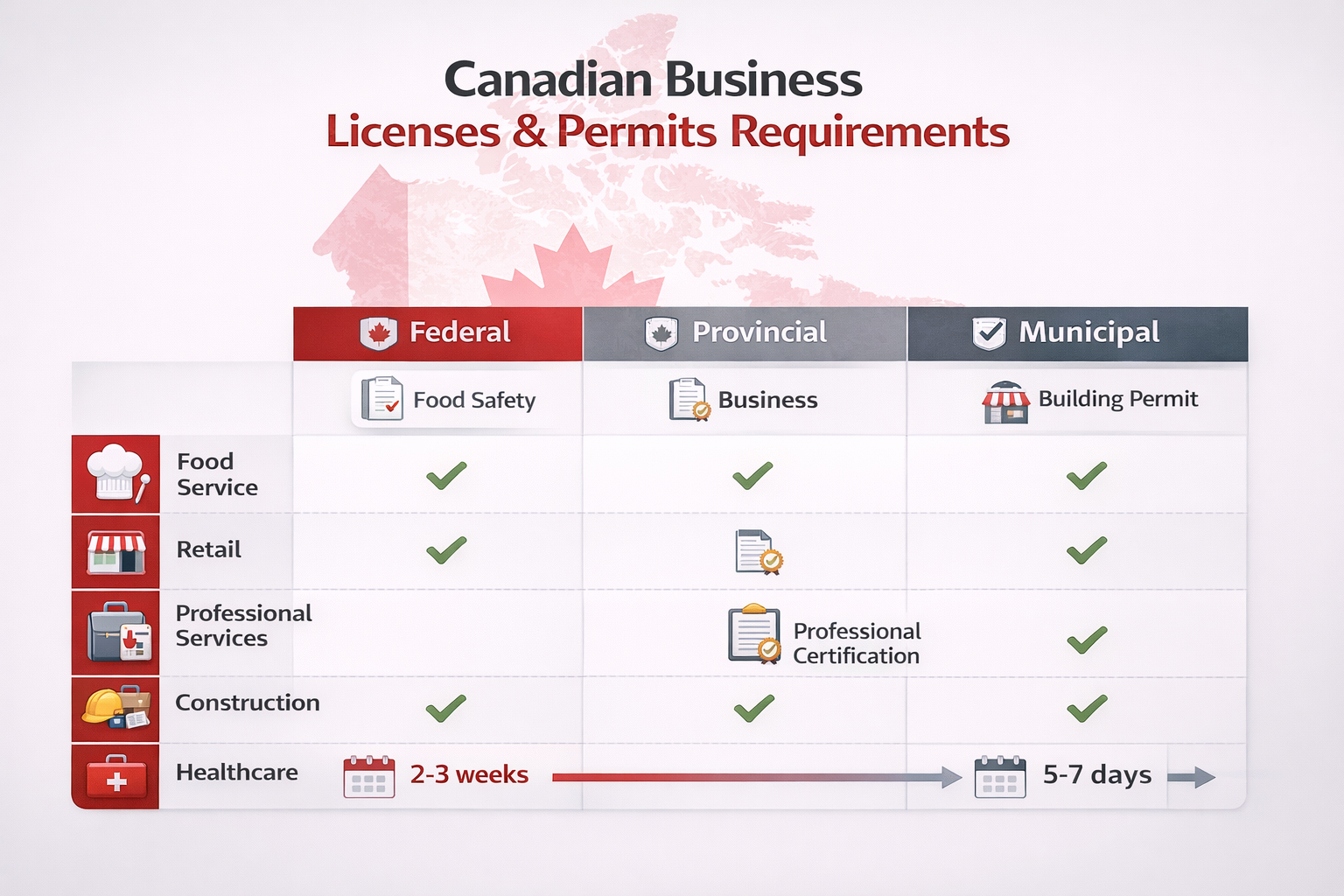
This license matrix helps you identify exactly which federal, provincial, and municipal permits your business needs.
Federal Business Licenses
Certain industries require federal licenses or permits:
- Food and Agriculture: Canadian Food Inspection Agency (CFIA) licenses for food production, processing, or import
- Broadcasting and Telecommunications: CRTC licenses for radio, TV, or telecom services
- Transportation: Transport Canada permits for commercial vehicles, aviation, or marine operations
- Financial Services: OSFI registration for banks, insurance companies, or pension plans
- Alcohol and Cannabis: Federal licenses for production, distribution, or sale
Check the BizPaL tool (bizpal.ca) to identify federal licenses specific to your business type and location.
Provincial Permits and Licenses
Provinces regulate many business activities. Common provincial licenses include:
- Professional Licenses: Doctors, lawyers, accountants, engineers, and other professionals need provincial licensing
- Retail Sales: Some provinces require retail business licenses
- Restaurants and Food Service: Health permits and food handler certifications
- Construction and Trades: Contractor licenses and trade certifications
- Alcohol Sales: Provincial liquor licenses
Each province has different requirements and fees. Contact your provincial business registry or use BizPaL to identify what you need.
Municipal Business Licenses
Most cities and municipalities require business licenses for companies operating within their boundaries. This applies even if you work from home.
Municipal business licenses typically cost $50-500 annually depending on business type and location. Some municipalities have different fees for home-based vs. commercial location businesses.
Contact your city or municipal government to determine requirements. Operating without a municipal license can result in fines and forced business closure.
Industry-Specific Regulations
Certain industries have additional regulatory requirements:
- Healthcare: Provincial health authority approvals, privacy compliance (PHIPA, PIPEDA)
- Childcare: Provincial licensing, facility inspections, staff certifications
- Financial Services: Securities registration, insurance licensing, FINTRAC compliance
- Environmental: Environmental assessments, waste disposal permits, emissions compliance
Research your industry's specific requirements early. Some licenses take months to obtain and require facility inspections or staff training.
Workplace Safety Registration
If you have employees, you must register with your province's workplace safety and insurance board:
- Ontario: Workplace Safety and Insurance Board (WSIB)
- British Columbia: WorkSafeBC
- Alberta: Workers' Compensation Board (WCB)
- Quebec: Commission des normes, de l'équité, de la santé et de la sécurité du travail (CNESST)
Workplace insurance premiums vary by industry risk level. High-risk industries (construction, manufacturing) pay higher rates than low-risk industries (office work, consulting).
When you're ready to hire your first employee, understanding these requirements prevents compliance issues that could derail your growth.
Step 6: Hire Employees in Canada
Hiring employees involves significant legal and financial obligations. Understanding Canadian employment law prevents costly mistakes and protects both you and your employees.

Understanding employment obligations ensures compliance and builds a strong foundation for your team.
Employee vs Independent Contractor
The distinction between employees and independent contractors is critical. CRA uses specific tests to determine worker classification:
Employee Indicators:
- You control how, when, and where work is performed
- Worker uses your tools and equipment
- Worker cannot subcontract or hire assistants
- Worker is economically dependent on you
- Ongoing relationship rather than project-based
Independent Contractor Indicators:
- Worker controls how work is performed
- Worker uses own tools and equipment
- Worker can hire assistants or subcontract
- Worker has multiple clients
- Project-based relationship with defined deliverables
Misclassifying employees as contractors can result in back taxes, penalties, and legal liability. When in doubt, treat workers as employees.
Payroll Deductions and Remittances
As an employer, you must deduct and remit:
Canada Pension Plan (CPP): 5.95% of employee earnings (2026 rate), matched by employer contribution
Employment Insurance (EI): 1.66% of employee earnings (2026 rate), employer pays 1.4x employee contribution
Income Tax: Based on employee's TD1 form and tax tables
You must remit these deductions to CRA by the 15th of the month following payment. New employers typically remit monthly. As payroll grows, you may need to remit more frequently.
Failure to remit payroll deductions is a serious offense. CRA can hold directors personally liable for unremitted amounts.
Employment Standards
Each province has employment standards legislation covering:
- Minimum wage (varies by province, $15-17/hour in 2026)
- Hours of work and overtime pay
- Vacation time and pay (minimum 2 weeks after 1 year)
- Statutory holidays
- Termination notice and severance
- Leaves of absence (maternity, parental, sick, family emergency)
Violating employment standards can result in complaints, investigations, and orders to pay back wages or penalties.
Building Your Team
Your first hires set the tone for your company culture. Building your team strategically means hiring for skills you lack, cultural fit, and growth potential.
Create an environment of psychological safety where employees feel comfortable taking risks, sharing ideas, and admitting mistakes. This foundation drives innovation and performance.
As you grow, you'll need to develop leadership capabilities to scale effectively. The skills that got you to your first hire won't necessarily get you to 10 or 100 employees.
Step 7: Launch Your Business in Canada
With registration, financial systems, permits, and team in place, you're ready to launch. This final phase focuses on getting your first customers and building momentum.

A strategic launch combines planning, marketing, and execution to acquire your first customers and build momentum.
Finalize Your Business Plan
Before launch, ensure your business plan is complete and realistic. Your plan should include:
- Executive summary and business description
- Market analysis and competitive positioning
- Marketing and sales strategy
- Operations plan and organizational structure
- Financial projections (3-5 years)
- Funding requirements and use of funds
Use our business plan generator to create a professional plan that covers all essential elements. A solid plan guides your decisions and is essential if you seek funding.
Develop Your Marketing Strategy
How will you reach your target customers? Your marketing strategy should align with where your customers spend time and how they make buying decisions.
Digital Marketing Channels:
- Website and SEO (essential for most businesses)
- Social media marketing (choose platforms where your customers are)
- Email marketing (high ROI for customer retention)
- Paid advertising (Google Ads, Facebook Ads, LinkedIn Ads)
- Content marketing (blogs, videos, podcasts)
Traditional Marketing Channels:
- Networking and referrals
- Trade shows and events
- Print advertising (if your audience reads print)
- Direct mail (effective for local businesses)
- Partnerships and collaborations
Consider an alternative marketing approach if traditional tactics don't fit your brand or audience. Sometimes the most effective marketing doesn't look like marketing at all.
When communicating with customers, avoid corporate jargon that confuses rather than clarifies. Clear, simple language builds trust and drives action.
Secure Business Funding
Most businesses need capital beyond personal savings. Canada offers multiple funding sources for new businesses:
Business Development Bank of Canada (BDC): Government-owned bank providing loans, venture capital, and advisory services to Canadian businesses. BDC is more flexible than traditional banks for startups.
Government Grants and Programs:
- Canada Small Business Financing Program (CSBFP): Loans up to $1 million for equipment and property
- Industrial Research Assistance Program (IRAP): Funding for innovation and R&D
- Scientific Research and Experimental Development (SR&ED): Tax credits for R&D activities
- Provincial programs: Each province offers grants and loans for specific industries or regions
Private Funding:
- Angel investors: High-net-worth individuals investing $25,000-500,000
- Venture capital: Institutional investors for high-growth startups
- Crowdfunding: Platforms like Kickstarter, Indiegogo, or FrontFundr
- Friends and family: Often the first source of external capital
Understanding how to secure your first funding round can accelerate your growth. If seeking investment, you'll need a compelling pitch deck that clearly communicates your opportunity.
Before seeking external funding, know your financial baseline. Use our net worth calculator to understand your personal financial position and how much you can invest without excessive risk. For a detailed breakdown, see our guide on exactly how much it costs to start a business in Canada in 2026.
If you're carrying debt, our debt calculator helps you understand your obligations and plan for business expenses alongside personal debt management.
Build Your Digital Presence
In 2026, every business needs a digital presence, even if you operate primarily offline:
Essential Digital Assets:
- Professional website with clear value proposition
- Google Business Profile (free and essential for local businesses)
- Social media profiles on relevant platforms
- Email address with your domain (not Gmail or Hotmail)
- Online payment processing capability
Your website should clearly communicate what you do, who you serve, and how customers can work with you. Include contact information, pricing (if appropriate), and social proof (testimonials, case studies, reviews).
Acquire Your First Customers
Launch doesn't mean waiting for customers to find you. Proactively reach out to your target market:
- Leverage your personal network for initial customers and referrals
- Offer launch promotions or early-bird pricing
- Partner with complementary businesses for cross-promotion
- Attend industry events and networking functions
- Use content marketing to demonstrate expertise
- Run targeted advertising to your ideal customer profile
Your first 10 customers are the hardest. They require personal outreach, relationship building, and often custom solutions. But they provide invaluable feedback, testimonials, and referrals that make the next 100 customers easier.
When facing tough decisions about pricing, positioning, or strategy, get strategic guidance tailored to your specific situation. Sometimes an outside perspective reveals opportunities you're too close to see.
Plan for Growth
From day one, think about how your business will scale. What works at $100,000 in revenue won't work at $1 million. What works with 3 employees won't work with 30.
Build systems and processes that can scale. Document your workflows, create standard operating procedures, and invest in technology that grows with you. The time you spend on systems now saves exponential time later.
Embrace modern approaches to business success that leverage technology and innovation. The businesses winning in 2026 aren't necessarily working harder—they're working smarter with better tools and systems.
Access our financial tools to help with planning, projections, and decision-making as you grow. And check out the best free AI tools for small business in 2026 to automate tasks from day one.
Pro Tip
Set up a compliance calendar from day one. Mark deadlines for GST/HST remittance, payroll remittance, corporate annual returns, business license renewals, and tax filing. Missing deadlines results in penalties that are completely avoidable with basic organization.
Common Mistakes to Avoid When Starting a Business in Canada
Learning from others' mistakes is cheaper than making them yourself. Here are the most common errors new Canadian business owners make:
1. Choosing the Wrong Business Structure: Many founders incorporate when a sole proprietorship would suffice, or stay as sole proprietors when incorporation would provide significant tax benefits and liability protection. Make this decision based on your specific situation, not generic advice.
2. Mixing Personal and Business Finances: Using personal accounts for business transactions creates accounting nightmares, tax complications, and potential legal issues. Separate your finances from day one.
3. Ignoring GST/HST Requirements: Failing to register when required, not collecting GST/HST properly, or missing remittance deadlines results in penalties and interest. Understand your obligations before your first sale.
4. Misclassifying Workers: Treating employees as contractors to avoid payroll obligations backfires when CRA reclassifies them and assesses back taxes, penalties, and interest. Use the proper classification from the start.
5. Operating Without Required Licenses: Assuming you don't need licenses or permits because you're small or home-based is risky. Research requirements before launch, not after you're operating.
6. Inadequate Record Keeping: Poor bookkeeping makes tax filing difficult, prevents you from understanding your financial position, and creates problems if CRA audits you. Implement proper systems immediately.
7. Underestimating Startup Costs: Most founders underestimate how much capital they need and how long until profitability. Build a realistic budget with a cushion for unexpected expenses.
8. Skipping Market Validation: Falling in love with your idea without confirming market demand leads to registered businesses with no customers. Validate before you invest.
9. Trying to Do Everything Yourself: Founders who refuse to delegate or hire expertise (accountants, lawyers, consultants) often make expensive mistakes. Know when to get professional help.
10. Neglecting Legal Agreements: Operating without proper contracts, partnership agreements, or terms of service creates risk. Invest in proper legal documentation early.
Making sound strategic decisions from the beginning prevents these mistakes and sets you up for sustainable success.
Timeline and Cost Summary
Here's what to expect in terms of time and money when starting a business in Canada:
Sole Proprietorship:
- Timeline: 1-2 weeks
- Costs: $60-150 (business name registration) + $0 (BN and GST/HST registration are free)
- Total: $60-150
Partnership:
- Timeline: 2-3 weeks
- Costs: $60-150 (business name registration) + $500-1,500 (partnership agreement from lawyer)
- Total: $560-1,650
Provincial Corporation:
- Timeline: 1-2 weeks
- Costs: $75-100 (NUANS search) + $300-500 (incorporation) + $500-1,500 (lawyer fees, optional) + $0 (BN and GST/HST registration)
- Total: $375-2,100
Federal Corporation:
- Timeline: 2-4 weeks
- Costs: $75-100 (NUANS search) + $200 (incorporation) + $500-1,500 (lawyer fees, optional) + $0 (BN and GST/HST registration)
- Total: $275-1,800
Additional Costs to Budget:
- Business bank account: $0-50/month (often free first year)
- Accounting software: $0-70/month
- Business licenses: $50-500+ depending on industry and location
- Professional fees (accountant, lawyer): $500-5,000+ annually
- Insurance: $500-5,000+ annually depending on industry
- Website and marketing: $500-10,000+ depending on approach
Total startup costs typically range from $2,000-15,000 for most small businesses, though some industries require significantly more capital for inventory, equipment, or facilities.
Next Steps: From Registration to Revenue
Starting a business in Canada is achievable when you understand the process and follow it systematically. The key is taking action while avoiding common pitfalls.
Your next steps:
- Validate your business idea with real market research and customer conversations
- Choose your business structure based on your specific tax, liability, and growth situation
- Register your business with the appropriate federal, provincial, and municipal authorities
- Set up proper financial systems including business banking and accounting software
- Obtain all required licenses and permits before operating
- Understand employment obligations before hiring your first employee
- Launch with a clear marketing strategy and focus on acquiring your first customers
The businesses that succeed aren't necessarily those with the best ideas—they're the ones that execute systematically, learn quickly, and adapt based on market feedback.
Starting a business is challenging, but Canada offers a supportive environment with government programs, funding sources, and resources designed to help entrepreneurs succeed. Take advantage of these resources, build strong foundations, and focus on creating value for your customers.
Your entrepreneurial journey starts with a single step. Make it count.
Already started? Get discovered.
If you've registered your Canadian business, the next step is visibility. List your business for free in our directory — indexed by Google, recommended by AI assistants, and seen by entrepreneurs worldwide. Takes 30 seconds.
Related Reading
- Every Tax Deduction Canadian Small Businesses Can Claim (2026)
- Sole Proprietorship vs Corporation in Canada
- How Much Does It Cost to Start a Business in Canada? (2026)
- Built to Be Found: The Anatomy of a Discoverable Business
- The Scam-Proof Business: When Trust Becomes the Product
Go deeper — one book worth your time

Once the paperwork is done, this helps you dodge the real trap: building something nobody actually wanted.