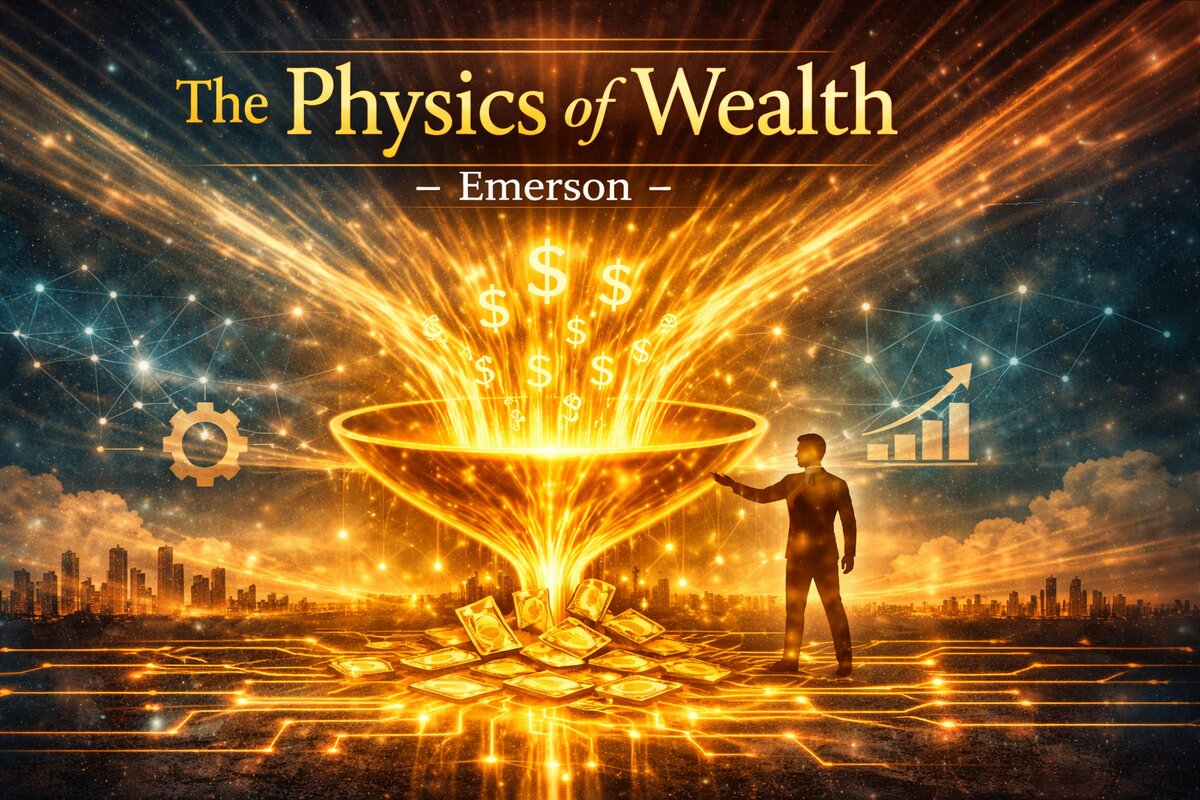

In 1860, Ralph Waldo Emerson wrote an essay called "Wealth." Most people never read it. Those who did often missed the point. Emerson wasn't writing about saving money or working harder. He was describing the physics of wealth creation—a formula so precise it predicted everything from industrial fortunes to modern tech empires. Here's what he actually said, translated for builders who want the blueprint, not the platitudes.
Wealth Is Not Money
Emerson's opening thesis destroys the conventional definition: Wealth is not money. Wealth is mind applied to nature.
Break that down:
- Raw nature (coal, iron, land, data) = latent potential, worthless until activated
- Mind (organization, insight, timing, code) = the activation layer
- Result = wealth
He wrote: "A better order is equivalent to vast amounts of brute labor." Translation for today: leverage beats effort. Systems beat hustle. Insight beats hours. The person who sees the pattern and builds the structure wins against the person grinding without direction.
This isn't motivational. It's mechanical. Wealth follows laws, like physics. Understand the laws, apply them correctly, and the outcome is predictable.
The Mechanism: Right Placement
Emerson identified the core mechanism of wealth creation: putting things where they are needed, at the right time, in the right form.
His examples:
Steam: Existed for millennia. Useless. Applied to transport? Massive wealth.
Wheat in Michigan: Worthless sitting in a field. Connected to market infrastructure? Wealth.
Peaches on the ground: Low value. Moved to the city? 100× increase.
This is arbitrage plus logistics plus systems design. It's seeing that value isn't intrinsic—it's contextual. The same asset in a different position, time, or form creates exponentially different outcomes. Modern version: APIs existed, useless until applied to platforms. Data existed, worthless until structured and distributed. Code existed, inert until deployed at scale.
The wealth isn't in the thing. It's in the placement. That's why market research matters—you're not looking for what exists, you're looking for what's misplaced, mistimed, or misunderstood.
The Perceiver vs. The Laborer
Emerson drew a brutal distinction between two types of people:
The Laborer: Extracts value slowly, directly, through effort. Trades time for money. Works hard, earns incrementally, never escapes the grind.
The Perceiver: Sees flows before others see them. Understands infrastructure. Detects asymmetries. Emerson wrote: "Another sees by the course of streams, and the value of stone-quarries… goes to sleep, wakes up rich."
That's not luck. That's infrastructure thinking. It's recognizing that rivers create trade routes, quarries enable construction, and whoever controls the chokepoint controls the value. Modern equivalent: whoever sees the platform opportunity, the distribution gap, the network effect—before the crowd—captures disproportionate returns.
The perceiver doesn't work harder. The perceiver sees differently. And that difference in perception creates the wealth gap.
Pro Tip
Ask yourself: Am I extracting value directly (laborer) or positioning myself in the flow (perceiver)? If you're trading hours for dollars with no leverage, you're in the wrong game. Find the flow, position yourself correctly, and let the system work.
Wealth as Amplification System
Emerson understood wealth as tools that extend human capability:
- Transportation extends your legs
- Machines extend your hands
- Books extend your mind
- Networks extend your reach
So wealth isn't accumulation. It's amplification. It's building systems that multiply your agency. Every dollar you spend should either extend your capability or increase your leverage. If it doesn't, it's waste.
Modern translation: software extends cognition, automation extends execution, platforms extend distribution, AI extends decision-making. The wealthiest people aren't hoarding cash—they're building amplification systems that let them operate at 100× the scale of a normal human.
This is why strategic planning matters. You're not planning tasks. You're designing an amplification architecture. What tools, systems, and structures will let you operate beyond your natural limits?
The Moral Constraint
Emerson wasn't naive about money. He understood the corrupting forces:
Poverty corrupts. It forces short-term thinking, desperation, compromise. You can't build long-term when you're scrambling for survival.
Debt enslaves. "A man in debt is so far a slave." Debt removes agency. It forces you to work for the creditor, not for yourself. Financial freedom isn't luxury—it's moral infrastructure. Independence is the prerequisite for integrity.
This is why the path to wealth must include financial discipline. Not because saving is virtuous, but because freedom requires it. Use the debt calculator to understand your baseline. Know where you stand. Then build the system to escape.
Wealth tied to integrity compounds. Wealth divorced from integrity collapses. Emerson saw this clearly: the person who builds wealth through deception or exploitation eventually loses it. The system self-corrects. Reality has a way of punishing misalignment.
Emerson's Five Laws of Wealth
Emerson laid out five principles. Translated cleanly for modern application:
1. Spend Along Your Genius
Invest in your core advantage. Cut everything else. Misalignment is financial death. If you're spending time, money, or energy on things outside your zone of genius, you're bleeding value. Find what you do better than anyone else, double down, and ruthlessly eliminate the rest. This is strategic resource allocation—not diversification, but concentration on asymmetric advantage.
2. System > Income
Wealth isn't income. It's income minus expense structure. You can earn $500K and be broke if your system is broken. You can earn $100K and build wealth if your system is tight. The system is everything. Build the infrastructure first. Revenue without structure collapses. Structure without revenue scales when the opportunity arrives.
3. Follow Reality, Not Ego
Don't impose your ideas blindly on the world. Observe how things actually work. Nature already solved most problems—your job is to see the solution and apply it. Emerson: "The world is mathematical, and has no casualty." Meaning: there are patterns, laws, structures. Find them. Follow them. Stop fighting reality because your ego wants a different answer.
4. Like Attracts Like
Money doesn't buy everything. Money doesn't buy respect. Fame doesn't buy competence. Skill attracts skill. Character attracts character. If you want high-quality outcomes, become high-quality yourself. The market rewards alignment. You can't fake your way to sustainable wealth—the system detects fraud and ejects it.
5. Ascend
This is the deepest idea. Emerson wrote: "Spend for power, not for pleasure." There's a hierarchy:
- Food → energy
- Energy → thought
- Thought → character
- Character → power
True wealth is upward transformation. Every resource should move you up the hierarchy. Don't spend on consumption that leaves you where you started. Spend on transformation that elevates your capability, your thinking, your character. That's how wealth compounds—not through accumulation, but through ascension.
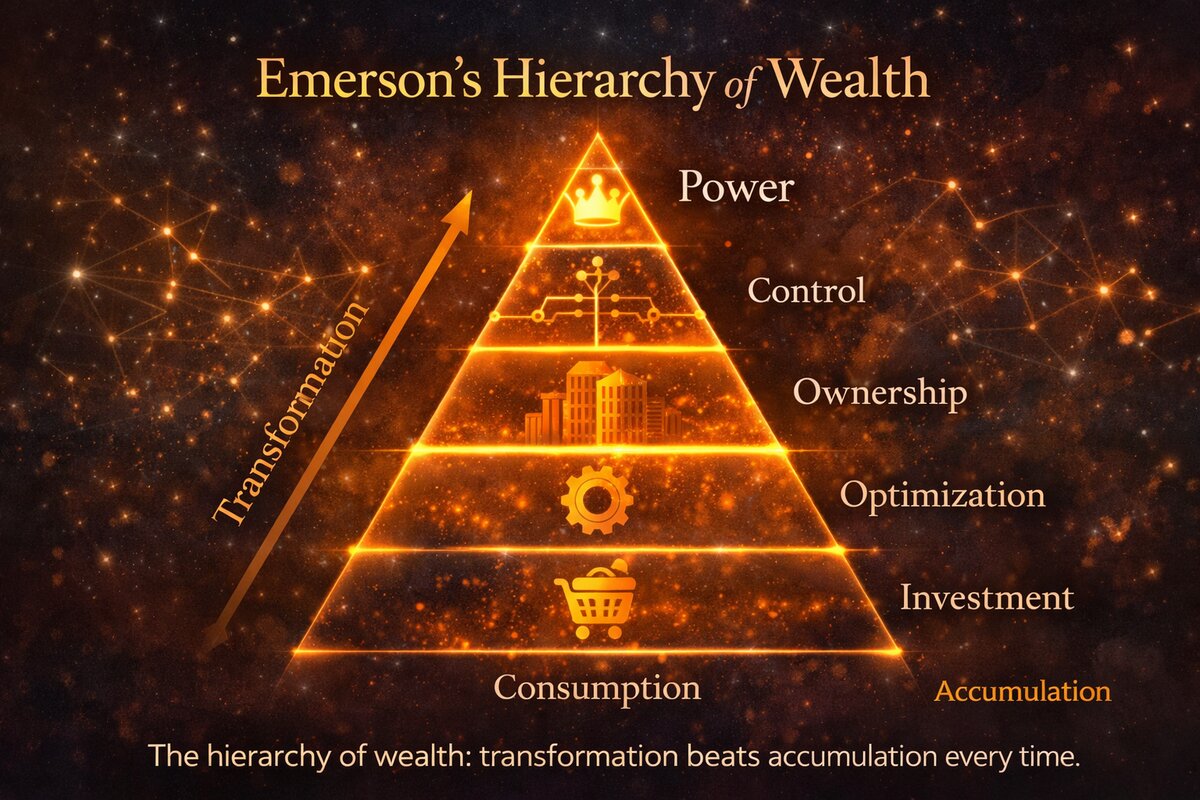
The hierarchy of wealth: transformation beats accumulation every time.
The Modern Translation
Map Emerson's framework to today:
- Steam + wheat = APIs + distribution networks
- Merchant = platform builder
- Transport value = data logistics, marketplaces, infrastructure
- Tools = software, automation, AI
- Mind applied to nature = code applied to systems
The principles don't change. The medium does. Emerson saw that wealth comes from seeing flows, positioning correctly, building amplification systems, and ascending the hierarchy. That was true in 1860. It's true now. It will be true in 2100.
The question is: are you applying the formula, or are you ignoring it and hoping effort alone will save you?
The One Line That Matters Most
If you keep only one idea from Emerson, keep this:
"The art of getting rich consists in being at the right spot."
That's timing. Positioning. Leverage. Everything else is secondary.
You don't need to work harder. You need to see better. You need to understand where value is misplaced, mistimed, or misunderstood. You need to position yourself in the flow, not outside it. You need to build the system that amplifies your capability, not just extracts your effort.
Emerson decoded wealth as physics. The formula is clear. The question is whether you'll apply it.
Action Steps
1. Calculate your current position with the net worth calculator. Know your baseline.
2. Audit your spending: Are you spending along your genius, or bleeding value on misalignment?
3. Identify one flow you can see before others. Where is value misplaced in your industry?
4. Build one amplification system this quarter. What tool, process, or structure will multiply your capability?
5. When facing tough decisions, seek wisdom from those who walked the path before—or get AI-powered guidance tailored to your situation.
Final Thought
Emerson's essay on wealth is not about money. It's about power. It's about building systems that extend human agency. It's about seeing what others miss and positioning yourself correctly. It's about ascending the hierarchy from consumption to transformation.
The people who understand this—who apply mind to nature, who see flows, who build amplification systems—don't just get rich. They reshape industries. They create new markets. They operate at a scale that seems impossible to everyone else.
That's not luck. That's physics. And the formula is right here, waiting for you to apply it.