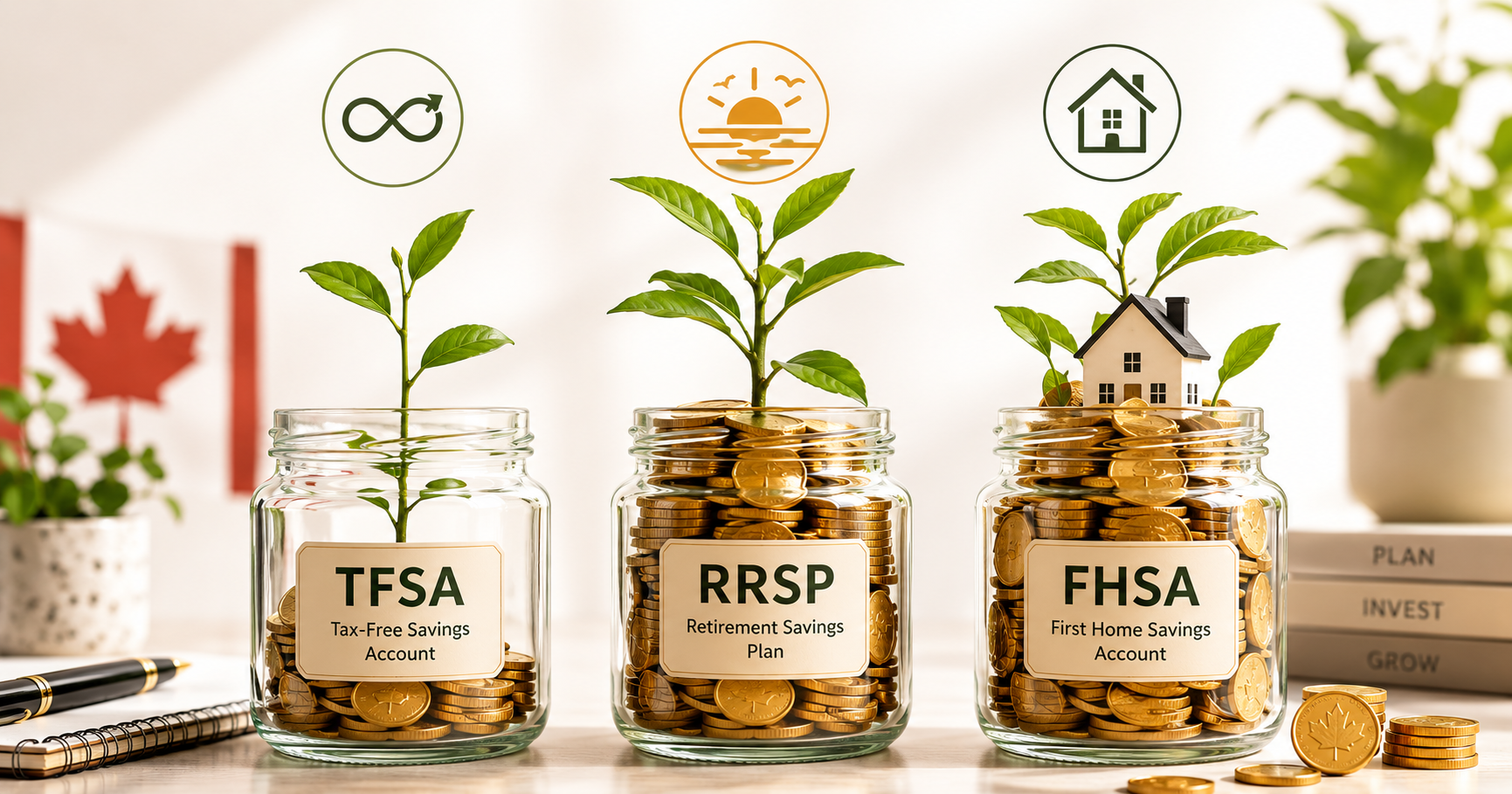

Every Canadian personal finance thread eventually devolves into the same debate: TFSA or RRSP? And now there is a third option confusing everyone even more. The FHSA showed up in 2023 and most people still do not understand what it does or where it fits. So let me make this simple. Painfully simple. Because this is not actually complicated -- it has just been made complicated by people who profit from your confusion.
Here is the one-sentence answer for each account, and then we will get into the details.
The One-Sentence Version
- TFSA -- Your flexible, do-anything, tax-free savings. Use it for everything from emergency funds to investing. No tax on growth, no tax on withdrawal, no restrictions on what you use it for.
- RRSP -- Your retirement and tax-deferral account. Best when your income is high now and will be lower later. Tax deduction going in, taxed on withdrawal.
- FHSA -- Your first home account. Triple tax advantage (deduction in, tax-free growth, tax-free out). If you do not own a home, this is the most powerful account available. Full FHSA breakdown here.
That is it. That is the core of it. Everything else is detail. But details matter when they are worth thousands of dollars -- so keep reading.
The Comparison Table
| Feature | TFSA | RRSP | FHSA |
|---|---|---|---|
| Tax deduction on contribution? | No | Yes | Yes |
| Tax-free growth? | Yes | Yes (tax-deferred) | Yes |
| Tax-free withdrawal? | Yes | No (taxed as income) | Yes (for home purchase) |
| Annual contribution limit | $7,000 (2024+) | 18% of income (max ~$31,560) | $8,000 |
| Lifetime limit | Cumulative (grows yearly) | Based on income history | $40,000 |
| Withdrawal restrictions? | None | Taxed + room lost | Must be for first home (or transfer to RRSP) |
| Room carries forward if unused? | Yes (since age 18) | Yes | Only after opening ($8K/yr max carryforward) |
| Best for | Flexibility, any goal | Retirement, high earners | First home purchase |
The Key Insight
The FHSA is the only account that gives you all three tax advantages simultaneously: deduction going in, tax-free growth, AND tax-free withdrawal. No other registered account in Canada does this. If you qualify, it should be your first priority.
The Decision Flowchart
Stop overthinking. Answer these questions in order:
1. Do you not own a home and might buy one in the next 15 years?
Yes --> Open a FHSA immediately. Put in $8,000/year. This is your #1 priority. Here is why.
2. Is your income above $55,000?
Yes --> Contribute to your RRSP up to the amount that brings you down to a lower tax bracket. The deduction is worth more when your marginal rate is high.
3. Do you have money left after FHSA and RRSP?
Yes --> Max your TFSA. It is the most flexible account and everything grows tax-free forever.
4. Income under $55,000 and not buying a home?
TFSA first. The RRSP deduction is less valuable at lower tax brackets -- you are better off with tax-free growth and flexible withdrawals.
Example -- Sarah, 28, earns $65,000, renting:
1. FHSA: $8,000/year (gets ~$2,400 tax refund + tax-free growth + tax-free withdrawal for home)
2. RRSP: $5,000/year (brings her taxable income to ~$52,000, saves ~$1,500 in tax)
3. TFSA: Whatever is left (flexible, tax-free, no restrictions)
Total tax savings from just contributing: ~$3,900/year. For moving money between her own accounts.
TFSA Deep Dive
What it actually is: A container where investments grow tax-free and withdrawals are tax-free. You fund it with after-tax dollars (no deduction going in), but everything that happens inside -- dividends, capital gains, interest -- is never taxed.
The superpower: Total flexibility. Use it for a vacation fund, an emergency fund, retirement investing, a house down payment, anything. Withdraw anytime with zero penalty. Contribution room comes back the following year.
Best for:
- Lower income earners (RRSP deduction is not worth much at low brackets)
- Emergency funds
- Medium-term goals (5-10 year timeline)
- People who want flexibility and zero restrictions
- Anyone who has already maxed their FHSA and RRSP
The mistake people make: Using it as a savings account with 1% interest. Put it in index ETFs if your timeline is 5+ years. Tax-free growth only matters if there is growth to shelter.
RRSP Deep Dive
What it actually is: A tax-deferral account. You get a deduction NOW (reducing this year's tax bill), the money grows tax-deferred, and you pay tax when you withdraw (ideally in retirement when your income and tax rate are lower).
The superpower: The tax deduction is immediate and powerful at high incomes. Earn $100,000? Put in $18,000? Your taxable income drops to $82,000. At a ~33% marginal rate, that is $6,000 back in your pocket at tax time.
Best for:
- High earners ($55,000+, especially $90,000+)
- People who expect lower income in retirement
- Employer matching programs (free money -- always take the match)
- The Home Buyers' Plan ($60,000 withdrawal for first home -- but must be repaid over 15 years)
The mistake people make: Contributing at a low income. If you earn $40,000, your marginal rate is low. The deduction saves you maybe 20%. Then in retirement, you might withdraw at the same rate or higher. You deferred tax for nothing -- or made it worse.
The RRSP Rule of Thumb
If your marginal tax rate now is higher than what it will be in retirement, the RRSP wins. If it is the same or lower, the TFSA wins. Most people under $55K income are better off with TFSA first.
FHSA Deep Dive
What it actually is: The best of both worlds. Tax deduction like an RRSP + tax-free growth and withdrawal like a TFSA. But restricted to first-home purchases (or transferable to RRSP if you never buy).
The superpower: Triple tax advantage. No other account does this. You get paid to save for a house. The government gives you money at tax time for the act of putting money in an account you own.
Best for:
- Anyone who does not own a home (even if buying is years away)
- Any income level (the deduction helps everyone)
- People who are unsure if they will buy (transfers to RRSP penalty-free if you never do)
The mistake people make: Not opening one because they are "not ready to buy." You do not need to be ready. You need to open the account to start the clock and secure contribution room. Open it with $1 today.
The Optimal Order (For Most Canadians)
If you qualify for all three accounts, here is the general priority:
- FHSA ($8,000/year) -- Triple tax advantage. Mathematically unbeatable. Always first if you qualify.
- RRSP (up to employer match) -- If your employer matches contributions, take the free money. Always.
- TFSA ($7,000/year) -- Flexible, tax-free, no restrictions. Your workhorse account.
- RRSP (additional) -- Fill up remaining RRSP room if your income is above $55-60K.
- Non-registered -- Once all registered accounts are maxed, invest in a regular taxable account.
Adjust based on your income level, timeline, and whether you plan to buy a home. But this order works for 80% of Canadians under 40.
The Power of Using All Three:
FHSA: $8,000/year x 10 years @ 7% = ~$118,000 tax-free for your home
RRSP: $10,000/year x 10 years @ 7% = ~$148,000 (tax-deferred for retirement)
TFSA: $7,000/year x 10 years @ 7% = ~$103,000 tax-free for anything
Total after 10 years: ~$369,000 in tax-advantaged accounts. From $25,000/year in contributions. The rest is growth that the government never touches.
Common Mistakes That Cost You Thousands
1. "I put everything in my RRSP at 25"
At $45,000 income, your RRSP deduction saves you maybe 20%. When you withdraw in retirement, if your income is similar, you gained nothing -- you just delayed the tax. TFSA would have been better (tax-free forever, no tax on withdrawal ever).
2. "I do not have a FHSA because I am not buying soon"
Contribution room only accumulates once the account is open. Every year without one = $8,000 of room permanently lost. Open it now, fund it later. This costs you $18,000+ per year of delay.
3. "I use my TFSA as a savings account"
A TFSA earning 1.5% interest shelters about $105/year from tax. The same TFSA in index ETFs earning 7% average shelters $490/year -- and it compounds. Tax-free growth is wasted on savings accounts.
4. "I withdrew from my RRSP for an emergency"
You paid tax on that withdrawal AND permanently lost the contribution room. That is the most expensive emergency fund possible. Use your TFSA for emergencies instead -- withdrawals are tax-free and room comes back next year.
5. "I will figure this out later"
Time is the only thing you cannot get back. Compound growth does not wait for you to feel ready. Every year you delay costs you real money that no amount of catching up can replace.
What to Do Right Now
Stop reading. Start doing. In order:
- If you do not own a home: Open a FHSA today. Any bank, any brokerage. Deposit $1 to secure your room.
- Check your TFSA room: Log into your CRA My Account or use our TFSA/RRSP/FHSA contribution calculator to see how much room you have. Start filling it.
- Check your RRSP room: Also on CRA My Account. If your income is above $55K, start contributing.
- Pick one all-in-one ETF (VGRO, XEQT, XGRO) and put it inside whichever account you prioritize. Do not overthink the investment -- the account structure matters more than the specific fund.
Need help building your financial plan? Get AI-powered coaching tailored to your situation, or calculate your net worth to see where you stand today. Use the debt payoff calculator if you are clearing debt before investing.
The best account is the one you actually open and fund. Do it today.