

Most people spend their lives chasing cash. Smarter people chase cash flow. But the wealthy? They chase something almost invisible: the acceleration of their cash flow. This is the second derivative of cash. And it's the only number that actually matters.
The Three Levels of Wealth
If you measure cash C(t) in dollars, then the first derivative dC/dt represents cash flow—the rate at which money enters your life. But there's a third level that changes everything: the second derivative d²C/dt², which measures cash flow acceleration—the rate at which your income itself is increasing.
This isn't metaphor. It's physics applied to wealth.
In physics, position tells you where you are. Velocity tells you how fast you're moving. But acceleration tells you how fast your velocity is changing. And acceleration is what changes trajectories.
The same principle applies to money:
- Cash = Your financial position (where you are)
- Cash flow = Your financial velocity (how fast money moves in)
- Cash flow acceleration = The rate your income growth is increasing (the game-changer)
Most people optimize for cash. They want a bigger number in their account. Smarter people optimize for cash flow—they build passive income streams and recurring revenue. But the truly wealthy? They optimize for acceleration.
Why Acceleration Changes Everything
Here's the mathematical truth that most people miss:
A person making $200,000 a year with zero acceleration is on a treadmill. No matter how fast they run, they stay in the same place financially. Their income is high, but it's flat. d²C/dt² = 0.
A person making $50,000 a year whose income doubles every 18 months is on a rocket ship. Their current position looks worse, but their trajectory is everything. d²C/dt² > 0.
Do the math. In three years, the second person's income surpasses the first. In five years, it's not even close. And the gap keeps widening, forever.
Same effort. Different systems. Completely different futures.
This is why entrepreneurs building scalable businesses often seem less wealthy than high-earning professionals—until suddenly they're not. The professional has high cash flow but zero acceleration. The entrepreneur has lower cash flow but strong acceleration. Time is on the entrepreneur's side.
The Filter That Changes Everything
Once you understand the second derivative, every decision becomes clear.
That high-paying consulting gig? Zero second derivative. You trade time for money, no matter how good the hourly rate. You can increase your cash flow by working more hours or raising your rate, but there's a ceiling. Your income growth isn't accelerating—it's linear at best.
That side project with compounding potential? Positive second derivative. Each hour you invest doesn't just generate income—it increases your capacity to earn more, faster. You're building a system where growth feeds growth.
The question isn't "Will this make me money?" The question is: "Will this make my income growth accelerate?"
This filter cuts through the noise:
- A promotion with a 20% raise? Feels good, but d²C/dt² ≈ 0. You're still trading time for money.
- Building an audience that can monetize in multiple ways? d²C/dt² > 0. Each follower makes the next one easier to get and more valuable.
- Taking on more clients manually? d²C/dt² = 0. More income, same model.
- Automating your service delivery? d²C/dt² > 0. You're building leverage that compounds.
The difference isn't obvious at first. But over time, it's everything. Because acceleration is what changes trajectories.
What Creates Positive Acceleration
Systems that create wealth—scalable assets, compounding investments, automation, networks, and reputation—work because they produce positive second derivatives.
Here's what that looks like in practice:
Scalable Assets: A software product, an online course, a book. The first sale is hard. The hundredth sale costs you nothing. Each customer makes the next one easier because you've built infrastructure, testimonials, and distribution. Your income doesn't just grow—it grows faster.
Compounding Investments: Not just financial investments, but investments in skills, relationships, and systems. Each investment returns value that can be reinvested at a larger scale. The returns themselves grow over time.
Network Effects: Every person in your network makes your network more valuable to everyone else. Your first 100 followers are hard-won. Your next 1,000 come easier. Your next 10,000 come faster still. The growth rate itself increases.
Reputation: Your first client pays you $5,000 and you deliver exceptional work. Your tenth client pays you $15,000 because of your track record. Your hundredth client pays you $50,000 because you're known as the best. Same work, accelerating income.
Notice the pattern? In every case, each success makes the next success easier and more valuable. That's positive acceleration. That's d²C/dt² > 0.
Contrast this with linear income models:
- Hourly work: More income requires more hours. No acceleration.
- Salary: Raises are incremental and capped. Minimal acceleration.
- Commission-only sales: You're only as good as this month's hustle. Zero acceleration.
These aren't bad ways to make money. But they're not paths to freedom, because time remains your constraint. You can increase your cash flow, but you can't create acceleration.
The Internal Foundation
Here's where it gets deeper: the systems you build are determined by your internal assets.
Your mindset, beliefs, knowledge, habits, and focus—these shape whether you even see opportunities for acceleration, let alone build them.
You can't build exponential systems with linear thinking. If you believe wealth comes from trading time for money, you'll optimize for higher hourly rates. If you believe wealth comes from building leverage, you'll optimize for systems that compound.
This is why two people with identical skills and resources can have wildly different trajectories. One sees a high-paying job and takes it. The other sees the same job and asks, "How do I build a business solving this problem at scale?" Same opportunity, different internal framework, completely different second derivatives.
Pro Tip
Your beliefs about money determine your d²C/dt². If you believe "hard work = money," you'll build linear income. If you believe "smart systems = money," you'll build acceleration. The math doesn't lie: your internal assets shape your external trajectory.
The internal work isn't separate from the external work—it's foundational. You need to:
- Shift your beliefs from "I trade time for money" to "I build systems that scale"
- Develop knowledge of leverage, compounding, and market dynamics
- Cultivate focus to say no to high-paying distractions and yes to acceleration-building projects
- Build habits that compound daily—learning, creating, connecting, iterating
- Adopt a mindset where you measure success not by income but by acceleration
This is why studying those who've built lasting wealth matters. They didn't just work differently—they thought differently. They saw the second derivative before they had the vocabulary for it.
Time Becomes Your Ally
When your cash flow is accelerating, time works for you instead of against you.
With zero acceleration, every year looks like the last. You're earning well, but you're not getting closer to freedom. You're running to stay in place.
With positive acceleration, every year is different. Your income isn't just higher—it's growing faster. The question isn't "When will I have enough?" The question is "How long until the acceleration makes the outcome inevitable?"
This is the difference between working hard and getting free.
Hard work with zero acceleration keeps you busy forever. Hard work with positive acceleration creates momentum that eventually carries you forward with less effort. You're not working harder—you're working on systems where each input generates increasing returns.
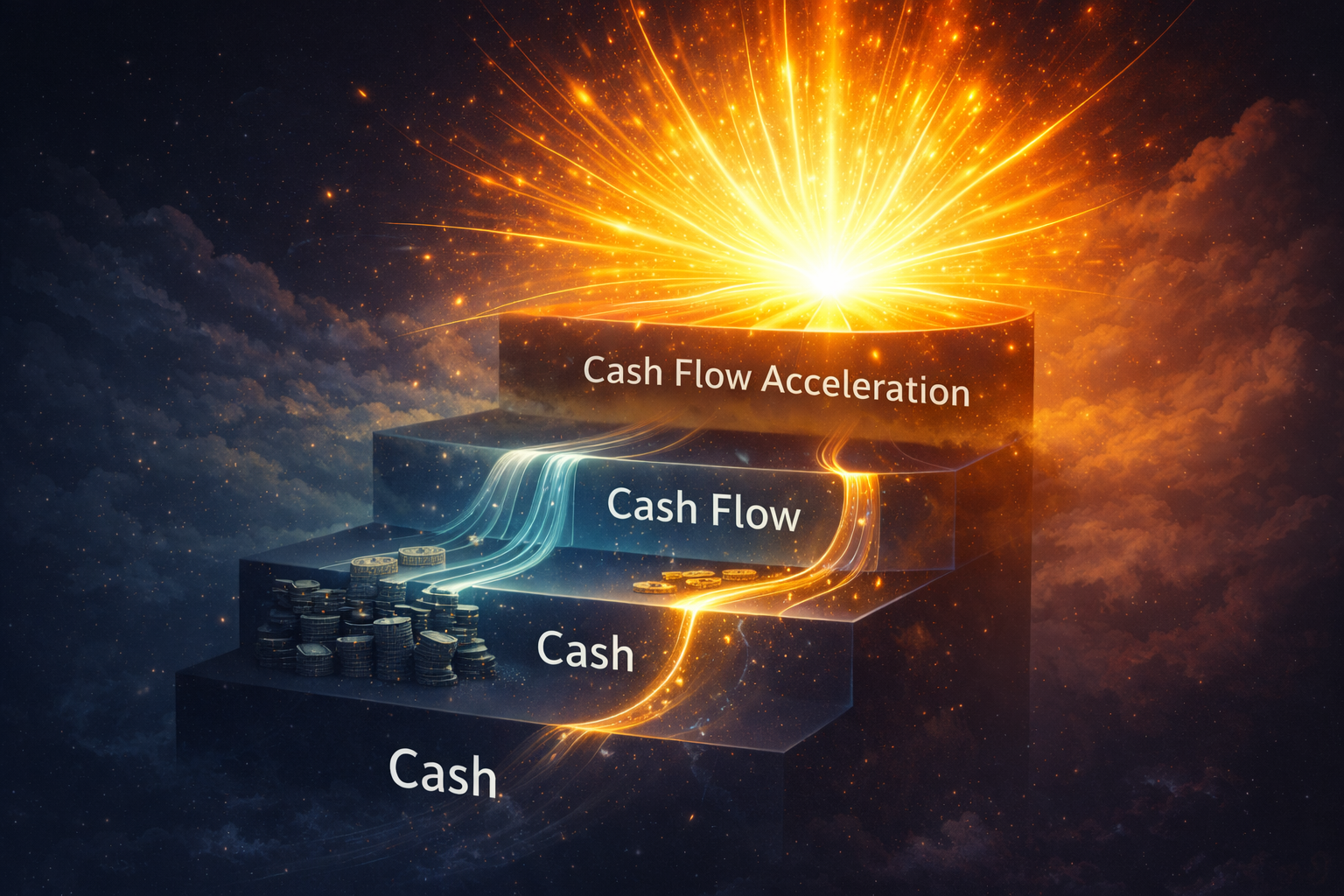
The three levels of wealth: cash is where you are, cash flow is your velocity, and cash flow acceleration is what determines your trajectory.
The Only Number That Matters
Cash is an outcome. Cash flow is a mechanism. But cash flow acceleration is the true engine of freedom.
And it's ultimately determined by the internal capacities that allow you to repeatedly create and scale value: your ability to see leverage, build systems, delay gratification, learn rapidly, and think in compounding terms.
Once you see this, you can't unsee it.
Every opportunity gets filtered through one question: Does this improve my second derivative?
Every decision becomes clearer. Every distraction becomes obvious. Every path forward reveals itself.
You stop chasing cash. You stop even chasing cash flow. You start building acceleration.
And when you do, time stops being your enemy and becomes your greatest asset. Because with d²C/dt² > 0, freedom isn't a question of if—only when.
The Acceleration Audit
Look at your current income sources. For each one, ask: "If I stopped working on this today, would my income from it still be growing six months from now?" If yes, you have positive acceleration. If no, you're trading time for money. The goal isn't to eliminate all linear income immediately—it's to gradually shift your focus toward building systems with d²C/dt² > 0.
Financial freedom isn't primarily about cash, nor even about cash flow. It's about building systems that create positive second derivatives—and developing the internal assets that allow you to see and build those systems in the first place.
The math is simple. The implications are profound.
Focus on the second derivative. Everything else follows.
Ready to build systems that accelerate? Start with a solid foundation—create your strategic business plan or get AI-powered guidance tailored to your specific situation. When you need wisdom from those who've built empires, connect with history's greatest business minds.