
It is the most repeated career advice of the last fifty years. It fits on a graduation card, a coffee mug, a motivational reel. And it has quietly bankrupted more capable people than any recession.
Follow your passion. Do what you love and you'll never work a day in your life. The sentiment is beautiful. The instruction is dangerous. Not because passion doesn't matter — it matters enormously — but because the advice gets the order of operations exactly backwards, and the people who suffer most are the talented ones who take it seriously.
So before we dismantle it, let's be fair to it. Because this dogma survived for a reason.
The grain of truth nobody should ignore
The advice exists as an antidote to a real poison: the life spent doing work you quietly hate for money you don't need, climbing a ladder leaned against the wrong wall. Anyone who has watched a parent grind through thirty years of a job they resented understands the impulse. "Follow your passion" is a rebellion against that waste. And the rebellion is correct.
Passion is also real fuel. Work you care about gets more hours, more attention, more deep focus than work you tolerate. Caring compounds. Nobody becomes excellent at something they're indifferent to. On that, the dogma is right.
The problem isn't the destination. The problem is the map. "Follow your passion" tells you the passion comes first and the work follows. In almost every durable career, it's the other way around.
What the research actually found
In 2018, Stanford psychologists Paul O'Keefe, Carol Dweck, and Gregory Walton ran five experiments with 470 participants and published the results in Psychological Science. They were testing a simple question: does believing your passions are found — fixed things waiting inside you to be discovered — help or hurt?
It hurt. People who held that "fixed" view of interest were less curious about anything outside their self-declared passion, and — this is the part that matters — they gave up faster when the thing they loved got hard. When a subject they'd called a passion suddenly turned difficult, they read the difficulty as a signal: maybe this isn't my true passion after all. And they quit.
The researchers called the better alternative a growth theory of interest: passions aren't excavated, they're built — through time, mentorship, and the willingness to sit in the frustrating middle where you're not good yet. The people who believed that stayed curious and stayed when it got hard. The study's own authors concluded that "find your passion" does a disservice to students and career changers, because it sells the fantasy that the right work should feel effortless from day one.
Read that again, because it's the whole game. The dogma doesn't just mislead you about where to start. It trains you to abandon the exact things you'd have grown to love, the moment they demand something of you.

The decorative "north" is engraved on the dial. The real pull is the quiet point off to the side.
Passion is a lagging indicator
Here is the reframe that changes everything. Passion, for most people, is not the cause of great work. It's the result of it.
Cal Newport made this argument in So Good They Can't Ignore You, and it has aged better than almost anything written about careers in the last decade. His case, built on actual interviews with people who love what they do, is that passion follows mastery, not the reverse. The people who are deeply engaged in their work rarely started that way. They got good first. Competence bred confidence, confidence bred autonomy, autonomy bred the kind of work worth loving — and then the passion showed up, as a dividend on skill.
Newport calls the alternative to passion-chasing the "craftsman mindset": stop asking what the world can offer you, start asking what you can offer the world, and relentlessly build rare and valuable skills until you have something to trade. He calls those skills career capital. You don't spend it by feeling passionate. You earn it by getting good.
Watch what happens when you flip the arrow. If passion comes after mastery, then "I haven't found my passion yet" usually just means "I haven't gotten good at anything yet." That's not a search problem. It's a reps problem. And reps are something you can start on a Tuesday.
Why the talented ones get hurt worst
This is the cruel twist. The dogma doesn't punish the lazy — it punishes the gifted.
A talented person is used to things coming easily. They were the kid who was "a natural." So when they finally hit the plateau that every craft contains — the long, unglamorous stretch where effort stops producing instant gains — they experience it as a verdict. If this were really my passion, it wouldn't feel like this. So they leave. And they do it again with the next shiny calling, and the next, collecting beginnings and no masteries. Meanwhile the "less talented" person who never expected it to be easy just keeps sharpening, and ten years later they're the one who's irreplaceable.
We've written before about the work that compounds while you're not watching — and skill is the deepest example of it. Mastery is quiet, boring, and exponential. Passion-chasing is loud, exciting, and flat. The invisible math of small, repeated decisions favors the one who stays.

You don't find the edge. You grind it — until the metal starts to catch the light.
The missing variable: the market doesn't care what you love
There's a second failure baked into the dogma, and it's the one that actually empties bank accounts. "Follow your passion" treats a career as a one-sided equation — just you and your feelings. But a business, or a paid skill, is a transaction. There are two parties. And the other party has no idea what you're passionate about.
A passion with no demand behind it isn't a career. It's a hobby with a cash-flow problem. The market pays for value delivered to someone else, not for the intensity of your interest in delivering it. This is where the gifted go broke most spectacularly: they pour years into something they love, assuming the loving is enough, and discover too late that nobody was waiting on the other side of it. If you've ever struggled to put a price on what you do, this is often why — the thing you love and the thing the market rewards haven't yet been forced to overlap.
So the better formula has three inputs, not one: something you're willing to get good at, something the market will pay for, and the overlap between them. Passion is welcome in that equation — but as a tiebreaker, not the whole function. Start where your developing skill meets real demand, and let the caring grow there. It usually does, precisely because being wanted and being paid are their own powerful fuels.
What to do Monday morning
If the dogma is "find the thing you already love and chase it," the replacement is quieter and far more useful. Here's the version that actually builds a life you don't want to escape from.
Stop auditioning. Start accumulating. Pick something you're at least curious about and that someone will pay for, and commit to getting genuinely good at it before you judge whether you love it. Give it the eighteen months it takes to clear the plateau, not the eighteen days most passion-seekers allow. You are not trying to confirm a feeling. You are trying to build a rare and valuable skill — the kind that earns you leverage.
Follow the demand, then narrow. Find where your growing skill meets a real, paying need, and then go deep instead of wide. The unreasonable advantage of doing one thing is that mastery lives at the bottom of a narrow well, not across a wide field. If your market feels too crowded, the answer is usually to cut your niche in half, then in half again, until you're the obvious choice for someone specific.
Treat difficulty as the path, not the exit sign. The moment the work gets hard is the moment the Stanford study predicts a passion-seeker will quit — and the moment a craftsman leans in. Reframe the plateau as the toll road to the good part. Nobody loves the plateau. Everybody who's great got there by refusing to read it as a verdict.
Build the asset, not just the feeling. Skill that only lives in your hands is fragile. Skill that becomes a product, a system, or something that earns while you sleep is where mastery turns into freedom. If you're deciding how to even structure the thing you're getting good at, the solopreneur-versus-startup decision is a better first question than "is this my passion?"
And if you want to argue with the premise — if "but some people really did follow a lifelong passion and win" is on the tip of your tongue — you're right, a few did. Survivorship makes them loud. For every one, a hundred equally passionate people went quietly broke doing the same thing without the market behind them. When you're weighing a path, it helps to talk it through with minds who built real things and ask what they actually did on the hard days — not what the mug says.
Passion isn't the compass. It's the heat that comes off the engine once it's finally running. Build the engine. Get so good at something real that the world can't look away. The love, more often than not, is waiting on the other side of the work — not in front of it.
Don't follow your passion. Earn it.
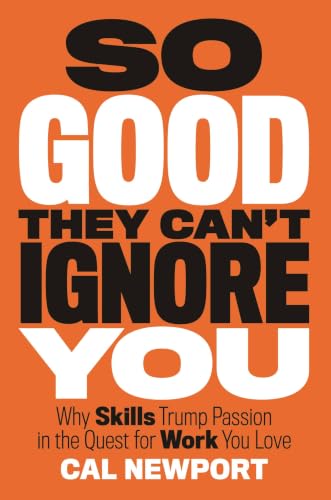
The book that killed "follow your passion" for a generation of careful thinkers — the case for building rare skills first and letting the love follow the mastery.
View on Amazon