
You can have the best product in your market. The sharpest positioning. The most elegant delivery. And a single wrong digit on your price tag will make all of it invisible.
I've watched it happen dozens of times. A founder builds something genuinely good — then prices it at $15 and wonders why nobody takes it seriously. Or prices it at $300 and watches potential clients ghost after the first call. Same product. Same value. Different number. Completely different outcome.
Here's what nobody tells you in business school: pricing is not a math problem. It's a psychology problem. And the brain evaluating your price tag is running software that was last updated in the Pleistocene era.
Let's open the hood.
The Anchor Effect
Every price you've ever seen lives relative to another number already in the buyer's head. You don't control what your price means — you control what it sits next to.
This is why SaaS companies put a $499/month "Enterprise" tier on their pricing page that almost nobody buys. It's not there to be purchased. It's there to make the $99/month plan feel like a steal. The $499 is the anchor. The $99 is the real product. But without the anchor, $99 feels expensive.
The research is brutal on this. Kahneman and Tversky showed that even random numbers — a spinning wheel, a zip code, a number someone mentioned in passing — affect how much people are willing to pay for completely unrelated things. The first number the brain encounters becomes the reference point. Everything after is judged as "more than" or "less than" that anchor.
What this means for you: whatever number your customer sees before your price determines whether your price feels high or low. If they just came from a competitor charging $500, your $200 feels like a gift. If they just saw a free alternative, your $200 feels like robbery.
You're not setting a price in a vacuum. You're positioning a number inside someone's head — next to whatever was already there.
The Anchor Rule
Always show the most expensive option first. Not because you expect people to buy it — but because everything after it feels reasonable by comparison. The anchor reshapes reality.
The Weber-Fechner Law
Here's a question: would you drive 20 minutes across town to save $10?
If the item costs $15, most people say yes. If the item costs $500, most people say no. Same $10. Same 20 minutes. Completely different decision.
This is the Weber-Fechner Law — the brain perceives price changes as ratios, not absolute differences. A $10 increase on a $10 product is catastrophic (100% more). A $10 increase on a $500 product is invisible (2% more). Same number. Different psychological weight.
This explains things that otherwise seem irrational:
- Why people agonize over $3 vs. $4 for an app but don't blink at $4.50 vs. $5.50 for coffee
- Why subscription services can raise prices by $2/month without losing anyone — but a $2 one-time charge feels offensive
- Why raising your price from $97 to $127 loses fewer clients than raising from $9 to $12
The practical application: if your product is cheap, every dollar of price change feels enormous to the buyer. If your product is expensive, you have room to move. This is one reason why premium pricing is more forgiving — the ratios work in your favor.
Charm Pricing Is Dead. Or Is It?
$9.99 instead of $10. $29.97 instead of $30. The "charm pricing" playbook that every retailer has used since the 1880s.
Does it still work? Depends on what you're selling.
The research says: charm pricing signals value. Round pricing signals quality. These are different messages to different buyers.
When someone sees $9.99, their brain reads "deal." When someone sees $10, their brain reads "confidence." When someone sees $10.00, their brain reads "premium." The cents aren't just cents — they're a declaration of what category you belong to.
The rule that emerged from 30 years of research:
- Selling commodity / value products: Use $X.99 or $X.97. The brain processes the left digit first — $29.99 genuinely feels closer to $20 than $30 to most people.
- Selling premium / luxury / expertise: Use round numbers. $100. $500. $2,000. The roundness communicates that you didn't calculate — you decided. That's confidence. That's premium positioning.
- Selling B2B / high-consideration: Use precise numbers. $4,700. $12,350. Precision suggests the number was calculated based on actual value delivered — not pulled from thin air.
Most founders pick their pricing format randomly. It's not random. It's a signal. And the wrong signal — $9.99 on a consulting package, or $1,000.00 on a digital download — creates cognitive dissonance that kills the sale before the brain even finishes processing.

Same value. Different price. Different reality.
The Price-Quality Heuristic
Here's the paradox that destroys new businesses: you lower your price to get more customers, and sales drop.
Not because the product changed. Because the perception of the product changed.
The brain uses price as a proxy for quality. This isn't stupidity — it's efficiency. When you can't evaluate a product directly (which is most of the time), the price is the strongest signal available. Expensive = probably good. Cheap = probably not.
The wine studies proved this beyond doubt: same wine, different price label. People's brains — measured by fMRI — literally experienced more pleasure drinking the "expensive" one. Not reported more pleasure. Actually felt it. The price changed the physical experience of the product.
What this means for your business:
If you're unknown, cheap is suspicious. If your first customers don't have referrals or reviews to guide them, your price IS your reputation. A $50 coaching session says "amateur." A $500 coaching session says "expert." Same person. Same advice. Different perceived value.
I've seen founders triple their price and see more sales — because the higher price finally matched what the product actually delivered. The market wasn't wrong before. The price was sending the wrong signal.
The Suspicion Threshold
If your conversion rate is low and you're priced significantly below competitors, raise the price before you change anything else. You might be tripping the "too cheap to be real" alarm in the buyer's brain.
How to Actually Set a Price
Forget competitor research for a moment. Forget what the market "expects." Those are useful inputs but they're not the starting point.
Start with three numbers:
1. The Maximum. What's the most anyone has ever paid you — or would plausibly pay you — for this result? Not the average. The ceiling. That number tells you what the market considers possible.
2. The Minimum. What's the lowest price you'd accept without resenting the work? Below this number, you'll deliver badly, cut corners, or quietly hate your clients. That's a death spiral for retention.
3. The Uncomfortable Number. What price makes you slightly nervous to say out loud? Not terrified — just a little uncomfortable. A small voice saying "is that too much?"
That third number is usually correct.
Why? Because discomfort means you've priced at the edge of your own perceived value — which is almost always below the market's perceived value. Founders chronically underprice because they know exactly how easy the work is for them. The client doesn't know that. The client only knows the result — and the result is worth what it's worth, regardless of how many hours it took you.
After you set the number, test it. Sell at that price for 30 days. If everyone says yes immediately with no hesitation — you're too cheap. If everyone ghosts — you're too high or your positioning doesn't support the number yet. If roughly 60-70% convert after a real conversation — you're in the zone.
Build a plan around that price point. Then protect it like it's the most important decision you've made — because it is.
The Number Is the Message
Here's what I want you to take from this:
Your price is not a description of cost. It's not a reflection of hours worked. It's not a calculation of materials plus margin.
Your price is a message. It tells the buyer who you are, what category you belong to, and whether they should trust you — all before they read a single word of your sales page.
The wrong number doesn't just lose a sale. It tells the wrong story. It positions you in the wrong category. It attracts the wrong clients and repels the right ones. It makes your entire business feel slightly off — and neither you nor your customer can articulate why.
The right number does the opposite. It pre-sells. It qualifies. It signals. It builds trust before you've opened your mouth. The mechanics of monetization start with this one decision.
So look at your price right now. Not at what it costs you. Not at what competitors charge. Look at what it says.
Is it saying what you mean?
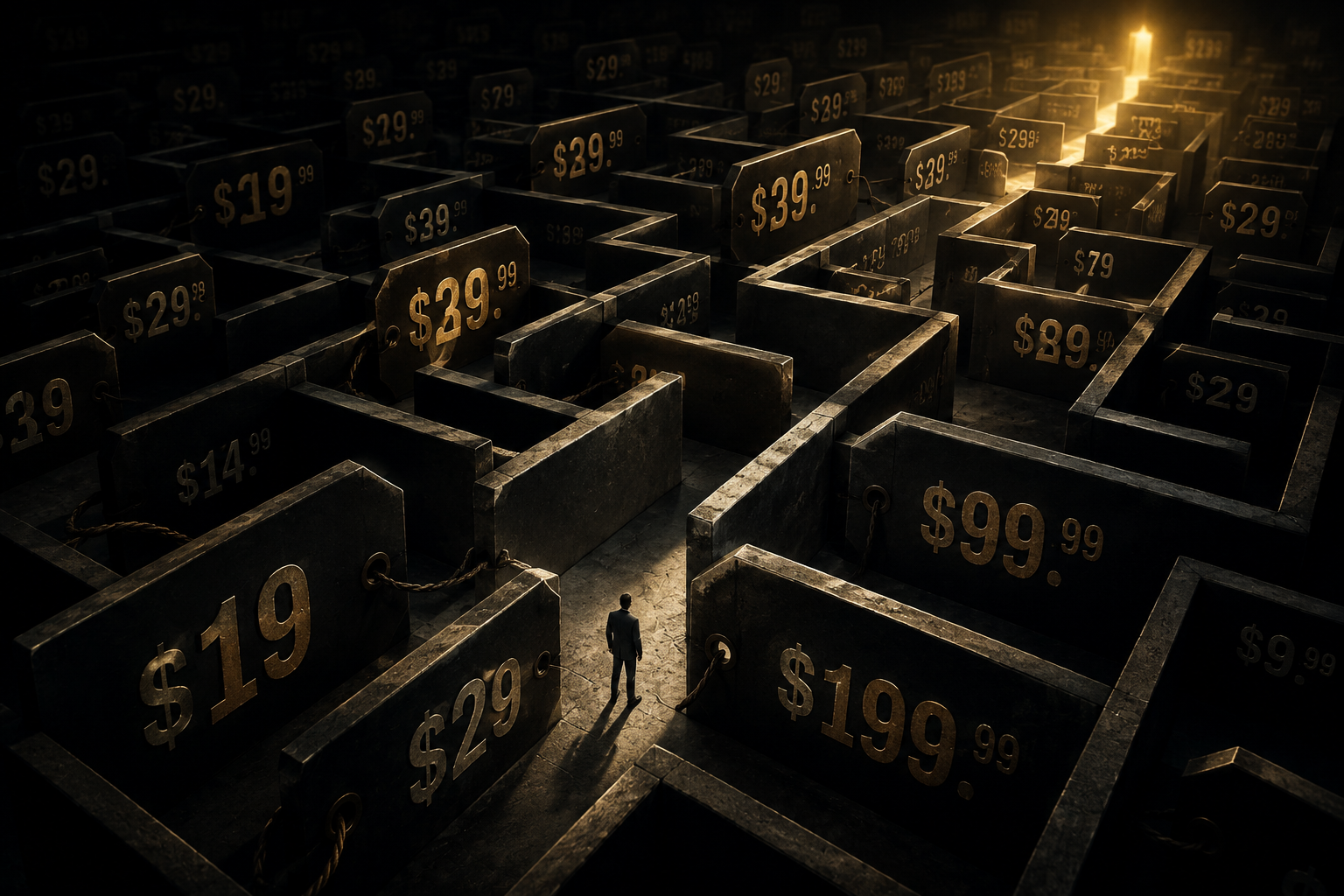
If not — change it tomorrow. Not next quarter. Tomorrow. The maze has an exit. It's not about walking faster — it's about seeing the walls for what they are.