
For forty years, the person who got paid was the one who knew the exact words. The command. The parameter. The clause. Knowing the syntax was the job. In 2026, the machine knows all the syntax. What's suddenly rare — and suddenly valuable — is knowing what you actually want, and being able to say it precisely.
I want to be careful here, because this is easy to get wrong. This isn't a story about skills dying. It's a story about which skill moved to the center of the table. And if you've been quietly worried that everything you learned is becoming worthless, stick with me — because you're closer to the front than you think (you're not behind, you're early).
The syntax was never the point. We just couldn't skip it.
Think about what "knowing the syntax" actually meant. It meant holding a private dictionary in your head. The precise CSS property. The Excel formula nesting. The SQL join. The exact phrasing of a contract clause that wouldn't get thrown out. The command-line flag that did the thing.
None of that was ever the goal. Nobody wants a formula. They want the number it produces. Nobody wants the CSS property — they want the page to feel warm and calm. The syntax was a toll you paid to cross the bridge between what you wanted and the thing existing. For decades, that toll was expensive, and the people who'd paid it their whole careers guarded the booth.
Insight
Expertise didn't live in the answer. It lived in the translation — turning a fuzzy human wish into the machine's exact language. That translation layer is exactly the part that got automated.
What replaced it isn't easier. It's different.
Here's where people oversimplify and say "now anyone can do anything." Not quite. The toll booth didn't disappear — it moved. And the new toll is a strange one, because it's a skill most of us were never taught and most of us are quietly bad at: saying exactly what we mean.
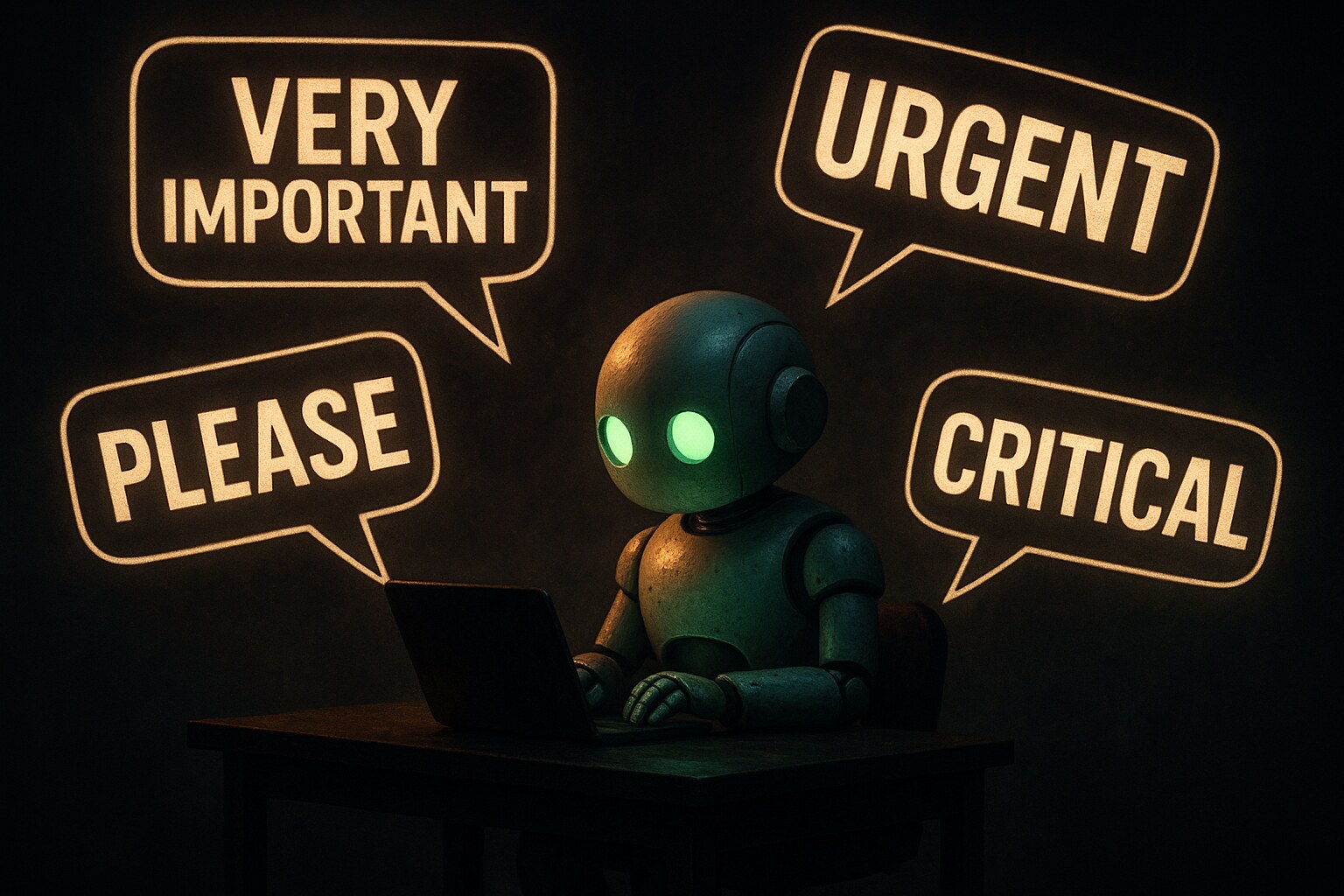
Watch someone use an AI tool badly. They type "make it better." Better how? Faster? Warmer? Shorter? Bolder? The machine will guess, and the guess will be generic, and they'll conclude the tool is dumb. It's not. They just handed it a fuzzy wish and expected a sharp result. The skill isn't in the tool — it's in the ask (this is why yelling at your AI never works).
Now watch someone who's good at it. They don't say "make it better." They say: "Warmer. Drop the corporate tone. Shorter sentences. Lead with the customer's pain, not our feature. And cut the word 'seamless' — it's dead." Same tool. Completely different result. The difference wasn't technical knowledge. It was clarity of intent, expressed with precision.
Describe, don't type
Let me make this concrete, because the shift is genuinely beautiful once you see it.
The old way: you wanted a specific shade for a headline, so you opened a color reference, scrolled a palette, found the hex code, copied it, pasted it into the exact right spot, refreshed, decided it was too dark, and did it again. The knowledge that mattered was where to put #8B2635 and how to write it without breaking the file.
The new way: you say "make that headline a deep cherry red, then shift it toward plum as it scrolls." Done. The hex code still exists somewhere underneath — the machine wrote it — but you never touched it. Your job was to know that you wanted cherry-to-plum and to say it cleanly.
That second skill is not lesser. In many ways it's harder, because it demands taste. Anyone can look up a hex code. Not everyone can tell you that a florist's brand should feel "soft, a little vintage, like late-afternoon light" instead of just "nice." The rare thing was never the syntax. It was the vision — and now the vision is the whole job.

The old moat was memorizing the manual. The new one is knowing precisely what you want — and naming it.
Where the value actually pooled
When a scarce skill becomes free, value doesn't vanish — it relocates. It flows to whatever is next in the chain and still scarce. When the syntax became free, value pooled in three places, and none of them are technical.
Taste. Knowing that this is good and that is generic. The machine can produce a thousand options; only judgment picks the right one. This is the same reason a sharp brand beats a big one — the ability to make a specific, opinionated choice (the courage to narrow it down) is a taste problem, not a tooling one.
Precision of language. The gap between "make it professional" and "confident but not stiff, like you're explaining it to a smart friend" is the gap between amateur and expert now. If you've ever struggled to strip the buzzwords out of your own writing, you already know how hard clean description is (say what you actually mean).
Knowing what to ask for at all. This is the deepest one. The machine will build anything you can specify — but it will never tell you what's worth building. That still comes from you: your read of the market, your customers, your gut. When you're not sure of the direction, that's the moment to think it through out loud (with AI-powered guidance) or to pull wisdom from people who've navigated big shifts before (the minds who lived through their own revolutions).
The floor dropped. It didn't hit zero.
Let's be honest about the limits, because the hype crowd won't be. "Anyone can build anything now" is a lovely line and it's not quite true.
The floor dropped — dramatically. The power to make software, to design, to draft, to create digital things used to require years of syntax-tolls. Now it's within reach of ordinary people who can describe what they want. That's real, and it's the most democratizing shift in creative power I've seen in my career (create real things with no coding).
But describing well is itself a skill, and it doesn't come for free. Some people will find this wave too technical no matter how low the floor goes — knowing what you want and naming it precisely is genuinely hard, and it's uncomfortable in a way memorizing a manual never was. The barrier moved from technical knowledge to clarity of thought. For a lot of people, that's a harder barrier, not an easier one. So the threshold didn't disappear. It relocated — from the head to the mind, from recall to judgment.
Consider: a solo founder who can't write a line of code but can describe, in vivid, specific detail, exactly how she wants her booking flow to feel — where the friction should live, what a customer should feel at each step. In 2016 she was locked out. In 2026 she out-ships a technical founder who can write anything but can't decide what's worth writing. The syntax stopped being the bottleneck. Her clarity became the edge (solo builders are already outpacing funded teams).
CSS as the assembler
I keep coming back to one image. The languages we used to write by hand didn't die — they became infrastructure. CSS, formulas, queries: they're the assembly language of creation now. Assembly still runs the world; almost nobody writes it by hand anymore. The living layer moved up a floor. Humans describe the intent; a translation layer — increasingly an AI — turns it into the exact syntax underneath.
That's not a downgrade of the human. It's a promotion. We got pulled up out of the syntax basement and set down in the room where the real questions live: What should this be? Who is it for? What do I actually want here? Those were always the hard questions. We just used to be too busy paying the toll to spend much time on them.
The practical bridge
So what do you do with this, Monday morning?
Stop investing in memorizing syntax you can now describe your way past. Start investing in the muscle that pays: naming what you want with precision. Practice it out loud. When you ask for something and get a generic result, don't blame the tool — sharpen the ask. Notice the difference between "make it better" and a specific, opinionated instruction, and live on the specific side.
Build your taste deliberately. Look at a lot of good work and figure out why it's good, in words. Because in a world where the machine can produce anything you can specify, the person who can specify beautifully wins — and the one who mumbles "make it nice" gets mush. The advantage of doing one thing exceptionally still holds; it just lives in judgment now, not in recall (the people who moved first weren't more ready — they were clearer).
The syntax was never the point. It was the toll. The toll got cheap. The vision — knowing what you want and saying it clean — is the whole game now. And that, unlike a hex code, was never something you could just look up.