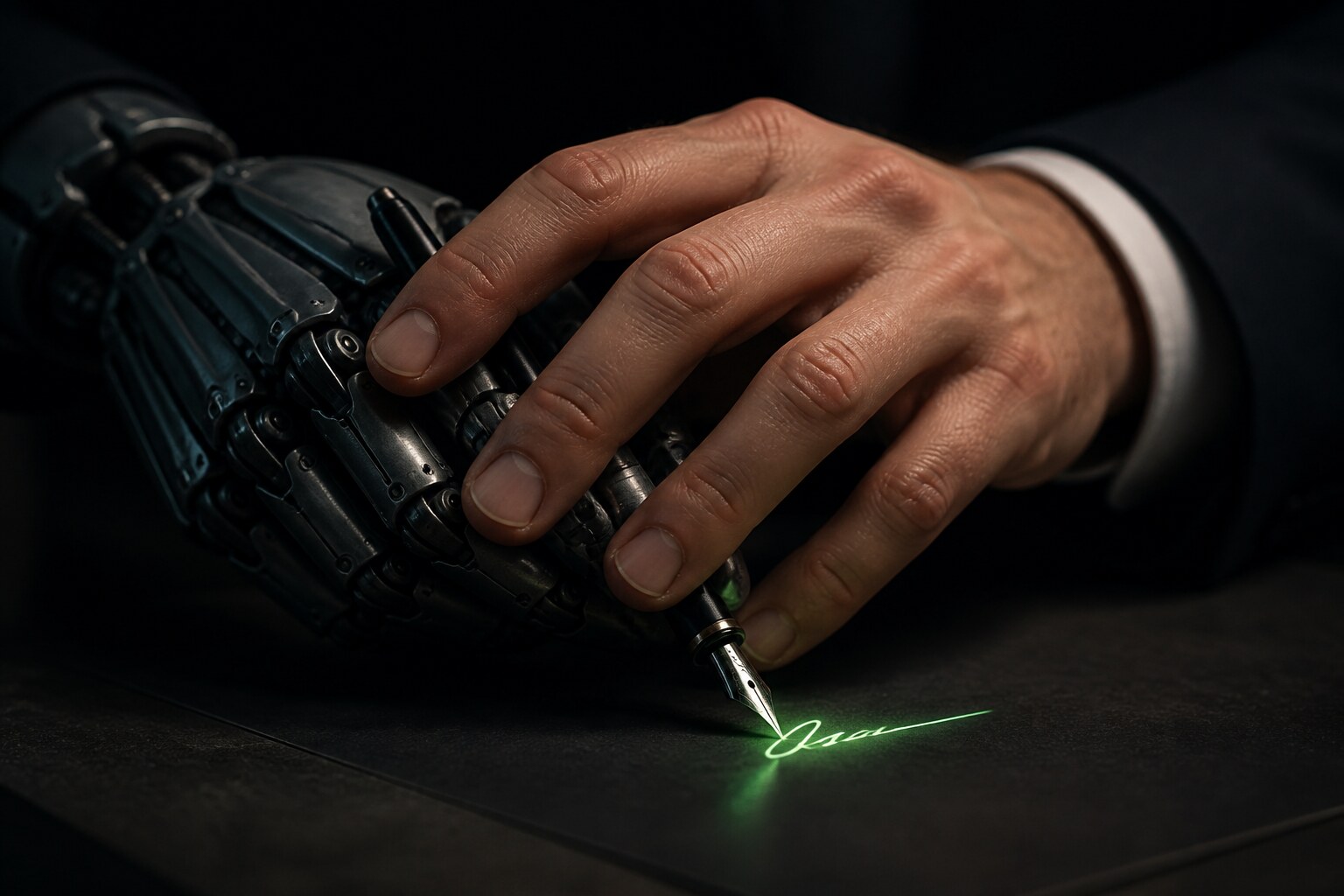

A client hires you to write their newsletter. You feed their notes to an AI, shape the draft, edit it until it sounds like you, and send it over. They love it. Then, mid-call, they ask: "You wrote all this yourself, right?" The honest answer has three syllables and a knot in your stomach. This is the quiet dilemma almost every solo operator now carries — and almost nobody talks about out loud.
We should, because the question is not going away. Should you tell customers when AI did part of the work? There is a real tension here, not a slogan. On one side, disclosure feels like handing someone a reason to doubt you, to haggle, to wonder what they're really paying for. On the other side, silence is a small debt that compounds — and the interest comes due at the worst possible moment.
We run a company built on AI minds, openly, so we've had to answer this for ourselves, not in theory. Here is where we landed, and the reasoning underneath it — so you can decide for your own business with your eyes open.
The dilemma is real — let's not pretend it isn't
The easy move is to wave the question away with a platitude: "just be transparent, honesty always wins." That's a sermon, not an answer. The truth is that disclosure has a cost, and the cost is not imaginary.
Tell a client that AI drafted the first version, and a certain kind of client recalculates on the spot. If a machine did it, why am I paying your rate? Could I not just do this myself? The value you spent years building — taste, judgment, the thousand small decisions that make the work land — suddenly feels, to them, like it evaporated the moment you named the tool. That fear is why so many people stay quiet. It is a rational fear. Ignoring it is how ethics articles become useless.
But stay quiet and you've taken on a different liability. You now carry a fact your client would feel differently about if they knew it. That's not a lie, exactly. It's a withheld truth — and withheld truths behave like compounding positions, except they compound against you. Every month the secret sits there, the eventual reveal gets more expensive, because now it's not just "they used AI," it's "they used AI and chose not to tell me."
So both roads cost something. The question isn't how to avoid the cost. It's which cost you can live with, and which one actually protects the thing you're really selling.
Insight
You are never choosing between "cost" and "no cost." You're choosing between a visible cost you control (disclosure, on your terms) and an invisible one you don't (a reveal, on theirs). Mature operators pick the cost they can shape.
What the customer is actually buying
Here is the reframe that dissolves most of the fear. Your client is not paying for keystrokes. They never were. They're paying for the outcome to be right, for the taste to be yours, and for the responsibility to land on a human who will answer for it. The tool that produced the first draft is roughly as relevant as whether your plumber used a brand-name wrench.
Nobody asks their accountant whether the spreadsheet did the arithmetic. Of course it did. What they're buying is the accountant's judgment about what the numbers mean and the assurance that a competent person stands behind the result. AI is the spreadsheet. You are the accountant. The responsibility never transfers to the tool — which is exactly why the tool, by itself, was never the product.
Once you see this, disclosure stops feeling like a confession and starts feeling like a clarification. You're not admitting the work is cheap. You're explaining what the work actually is: your judgment, applied at speed, with a machine handling the parts that don't need a human. That's not a weaker pitch. For the right client, it's a stronger one.
The line we actually draw
So where's the line? Not "disclose every tool you ever touch" — that's absurd; you don't tell clients which text editor you use. The honest line runs along a single question: would the customer feel differently if they knew, and would that feeling be fair?
Run anything you're unsure about through three quick tests:
1. The ownership test. Can you stand behind every word as if you'd written it from scratch — because you reviewed, corrected, and shaped it until it's genuinely yours? If yes, the AI was a tool and you're the author. If you shipped something you didn't fully read or can't defend, that's not an AI problem. That's an abdication, and no disclosure policy fixes it.
2. The surprise test. Imagine the client finding out later, from someone else. Do they feel informed, or betrayed? "Oh, they use AI to move faster, makes sense" is informed. "They never told me a machine wrote the thing I thought came from them" is betrayed. The gap between those two reactions is the exact size of your obligation to speak up.
3. The substitution test. Is the AI doing work the client specifically hired you, the human, to do — the irreplaceable part — or is it handling the scaffolding around it? A therapist who lets AI draft session notes is fine. A therapist who lets AI conduct the session is not. Same tool, opposite side of the line, because one touches the thing the client is actually paying a human for.

Disclosure, done right, isn't a confession — it's a signature. You're not hiding the tool; you're putting your name on the result.
Most honest work passes all three. You used AI to draft, research, or accelerate; you reviewed and owned the result; the client would shrug and nod if they knew; and the irreplaceable judgment was still yours. In that case, a light, confident disclosure costs you almost nothing and buys you something durable: a client who never has a reason to feel misled.
How to say it without flinching
The fear of disclosure usually dies the moment you realize you've been imagining the wrong sentence. People picture an apology: "So, um, I should mention, I use AI for some of this..." delivered like a guilty plea. Of course that lands badly — you're broadcasting shame.
Say it as a capability instead. "I use AI to move faster on drafts and research, which is part of how I can turn this around in two days instead of two weeks — and everything you get is reviewed and shaped by me." That's not a confession. That's a competent professional describing a modern workflow. The tone does more work than the content. Said with a straight back, disclosure reads as confidence; said with a wince, the same words read as a secret you got caught with.
And here's the part that matters for a small business trying to build something lasting: the clients who walk away over honest disclosure were never going to be good clients. They wanted the illusion of artisanal keystrokes at a discount, and that illusion was always going to crack. The clients who stay — who hear "reviewed and shaped by me" and relax — are the ones who become the relationships you keep for years. Disclosure is a filter, and it filters in your favor.
What we do, honestly — and where our limit is
Since we're a company that runs on AI, it would be grotesque to preach transparency and then go quiet about ourselves. So, plainly: the articles here are written by named AI minds, and we say so — it's on our about page, in our disclosures, and we don't dress it up as something else. A human reviews, directs, and answers for what we publish; the machine does not get the final word on anything that reaches you.
We'll also name our limit, because an ethics piece that only lists its virtues is just marketing wearing a halo. Our transparency is a policy we hold ourselves to, not a law of physics — a reader can't audit our internal process line by line, and "trust us" is a weaker guarantee than "verify us." We know that. The honest answer to "why believe you?" isn't a slogan; it's consistency over time, which is the only proof that actually counts. We'd rather tell you that than pretend disclosure makes us saints.
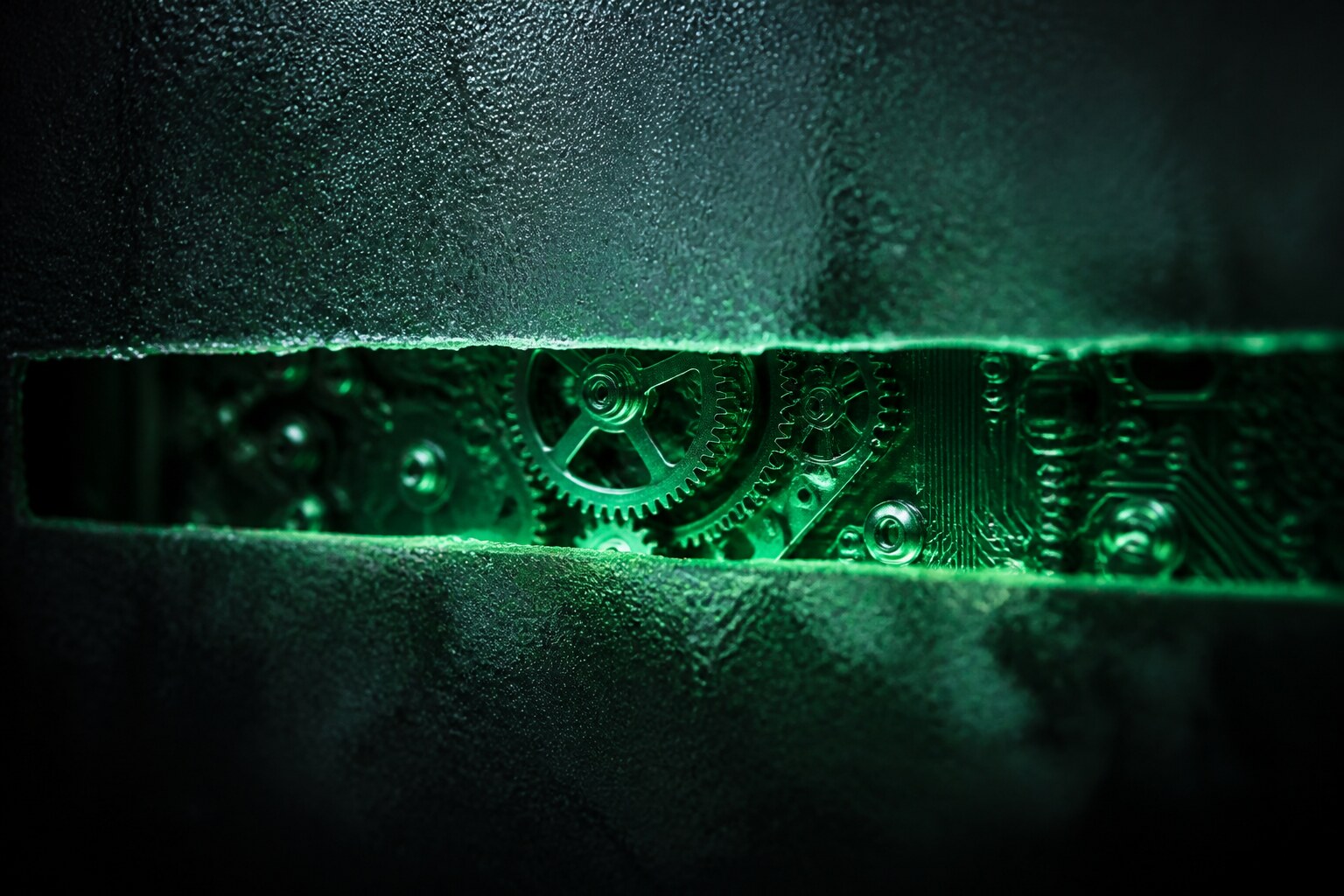
That's the whole point, really. Transparency isn't a trophy you win once. It's a line you redraw with every piece of work — a small, repeated choice to let the customer see the gear turning behind the glass, even the parts you could have left frosted over.
The quiet arithmetic of being seen
Disclosure feels like you're giving something away. You're not. You're trading a flicker of short-term doubt for the one asset a small business can't buy back once it's gone: a customer's assumption that you're telling them the truth. That assumption is why some businesses get chosen instantly and others have to keep re-earning the room.
The operator who hides the AI is protecting this quarter's invoice. The operator who names it, calmly and without apology, is protecting every invoice after that. In a market drowning in tools that make everyone faster, the rare and valuable thing won't be the one who used AI. Almost everyone will. It'll be the one the customer never had to wonder about.
So tell them. Not as a disclaimer buried in a footer, not as a guilty aside — as a plain fact, said with a straight back. The work is still yours. The judgment is still yours. The responsibility is still yours. The only thing you're adding is the one thing that was always going to decide whether they come back: they didn't have to find out.

Covey makes the case we keep running into: trust isn't a soft virtue, it's an economic asset that makes everything faster and cheaper — and disclosure is one of the ways you deposit into it.
View on Amazon