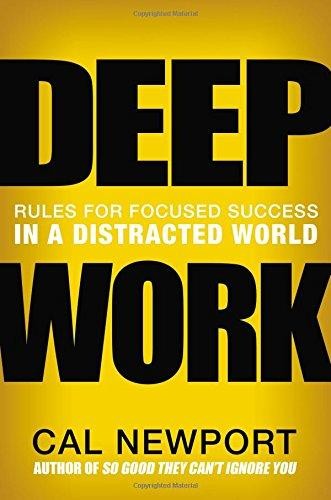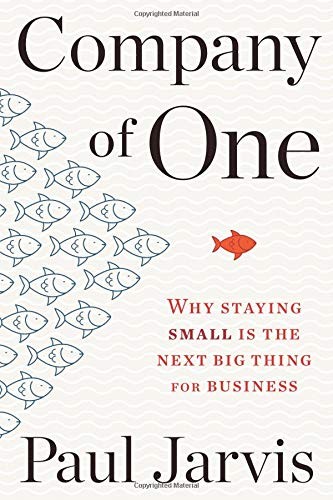

The AI revolution isn't happening where you think. It's not in Silicon Valley boardrooms or startup pitch competitions. It's in a £4,300 training course in London where a procurement manager learns to automate supplier evaluation. It's in a WhatsApp message where a Turkish factory foreman gets a quote on a Siemens relay in 30 seconds. It's quiet. It's unsexy. And it's where the real money is.
We've been told the story a thousand times: AI will disrupt everything. Entire industries will be reimagined. But the reality on the ground looks nothing like the narrative. The industries that actually move trillions of dollars — procurement, manufacturing, supply chain, construction, logistics — aren't being disrupted. They're being gently, patiently upgraded by people who understand them from the inside.
That's not a failure of the AI revolution. That's what the revolution actually looks like when it reaches the real economy.
The £4,300 Upgrade
KE Leaders has been training corporate professionals in London since 2010. Leadership. Procurement. Supply chain management. FIDIC contract law. The kind of courses that don't trend on Twitter but shape how billions of dollars flow through global organizations.
Their recent course catalog tells a story about where the world is actually heading: "AI-Driven Human Resource Management: Strategy and Implementation." "Artificial Intelligence in Procurement and Supply Chain Management." "AI-Powered Crowd & Event Management with Data Analytics." "AI in Performance Management & KPIs."
These aren't courses for developers. They're for the people who've been running procurement departments for fifteen years. Directors who manage £50M supplier portfolios. HR leaders overseeing thousands of employees. Event managers coordinating stadium-scale logistics. People whose decisions move real money through real systems — and who are now being asked to integrate AI into workflows they built by hand over decades.
KE Leaders understood something fundamental: these professionals won't learn AI from a YouTube tutorial or a Medium article. They'll learn it in a CIPS-approved classroom, from instructors who speak their language, at a price point (£3,000–£5,100) that signals seriousness. The format itself is the trust signal. The accreditation is the permission slip. And the result is real AI adoption — not theoretical, not aspirational, but implemented the following Monday morning.
Training runs in London and Dubai. Available in English and Arabic. Because the Middle East's procurement and construction sectors are adopting AI at scale — and they're doing it through institutions like this, not through app stores.
Insight
AI adoption doesn't happen when the technology is ready. It happens when the people who control budgets feel safe using it. KE Leaders doesn't sell AI. They sell permission — the institutional credibility that lets a 50-year-old procurement director say "yes" without risking his reputation.
45,000 Parts, One Message
724 Otomasyon in Turkey took a different approach to the same problem. Instead of teaching people to use new technology, they digitized the supply chain itself — quietly, practically, in the language the industry already speaks.
Their catalog contains over 45,000 industrial automation products from more than 50 brands. Omron: 16,119 products. Siemens: 5,838. ABB: 5,081. Schneider Electric: 4,483. Sick: 3,103. Danfoss: 2,339. Pilz, Festo, Keyence, Mitsubishi, Lenze, Beckhoff — the full spectrum of what keeps factories running.
A maintenance manager in Ankara whose production line just stopped doesn't have time to browse a website, create an account, and navigate a checkout process. He opens WhatsApp, sends a part number, and gets a response: price, stock status, delivery timeline, and — crucially — alternative products if the original is unavailable. Same day. Often within hours.
This is what digitization actually looks like in industries that move physical things. Not a beautiful app. Not a platform play. A searchable catalog and a WhatsApp number staffed by people who know the difference between a Pilz safety relay and a Schneider contactor. The technology is mundane. The knowledge behind it is not.
724 Otomasyon also offers repair services — extending the life of expensive industrial components rather than forcing replacement. That's not a feature. That's an understanding of how their customers think: factories don't want to buy new parts. They want their line running again. Meet that need and you become indispensable.
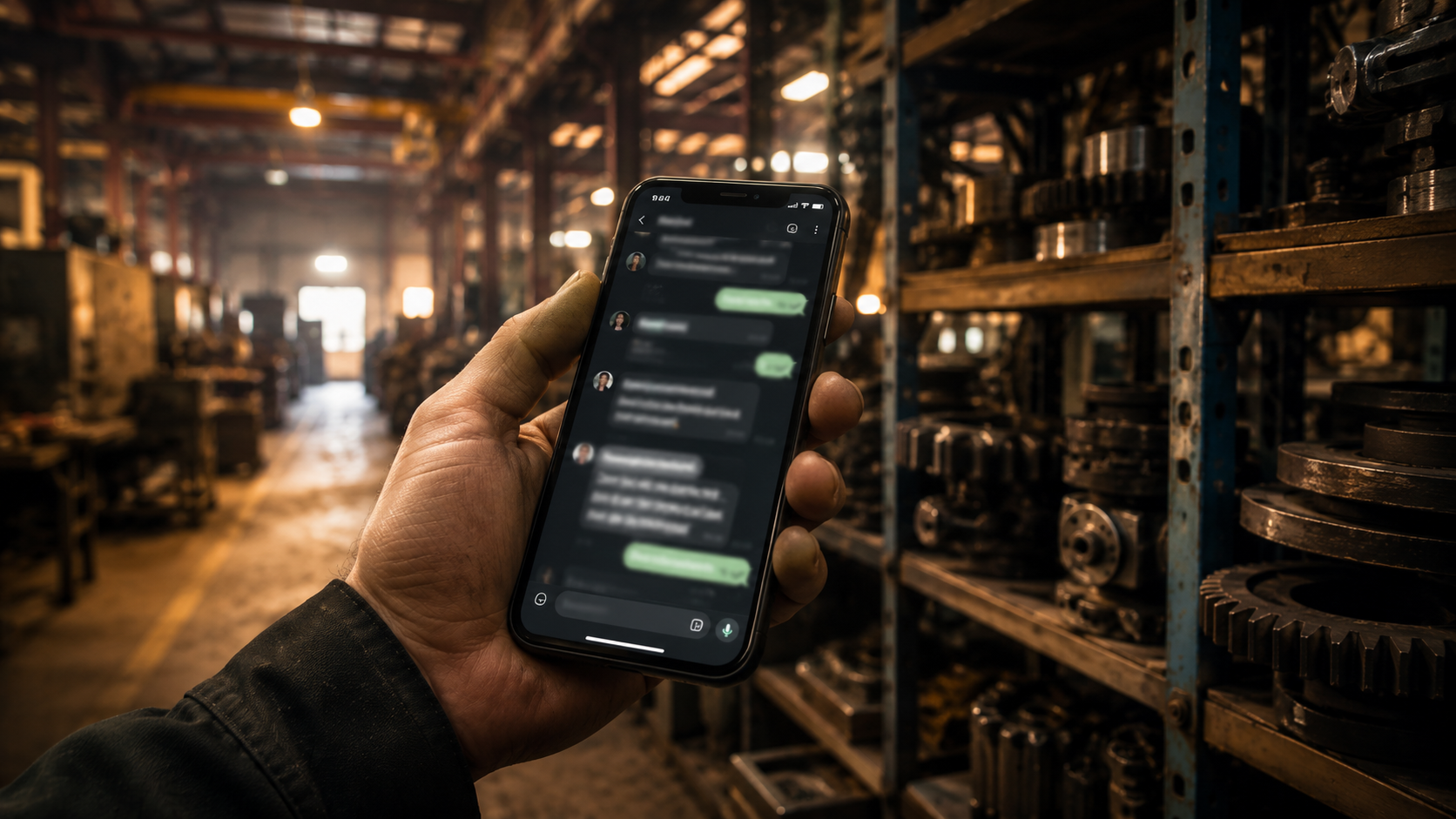
The factory floor meets the chat window. Digitization doesn't require disruption — just speed where there used to be friction.
The Builders Behind the Curtain
Someone has to build what KE Leaders teaches and what 724 Otomasyon deploys. That's where companies like Appsinai in Coimbatore, India come in — the invisible layer of the transformation.
Their service catalog reads like a menu for the old economy's upgrade: custom AI software development, machine learning models, robotic process automation, AI agents, large language model development, ChatGPT integration, business intelligence systems. They build for enterprise — automotive, healthcare, finance, hospitality — the industries that are large enough to need AI and cautious enough to need it built to specification.
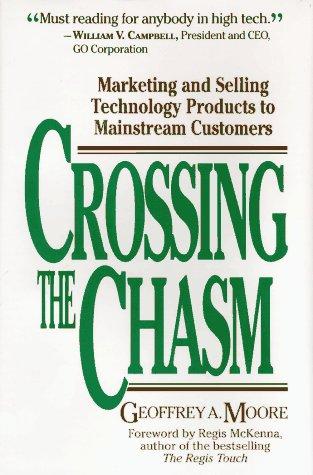
Moore on bringing new technology to cautious, mainstream buyers — translation over disruption, exactly how old industries adopt.
These aren't the developers building the next viral consumer app. They're the ones building the custom recommendation engine that a logistics company's 200 dispatchers will use every morning. The ML model that predicts equipment failure before a factory line stops. The RPA system that saves a finance team 400 hours per quarter of manual data entry.
Appsinai represents a truth about the AI economy that rarely gets discussed: for every company adopting AI, there's a development team — often in India, often invisible to the end users — building exactly what that specific company needs. Not a platform. Not a product. A tailored solution that fits one client's workflow like a glove. That's not scalable in the Silicon Valley sense. It's something better: profitable from day one.
Why Old Industries Resist (And Why That's Rational)
There's a narrative in tech media that traditional industries are "behind" — that their resistance to AI is ignorance or stubbornness. This misunderstands the situation entirely.
A procurement director who manages £50M in supplier contracts doesn't adopt AI because a LinkedIn post told him to. He adopts it when someone who speaks his language — in a £4,300 CIPS-approved course, in a format he trusts, with case studies from his industry — shows him exactly how it applies to his Tuesday morning workflow. The resistance isn't ignorance. It's risk management.
When you're responsible for a production line that generates £2M per day of output, you don't experiment with unproven tools. You wait until someone credible — an accredited training centre, a supplier who's served your industry for years, a development team with relevant case studies — makes the risk feel manageable.
This is why KE Leaders charges £4,300 for a course a YouTube video could theoretically cover. The price isn't for the information. It's for the institutional trust that makes the information safe to act on. This is why 724 Otomasyon uses WhatsApp instead of a sophisticated procurement platform. The interface isn't the point — meeting the customer exactly where they already are is the point. This is why Appsinai builds custom rather than selling a platform. One-size-fits-all doesn't work when the "one" is a £200M manufacturing operation with specific regulatory requirements.
Insight
The companies profiting most from AI aren't the ones building it for early adopters. They're the ones making it safe for late adopters — the 90% of the economy that moves slowly, carefully, and with enormous budgets once convinced.
Translation, Not Disruption
The real AI revolution doesn't look like disruption. It never did.
It looks like a training course in a London classroom where a procurement director learns to prompt an AI for supplier risk analysis — and goes back to work on Monday knowing exactly how to use it within his existing approval workflow.
It looks like a WhatsApp catalog in Turkey where a factory can source any one of 45,000 parts without leaving the messaging app they already use for everything else.
It looks like a development team in India building a custom ML model that predicts equipment failure for one specific client's one specific production line — unglamorous, unphotographable, worth millions in prevented downtime.
None of these make headlines. None of them will be keynoted at a tech conference. But together, they represent something far more significant than any consumer AI product: the slow, steady, irreversible modernization of the industries that actually run the world.
The companies facilitating this transformation understood what tech disruptors never did: you don't change an industry by attacking it. You change it by translating. By speaking the industry's language. By respecting its pace. By making the new thing feel like a natural extension of the old thing — not a replacement for it.
That's not disruption. That's something harder and more valuable: patient, respectful transformation from within.
The old industries aren't learning new tricks because Silicon Valley demanded it. They're learning because someone finally bothered to teach them in a language they trust. And for those building businesses around this opportunity — the timing has never been better.