
There is a particular kind of victory that feels like winning and functions like theft. You leave the table with the better price, the tighter terms, the last word — and a quiet certainty that you came out ahead. You did, for exactly one transaction. Then the other party goes home, does the arithmetic on how they were made to feel, and decides — without announcing it — never to sit across from you again.
You won the negotiation. You lost the relationship. And in commerce, as in most things that compound, only one of those two ever pays.
We are taught to admire the closer who extracts, the operator who never leaves a dollar on the table. Yet the founder who runs a business with their own name on the door learns a stranger truth: the most profitable posture is not to win against people, but to become someone worth returning to. This is not sentiment. It is arithmetic played over time.
The Illusion of the Fixed Pie
The error begins with a picture in the mind: the pie is fixed. Whatever you keep, the other side loses; whatever they gain, you forfeit. Under this belief, every concession feels like a wound, and so you optimize to take — squeeze the price, harden the terms, treat generosity as leakage.
But most real deals are not zero-sum. The two parties rarely want the exact same things in the exact same proportions, and in that gap lies the possibility of a larger pie — value created rather than merely divided (this is the quiet mechanics of how value actually becomes currency). To insist the pie is fixed is not hard-nosed realism. It is a slow bankruptcy — one that never shows on today's invoice, only on the deals that never come.
Insight
Zero-sum thinking doesn't ruin you in a single stroke. It bleeds you — invisibly — through the repeat business that stops repeating and the referral that never gets made. The bill arrives late, which is precisely why it goes unnoticed.
One Hand Versus the Whole Game
Game theory draws a sharp line between a single encounter and a repeated one. In a game played exactly once, defection is rational — grab, squeeze, win, walk away, for there is no tomorrow to punish you. But in a game played again and again, the calculus inverts. Cooperation wins, because your counterpart remembers, and memory is a form of accounting.
Here is the trap: most people play every deal as though it were the single-round game, when nearly all real business is the repeated one. This is doubly true for the solo operator, whose market is small, whose reputation travels by word of mouth, and who lives almost entirely inside systems that loop back on themselves. You are not closing isolated transactions. You are making moves in one long game whose other players talk to each other.

Left: the one-sided win — you leave with the prize and the table goes cold behind you. Right: the shared win — you both walk out carrying something, and the road keeps going.
The Deferred Bill
The win-lose deal does not cost you on the day you close it. It costs you in the deals that quietly fail to happen afterward. The client who felt squeezed does not return, so you forfeit the lifetime of that relationship (and retention is where the real money hides). They do not refer you, so you lose the deals their word would have delivered — and the right early relationships are worth more than any volume you could chase. Worse, they narrate you. They tell the story of how it felt to deal with you, and that story does business in rooms you will never enter.
This is the same deferred-bill logic that governs the human side of a solo venture: your weakest relationship becomes the ceiling on what you earn. A loser at your table is not a win you have banked. It is a cost you have postponed — and postponement, in a repeated game, always charges interest.
Trust Is the Compounding Asset
What the win-win builds is the one asset that pays forever: the quality of being worth coming back to. Every fair deal is a deposit into it; every squeeze is a withdrawal, taken with a penalty. Over enough rounds, the person who deposits consistently accrues something no clever tactic can buy — the willingness of others to choose them without shopping around, to decide once and never reconsider.
This is why some businesses are trusted almost on sight while others must argue for every inch (the psychology of being chosen runs on exactly this), and why the encounter itself — the way a person is treated in the moment of the deal — is not a nicety but the whole product wearing a different name. Win-win, then, is not the generous alternative to self-interest. It is the most self-interested strategy that exists over time, because it is the only one that does not consume its own future.
How to Play Win-Win Without Being a Pushover
None of this counsels surrender. Win-win is not giving everything away and calling it virtue; that is merely losing with better manners. The discipline is subtler, and it has an edge.
Find the trade where both sides genuinely gain — because your priorities differ from theirs, there is almost always a structure where each gets more of what they value most. Be generous with what is cheap to you and precious to them; it is the highest-return spend in business. And hold your price while protecting their dignity — firmness and fairness are not opposites. The line "I can't move on the number, but here's how I can make this easier for you" wins the deal and the relationship. These are the tense, decisive moments where win-win is actually won or lost — the five conversations every solo operator must learn to hold, including the art of hearing what a hesitant buyer actually means. Even the timing of a deal carries an ethic: to press hardest at another's worst moment is to win a round and forfeit the game.
Consider: Two suppliers quote the same job. One negotiates you to the bone, delivers exactly the contract and not an ounce more, and is never thought of warmly again. The other holds a fair price, throws in the small thing that cost them little and helped you enormously, and becomes the first name you speak when a peer asks for a recommendation. A year later, the second supplier has three of your referrals and the first has a single completed invoice. Same craft. Different game.
Be Worth Dealing With Again
Before your next deal, set aside the question of how to win it and ask a better one: will they be glad they did this with me a year from now? If the answer is yes, you are manufacturing your own future supply of deals. If it is no, you are spending that supply down to buy a single win. The person who can count knows which is the better trade.
And you do not play this game alone. The entire point of building something is to accumulate a web of people — clients, partners, collaborators — who want to keep transacting with you, because no one really builds in isolation, and a one-person enterprise is, in truth, a dense network of relationships wearing a single name. When you want to study how the most enduring builders in history treated the people across the table, their answers are one conversation away. Frame the venture around that from the start (a plan built on repeat relationships, not one-off wins).
So stop trying to win the deal. Start trying to be the one worth dealing with again. The first is a victory that ends at the table. The second is a fortune that compounds long after everyone has stood up and shaken hands.
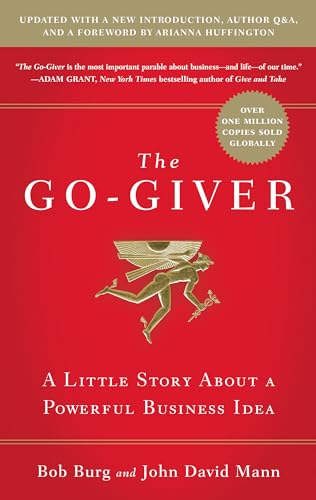
A short parable that makes the argument of this essay unforgettable: giving isn't the opposite of winning — over a repeated game, it's the most reliable way to win at all. The clearest case ever written for generosity as the smart money.
View on Amazon