
Last time, we said the hard thing out loud: your weakest relationship is the ceiling on what you earn. True — but "get better with people" is useless advice. It's too big to act on. You can't practice "people." So here's the version you can actually use.
When you're solo, you don't need to master humanity in the abstract. You need to get good at exactly five conversations. That's it. Miss them and no product, price, or funnel will save you. Get fluent in them and the ceiling lifts on its own. You don't need to become a charmer — you need to stop dreading five predictable moments.
Here they are, why each one scares you, and how to walk through it instead of around it.
1. The Price Conversation
The moment you say your number. For most solopreneurs this is the single most terrifying sentence in the business, and the fear is always the same: sounding greedy, or hearing "no." So they hedge. They pad it with apologies. They discount before anyone even pushes back — quietly negotiating against themselves.
Here's the fix, and it's almost insultingly simple: state your number plainly, then stop talking. Silence after a price is not your enemy — it's the other person doing math, and the first one to speak usually loses. The wrong number kills a business faster than no number at all (the psychology of pricing runs deeper than most founders think), and pricing with confidence is a nerve skill long before it's a math one (especially when you have no sales team to hide behind). Say it. Breathe. Wait.
Insight
You don't rise to the occasion in a hard conversation — you fall to your preparation. Every one of these five gets easier the moment you've decided your words in advance instead of improvising under pressure.
2. The "I'll Think About It"
The soft no. It feels polite, so it's easy to accept and walk away — and that's exactly the trap. "I'll think about it" is almost never about thinking. It's an objection the person hasn't said out loud yet: too expensive, not sure it works, needs to ask someone, doesn't trust you fully. The fear here is looking desperate if you push, so you don't push — and the deal quietly dies of politeness.
The fix isn't pressure, it's curiosity. A calm "totally understand — what's the part you're weighing?" surfaces the real hesitation so you can actually address it. This one conversation has its own hidden grammar worth studying, because what buyers really mean is rarely what they say. You're not chasing. You're helping them finish a thought they got stuck on.
3. The Follow-Up
Reaching out again after silence. Nothing feels needier, so this is the conversation most solopreneurs skip entirely — and it's the most expensive skip of all. Here's the reframe that changes everything: silence is almost never a no. It's a "not yet — remind me." People are busy, distracted, drowning in their own inboxes. Your follow-up isn't an imposition; it's a favor to someone who genuinely meant to get back to you.
Two clean, warm follow-ups will close deals your talent alone never would. It's often the highest-value task you refuse to do, and you refuse it for a purely emotional reason — it feels awkward. Awkward is cheap. A lost client is not.

The whole game, in one image. The hesitating hand and the deciding hand belong to the same person — the difference is just reps.
4. The Upset Client
Something went wrong and they're not happy. This is the one that separates businesses that last from businesses that leak. The instinct is to retreat to email, go defensive, or over-explain — all three make it worse. The fear is the conflict itself, the raised voice, the disappointment aimed at you.
The fix is a three-beat move: acknowledge, don't defend, solve. "You're right, this isn't what you expected — here's what I'm going to do." A calm, non-defensive response in this exact moment is what turns a one-star risk into a loyal client who tells everyone how you handled it. This is where customer experience stops being a department and becomes you, personally, and it's the hinge of whether people stay or quietly leave. It's also where trust is either built or burned in a single exchange. Stay in the room.
5. The Clean No
Turning down bad-fit work, scope creep, or a client who drains more than they pay. Solopreneurs are terrible at this because every no feels like money walking out the door, so they say yes to everything and slowly bury themselves in work they resent. The fear: losing the client, or being seen as difficult.
The fix is the clean no — warm, firm, brief, with a door left open. "I'm not the right fit for this one, but I'd be glad to help if X changes." No long justification (over-explaining invites negotiation). Protecting your yes is how your best clients get room to grow, and why the right early clients matter more than a pile of wrong ones. A clean no isn't lost revenue. It's revenue you're reserving for the work that actually fits.
Consider: None of these five require charisma. They require a decided sentence and the nerve to sit in a few seconds of discomfort. The founder who earns triple isn't more likeable — they've just rehearsed these five lines until saying them stopped feeling dangerous.
Scripts Beat Willpower. Reps Beat Readiness.
Two moves make all five dramatically easier. First, write your scripts once. You will not magically find the right words mid-conversation while your heart is pounding — you'll reach for whatever you've rehearsed. Draft your price line, your curiosity question, your follow-up note, your acknowledge-don't-defend opener, and your clean no. Reuse them forever. Keep them in your one-person operating manual, and if you struggle to say the firm thing kindly, our plain-language translator is a surprisingly good rehearsal partner.
Second, chase reps, not readiness. You get fluent by having these conversations badly a handful of times — not by waiting until you feel ready, which is never. Every awkward attempt is a rep, and reps are how fear shrinks. Even directing your tools is practice: being clear and firm with an AI is the same muscle as being clear and firm with a client, which is why the skill of describing what you want instead of insisting louder carries straight over. Build the plan around getting more of these moments, not fewer (a plan that assumes you'll practice), and when you want to watch persuasion done by masters, history's sharpest minds are one click away.
Going solo didn't free you from people — you were never going to work alone anyway. It signed you up to get good at five conversations. That's not a personality you have to be born with. It's a short, learnable list — and the day you stop dreading it is the day the ceiling lifts.
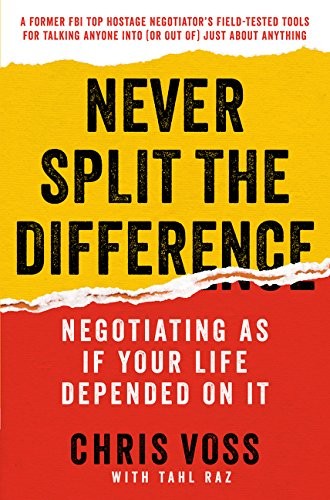
A former FBI hostage negotiator's field manual for the exact five conversations above — the price, the soft no, the tense client. Tactical empathy beats pressure every time, and this is the book that turns dread into a repeatable script.
View on Amazon