

There's a sentence almost no one says out loud at work: "I want more money, and I think I've earned it." It's true, it's fair, and it's roughly impossible to say with a straight face. So we translate. We soften, we hedge, we abstract — and somewhere in the translation, the ask gets so polite it stops being an ask at all. The art of asking for a raise in corporate speak isn't about courage. It's about knowing exactly which words carry your number across the table without blowing up the room.
The number is the easy part. You can calculate your worth with a net worth calculator, benchmark the market, line up your wins. The hard part is the sentence — the one you have to actually say to a human being who controls your paycheck and will remember how you said it. And corporate speak, for all its sins, exists precisely for that moment: the moment the raw truth is too hot to touch.
The machinery underneath the ask
Every polished raise conversation runs on the same handful of linguistic machines. Learn to see them and you stop being their victim — you start driving them.
Euphemism takes "pay me more" and dresses it as "revisiting my compensation." Nobody revisits anything; you want a bigger number. But "revisit" lets both sides pretend the conversation is a routine review rather than a demand — and that fiction is what keeps it comfortable. This is the same soft-landing instinct behind how we say "no" at work: the euphemism isn't a lie, it's a cushion.
The passive voice is the coward's best friend and, used well, your quiet ally. "Mistakes were made" hides the actor. In a raise talk, the inverse is your weapon: you want the active voice for your wins ("I closed the Henderson account") and a gentle passive for the ask ("I'd like my compensation to be reviewed"). You take credit loudly and request quietly. That asymmetry is the whole game.
Abstraction turns a specific, awkward number into a fuzzy category: "market alignment," "total rewards," "growth trajectory." Abstraction is dangerous when it's used against you ("let's talk about your development path" = no raise this year). It's useful when you use it to frame the ask inside a bigger story than "give me cash."
Hedging — "I was hoping," "if possible," "when you get a chance" — is the one to watch. A little hedging keeps you from sounding entitled. Too much, and your ask evaporates. The people who get raises hedge the tone, never the number. "I'd love to find a path to $95K" is firm and warm. "I was wondering if maybe there might be room for something" is a sentence that pays you nothing.
Insight
The goal of corporate speak in a raise talk is not to disguise the ask — it's to lower the social cost of hearing it. Keep the number sharp. Soften everything around the number. The moment you soften the number itself, you've negotiated against yourself before your boss said a word.
You mean / You say
Here's the translation table — the gap between what's true in your head and what actually survives the meeting. Read it twice: once to laugh, once to notice which column you've been living in.
You mean: "I'm underpaid and I know it."
You say: "I'd like to make sure my compensation reflects the scope I've grown into."
You mean: "Everyone else got a bump and I didn't."
You say: "I want to make sure I'm aligned with the market and with my peers."
You mean: "Give me a number or I'm leaving."
You say: "I'm committed here — I'd love for us to find a path that keeps that easy for both of us."
You mean: "I did way more than my job this year."
You say: "I'd love to walk you through how my role has expanded and what that's delivered."
You mean: "'We'll see next quarter' is what you said last quarter."
You say: "Can we put a specific date on revisiting this so it doesn't drift?"
You mean: "That offer is insulting."
You say: "I appreciate that — it's a bit below where I was hoping to land. Can we close the gap?"
You mean: "I have another offer and it pays more."
You say: "I've had some conversations that made me realize my market value, and I'd rather grow that here."
Notice the pattern: every "you say" keeps the real ask intact and just removes the threat, the resentment, and the ego. That's not dishonesty. That's the difference between winning the negotiation and losing the relationship — and the whole point is to win the money and keep the room warm enough to come back to.

A number said out loud has weight. The skill isn't hiding it — it's placing it where the other person can pick it up.
Why we talk like this (it's not just cowardice)
It would be easy to call all of this spineless. It isn't. The corporate dialect around money does real social work, and understanding that work is what lets you use it instead of drowning in it.
A raise conversation is a status negotiation wearing a budget conversation's clothes. When you ask for more, you're implicitly saying "I'm worth more than you've been paying me" — which implies, ever so slightly, that someone miscalculated. The euphemisms exist to let everyone save face while that recalibration happens. "Revisiting compensation" lets your boss say yes without admitting they underpaid you, and lets you ask without accusing them. Both parties get to keep their dignity. That's not weakness — that's cooperative strategy, the thing that keeps relationships intact across repeated games.
There's also a timing truth buried in the dialect. A business owner who's ever had to follow up on a stalled deal knows the move: you don't win by applying maximum pressure at the worst moment. The best raise conversations borrow the logic of why the worst moment sets the price — you ask when your leverage is quiet and your wins are fresh, not when you're furious. Corporate speak is the velvet that lets you make a hard ask on a soft day.
And there's a deeper thing, the one nobody tells you: asking for money is really asking the company to choose you again. The same instinct that makes a customer trust one business over another is at play when a manager decides whether your raise is "obvious" or "a stretch." You're not begging. You're reminding them what it would cost to replace what you do — the quiet math behind how value becomes currency. The polite words are just the delivery mechanism for a very unsentimental truth.
Consider: Two people with identical results walk into identical reviews. One says, "I was hoping maybe we could possibly look at my salary at some point if that's okay?" The other says, "I've taken on the full client-onboarding function this year and I'd like my compensation to reflect that — I'm thinking $92K." Same work. Same worth. One of them named a number and tied it to a result. Guess which one the manager can actually act on. The hedged version doesn't just lose money — it hands the manager nothing to say yes to.
Generate the ask — and decode the answer
This is where corporate speak becomes a two-way instrument, and where most people only use half of it. You need to produce the right register going in, and read the register coming back.
Going in: if the phrasing doesn't come naturally — and under the stress of a money conversation, it rarely does — build it before you walk in. Paste your blunt version ("I want $95K because I'm doing two jobs") into our corporate speak generator, set the tone to something firm-but-warm, and watch it hand you back a sentence you can say without your voice cracking. The point isn't to sound like a robot. It's to arrive with the number already wrapped in language that protects the relationship, so you're not improvising diplomacy while your heart pounds. If you want the sharper, executive register for a formal review, the same tool will translate your ask into boardroom-grade phrasing — the version that reads as calm leverage, not nerves.
Coming back: the answer you get will almost never be plain. It'll be corporate speak too — and now you need to decode it. "Let's revisit this next cycle" usually means no, and I'm hoping you forget. "There's not a lot of room in the budget right now" means not impossible, but you'll have to push. "Let's focus on your development this year" means no raise, but I don't want you to quit. Drop their reply into the same generator and run it in decode mode — it strips the cushioning and tells you what was actually said, so you know whether you got a real maybe or a polite dead end. Reading the answer honestly is how you decide whether to accept, counter, or start quietly running the math on what leaving would actually look like.
That's the whole discipline. Say the number clearly, wrap it so it lands softly, then listen through the politeness to hear the real reply. The people who are good at this aren't braver than you. They just stopped mistaking the cushion for the message — and they never, ever let the hedge swallow the number. If you want to get sharper at the entire category of hard-but-necessary workplace sentences, it's the same muscle behind pushing back without sounding difficult and disagreeing with someone more senior — and it all starts with respecting your own number enough to say it out loud.
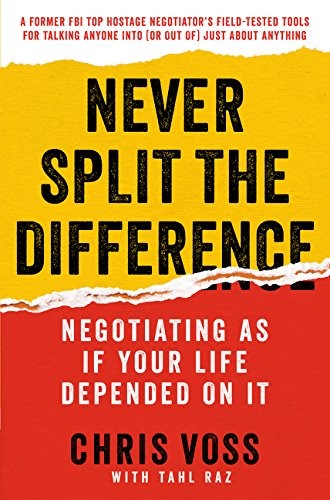
A former FBI hostage negotiator on how to hold your number without hardening the room — exactly the balance a raise conversation demands.
View on Amazon