
There is a sentence everyone has rehearsed in the shower and almost nobody has actually said out loud at work: "That's not what we agreed on." Five words. Completely true. And in most offices, roughly as welcome as a fire alarm during a client dinner.
So we don't say it. We fold it. We take the cleanest, most defensible position a person can hold — you promised me X, you delivered Y — and we wrap it in so much padding that by the time it reaches the other person it sounds less like an accusation and more like a gentle request to "revisit the original scope." Nobody's wrong. Nobody's cornered. And somehow, you still get your point across.
That translation layer — the one between what you mean and what you type — is the entire subject of corporate speak. It's not lying. It's load-bearing diplomacy. And "that's not what we agreed on" is one of the hardest phrases to run through it, because the raw version is correct, and correctness is exactly what makes people defensive. This is the same muscle we built decoding how to say "no" and how to disagree with someone more senior — only this time, you're not asking for anything. You're holding the line on something that was already decided.
The three machines doing the heavy lifting
When you watch a seasoned operator reclaim a broken agreement without a single raised voice, they're running the same three machines every time.
The passive voice, which quietly deletes the villain. "You said the deliverable included onboarding" has a culprit. "There seems to have been a different understanding of the deliverable" has nobody. The passive voice is corporate anesthesia — it lets you point at the problem while pointing away from the person. It's the grammatical equivalent of strategic silence: you leave a space where the blame would go, and let the other person fill it in themselves.
The abstraction, which turns a broken promise into a "misalignment." Nobody breaks a promise in corporate speak. There is only a "gap," a "disconnect," a "difference in expectations." These words float a few feet above the actual facts, and that altitude is the point — it gives everyone room to climb down without falling. The evolution of corporate jargon is really the evolution of ways to describe conflict without naming it.
The hedge, which makes certainty sound like curiosity. "This isn't what we agreed on" becomes "I want to make sure we're on the same page about what was agreed." You're not less sure. You've just dressed your certainty as a question so the other person can answer instead of defend. It works because people argue with statements and cooperate with questions — a small cognitive bias you can use for good.
Insight
The goal of translating "that's not what we agreed on" is never to soften the fact. The agreement stays exactly as firm as it was. You soften the exit — you give the other person a dignified way to honor it. Firm on the what, generous on the how.
The gallery: what you mean vs. what you send
Here is the raw thought, and the version that actually keeps the project — and the relationship — intact.
You mean: "That's not what we agreed on."
You say: "Circling back to our original scope — I want to make sure we're aligned on what was in and out, since this looks a little different from where we landed."
You mean: "You're trying to sneak extra work in for free."
You say: "Happy to take this on — it does fall outside the original agreement, so let's talk about how to fit it in."
You mean: "You changed the deadline without asking me."
You say: "I think the timeline may have shifted since we last confirmed it — can we re-baseline so I'm working from the right date?"
You mean: "We literally wrote this down. I'm looking at it."
You say: "Just pulling up our notes from the kickoff so we're working from the same reference point."
You mean: "No. That was never part of the deal."
You say: "That's a great addition for a future phase — it's beyond what we committed to here, so I'd want to scope it properly rather than squeeze it in."
You mean: "You promised this would be done by now."
You say: "Where are we against the commitment from last week? I want to flag it early rather than let it slip quietly."
You mean: "Stop moving the goalposts."
You say: "The target's moved a few times — can we lock the definition of done so we're not chasing it?"
Read them twice. Every "say" version does three things the "mean" version can't: it keeps the fact intact, it hands the other person a graceful off-ramp, and it reframes a conflict as a shared logistics problem. That's not weakness. That's how you win the negotiation without losing the relationship — the only win that actually pays.

A broken agreement is two gears that stopped meshing. The repair isn't force — it's realigning the teeth so they turn together again.
Why we talk like this (and why it isn't just cowardice)
It's tempting to read all of this as corporate spinelessness — grown adults too scared to say a true sentence. But that's lazy. The padding does real work, and the work is relational.
A bare "that's not what we agreed on" doesn't just state a fact. It assigns a role: you become the accuser, they become the liar or the fool. And people will defend their role far longer than they'll defend their position. Corner someone and they stop solving the problem and start protecting their ego — the exact dynamic behind "I'll think about it" and every other slow no. The corporate version strips out the role assignment and leaves only the logistics: here's where we are, here's where we agreed to be, how do we close the gap. It lets the other person stay a collaborator instead of a defendant.
There's also memory in it. The person across from you is someone you'll need next quarter, next deal, next crisis. Your weakest relationship is your revenue ceiling, and nothing weakens a relationship faster than being made to feel caught. The careful phrasing is you protecting an asset you'll want later — the quiet machinery of the trust economy, where the people who feel respected are the ones who choose you again without thinking.
And yes — sometimes it's armor. When the other person outranks you, the hedge is how you reclaim an agreement without staking your job on it. That's not cowardice. That's reading the board and choosing which fights to have out loud. The content writer who can hold a scope line politely is doing the same thing the great closers do in the five conversations every solopreneur has to master — turning a confrontation into a conversation.
Consider: The strongest version of "that's not what we agreed on" isn't a sentence at all — it's a document. "Let's go back to the kickoff notes" wins the point without you ever having to make it, because now the record is the one disagreeing, not you. Clarity on paper is the politest confrontation there is.
The decoder works both ways
Here's the part most people miss. Corporate speak isn't just a translator for what you send. It's a decoder for what lands in your inbox — and "that's not what we agreed on" is a phrase other people are aiming at you, dressed up the exact same way.
When a client writes "I want to make sure we're aligned on the deliverables," they are not confused. They are telling you, as politely as the language allows, that something you delivered isn't what they expected. "Let's revisit the original scope" means you overstepped, or I did, and one of us is about to pay for it. "I think there may have been a misunderstanding" almost never describes a misunderstanding — it describes a broken expectation someone is being kind enough to call a misunderstanding. Reading those signals early is the difference between a quick fix and a lost account, the same way retention is won or lost in the first flinch.
This is exactly why we built the Corporate Speak Generator to run in both directions. Drop in your raw "that's not what we agreed on" and it'll hand you back the executive version that holds the line and keeps the room calm. Or paste the "I just want to make sure we're aligned" email you just got, flip it to decode, and read what they're actually telling you before you reply. Say what you mean. And understand what they meant. Because the real cost of corporate speak isn't that it's dishonest — it's that it's a second language you're expected to be fluent in but nobody ever teaches. Now you have the dictionary.
A broken agreement, handled well, doesn't have to break anything else. You can hold the line and keep the relationship. You can be completely right and still be easy to work with. That combination — firm fact, graceful exit — is the whole art of it. And once you can run that translation in your head on command, "that's not what we agreed on" stops being the sentence you dread and becomes the one you deliver so smoothly that the other person thanks you for it.
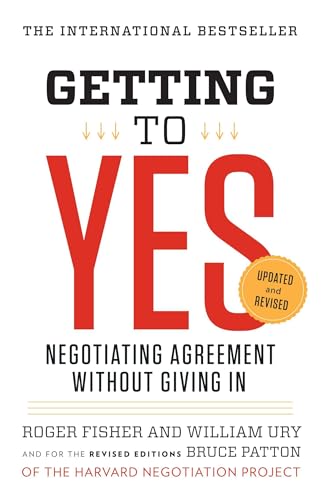
The classic that proves you can hold a hard line and keep the relationship — exactly the balance "that's not what we agreed on" demands.
View on Amazon