
Somewhere in a meeting right now, someone has a better idea and is saying nothing. Not because they're unsure — because the last person who pushed back got labeled "not a team player," and that label follows you into every room for a year. So we swallow it. We nod. And the company quietly ships the worse plan. The real skill isn't having the courage to disagree. It's learning to push back in a way that doesn't cost you the room.
Here's the trap. We think pushing back is a volume problem — that the people who get heard are just louder, blunter, more willing to make it awkward. So we either go silent to stay safe, or we go in hot and confirm everyone's suspicion that we're "difficult." Both lose. The move that actually works lives in the middle, and it's almost entirely a language problem, not a courage problem.
Corporate speak gets mocked as cowardice — a way to say nothing while sounding busy. But the good version is the opposite. It's a precision tool. It lets you plant a hard objection softly enough that the other person can pick it up without feeling attacked. You're not hiding your disagreement. You're packaging it so it survives contact.
The mechanics: how a hard "no, that's wrong" becomes safe to say
Listen to anyone who pushes back for a living — a good consultant, a seasoned negotiator, a leader people actually follow — and you'll hear the same four moves under the polish.
1. The question that is actually a statement. "Have we stress-tested the timeline?" is "the timeline is fantasy." But phrased as a question, you hand the other person the dignity of discovering the problem themselves instead of being corrected. The objection lands; the ego doesn't bruise.
2. Shared ownership of the problem. Not "your plan has a hole" — "we might be exposed here." The word we turns a confrontation into a huddle. Suddenly you're two people looking at the same risk, not two people on opposite sides of it. It's the quiet art of making it a team problem before it becomes a personal one.
3. Agreement before the pivot. "I love where this is going, and —" You name what's genuinely good first, honestly, then turn. Not the fake sandwich where everyone can smell the "but" coming. Real agreement buys you the right to the pivot. Skip it and your objection reads as opposition; lead with it and it reads as refinement.
4. The hedge that lowers the stakes. "I might be missing context, but..." gives everyone — including you — a graceful exit if you turn out to be wrong. You're not staking your reputation on being right. You're putting a concern on the table and inviting a check. That small bit of restraint is exactly what makes people lean in instead of bracing.
Insight
"Difficult" is almost never about what you objected to. It's about leaving the other person no room to change their mind without losing face. Give them the exit, and the same objection becomes "thoughtful."
You mean / You say
The gallery. Left is the thing burning in your chest. Right is the version that gets the room to actually move — without you becoming the office cautionary tale.
You mean: "That's a terrible idea."
You say: "Before we commit, can I pressure-test this a little?"
You mean: "You clearly didn't think this through."
You say: "Help me understand how we'd handle it if X happens."
You mean: "We've tried this and it blew up."
You say: "We've got some scar tissue here — want me to walk through what we learned last time?"
You mean: "No. Absolutely not."
You say: "I'm not there yet — what would it take to get me comfortable?"
You mean: "You're rushing us into a bad call."
You say: "I want to get this right more than I want to get it fast — can we buy a day?"
You mean: "This contradicts what we agreed last week."
You say: "Just so I'm tracking — how does this square with where we landed Tuesday?"
You mean: "I think you're wrong and I can prove it."
You say: "I'm seeing it differently — can I show you the angle I'm worried about?"

Pushback that works is a velvet glove over an iron point. The softness is real. So is the iron.
Notice what every right-hand version does. It keeps your actual position fully intact — you have not conceded an inch — while removing the one thing that gets you labeled: the implied "and you're an idiot for not seeing it." The objection is iron. The glove is just the delivery.
Why we talk like this (and why it's not weakness)
It's tempting to call the soft version dishonest — to insist that real integrity means saying the blunt thing. But that mistakes manners for lying. The blunt version and the packaged version carry the exact same information. The only thing the packaging changes is whether the other person can hear it.
Work runs on standing. Every room keeps a quiet ledger of who's safe to disagree with and who makes it a scene. The people who get overruled aren't usually the ones who were wrong — they're the ones who were right in a way that cost the room something to admit. There's a whole psychology to who gets trusted instantly, and it's less about being correct than about being safe to agree with.
This is also why psychological safety isn't a soft perk — it's the thing that determines whether your team's best objections ever reach the air. In a room without it, the smartest pushback stays in people's heads and the hard conversations never happen. The soft phrasing is how you create that safety one sentence at a time, especially when the person you're disagreeing with outranks you.
And when the pushback is about a broken promise — not a bad idea but a changed deal — the stakes climb again. That's its own dialect, the careful art of saying "that's not what we agreed on" without torching the relationship you still need tomorrow. Because you can be completely right about the terms and still lose the relationship that was carrying your revenue.

A spring held down by one finger isn't weak. It's full of force, applied with control. So is a good objection.
The vulnerability piece matters too. The hedge — "I might be missing something" — isn't self-erasure. It's the move that the strongest people make on purpose: they lower their own certainty a notch so the other person doesn't have to defend theirs. Counterintuitively, admitting you might be wrong is what gives your objection room to be right.
The practical bridge: build the muscle both ways
Pushing back without friction is a two-sided skill, and most people only train one side. You need to encode — take the hot thing in your chest and dress it so it survives the room — and you need to decode — hear the polished pushback aimed at you and catch the real message under it. Because "interesting approach, have we considered the downside?" is someone disagreeing with you in full corporate armor, and if you can't read it, you'll nod along to your own overruling.
That's exactly what we built the Corporate Speak Generator to do, in both directions. Paste the blunt objection you'd never say out loud and let it come back in a tone that lands — the Diplomatic No setting is tuned for precisely this, the firm point wrapped in the glove. Then flip it: paste the suspiciously smooth note your colleague just sent and decode what they're actually telling you. Generate the version that keeps your standing; translate the version aimed at you. One tool, both muscles.
None of this is about being fake. It's the opposite. It's caring enough about the idea to make sure it survives the delivery — and caring enough about the relationships you're building to disagree in a way that leaves them stronger, not scorched. Say the hard thing. Just hand it over with the glove on. When you need the deeper wisdom on holding a position without hardening it, the people who've navigated the toughest rooms are worth a conversation.
Difficult people make the room pay for their honesty. The ones who push back well make honesty feel like a gift. Same objection. Completely different year.
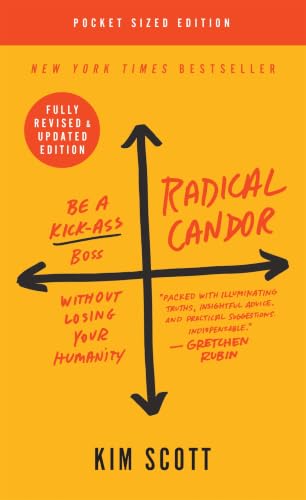
The whole book lives in one idea — challenge directly while caring personally — which is the glove-over-iron move spelled out at full length.
View on Amazon