
There is a sentence almost nobody says out loud in a meeting with their boss's boss in the room: "I think you're wrong, and here's why." It is one of the most useful sentences in business. It is also, apparently, radioactive. So we don't say it. We say something else — something softer, longer, and carefully drained of the one word that matters. We say, "I want to make sure we've pressure-tested this." We have just disagreed. We've also made sure nobody can prove it.
Disagreeing with someone senior is the moment corporate speak was invented for. It's where language stops being communication and starts being negotiation about who gets to be right without anyone losing face. If you've ever walked out of a room thinking "did I actually push back, or did I just... hum disapprovingly in corporate?" — this one's for you. We're going to decode the machinery, laugh at it a little, and then make it work on purpose instead of by accident. Clarity is a skill, and like most communication skills, it's one you can get sharper at (knowing when to speak and when to hold is half of it).
The three gears of "I disagree" (without the career damage)
When we disagree upward, the English language hands us a small, elegant toolkit. Every polished dissent runs on some combination of three gears. Learn to see them and you'll never be fooled by your own politeness again.
Gear one: the euphemism of concern. We don't say "that's a bad idea." We say "I have some concerns." Concerns is the great corporate pressure valve — it signals disagreement while implying you're on the same team, just a worried member of it. It converts an attack on the idea into a feeling about the idea, and feelings are harder to argue with. The brilliant part: "I have concerns" is unfalsifiable. You can always have concerns. The senior person can't say "no you don't."
Gear two: the passive voice. This is where disagreement goes to hide its fingerprints. "You missed the risk here" becomes "the risk here may have been underweighted." Notice what vanished: the subject. Nobody did anything. The risk simply, mysteriously, underweighted itself. The passive voice lets you point at the mistake without pointing at the person who made it — which, when that person signs your reviews, is a feature, not a bug. The same instinct shows up everywhere we try to win a point without losing a relationship.
Gear three: abstraction and the pre-emptive bow. We lift the disagreement off the ground and into the clouds of "frameworks," "alignment," and "the bigger picture," where no specific person can be wrong — only "the approach." And we open with a bow: "You know this space far better than I do, but—." The bow is a toll you pay to be allowed to disagree. Say the magic words, grant the seniority, then dissent. The whole move is a tiny ritual of status: I know my place, and from inside my place, I'd like to tell you you're off by a mile.
Insight
Every one of these gears does the same job: it separates the idea you're rejecting from the person who owns it. That instinct isn't cowardice — it's the whole trick. Done well, it lets you attack a decision while visibly protecting a human. Done badly, it's so busy protecting the human that the decision never gets attacked at all.
You mean / You say: the senior-disagreement gallery
Here is the translation layer in action. Left column: the raw, honest thought nobody risks. Right column: the version that survives contact with a VP.
You mean: "That's wrong."
You say: "Help me understand the thinking here — I might be missing something."
You mean: "You didn't think this through."
You say: "I want to make sure we've stress-tested a couple of edge cases."
You mean: "We tried this exact thing and it failed."
You say: "This reminds me of a similar initiative — worth pulling the learnings from it?"
You mean: "The numbers don't support you at all."
You say: "I'm seeing the data land a little differently on my end — can we reconcile?"
You mean: "No. Absolutely not."
You say: "I'd want to flag some real risk before we commit."
You mean: "You're letting ego drive this."
You say: "Let's make sure we're optimizing for the outcome and not the original plan."
You mean: "I'm not doing that."
You say: "Given current capacity, I'd want to talk trade-offs before I commit to that timeline."
Read them twice and you'll notice the right column isn't lying. That's the uncomfortable truth about good corporate speak: at its best, it's not deception — it's disagreement wearing a seatbelt. The same reframing instinct that softens "no" is at work when buyers tell you "I'll think about it" instead of a flat rejection. Humans route hard messages through soft words. Always have.

Disagreeing up is this: holding one position firm while the whole room leans the other way — without knocking the room over.
Why we talk like this (and it's not just fear)
It's tempting to read all of this as pure cowardice — a workforce too timid to say what it thinks. That's lazy. There's a real, defensible logic underneath the padding, and pretending otherwise will make you worse at your job, not better.
The first reason is information, not ego. When you disagree with someone more senior, you are almost always working with less context than they have. "You're wrong" assumes you can see the whole board. "Help me understand" assumes you might be the one missing a piece — which, honestly, you often are. The hedge is a bet on your own incomplete information, and it's frequently the right bet. Good disagreement starts from the humility that you have blind spots too.
The second reason is that in a hierarchy, how you disagree is itself data about you. A senior leader isn't only evaluating your point — they're evaluating whether you can carry a hard message without detonating it. Deliver dissent that makes the room defensive and you've demonstrated a judgment problem, no matter how right you were. This is the quiet engine behind why we instantly trust some people and brace against others: tone is a trust signal before content ever lands.
And the third reason is the one nobody admits: the padding buys the senior person a graceful exit. "You're wrong" forces them to either cave publicly or dig in. "Can we reconcile the data?" lets them change their mind and call it alignment. You're not softening the blow for yourself — you're building them a door to walk through. That's not weakness. That's the kind of social intelligence strong leaders rely on, and it's exactly what a culture of psychological safety runs on.
Consider: the single most respected person in most senior meetings isn't the one who never disagrees, nor the one who disagrees loudest. It's the one whose dissent the boss wants to hear — because it's always precise, never personal, and leaves everyone's dignity intact. That person didn't get there by avoiding corporate speak. They got there by mastering it, then spending it with surgical restraint.
Where it tips from skill into fog
Here's the failure mode, and it's the common one. The gears are so good at protecting the person that they end up protecting the idea too. You wrap your disagreement in so much concern, passive voice, and pre-emptive bowing that the senior person nods warmly — and does the wrong thing anyway, because they never actually heard a "no." You felt brave. Nothing changed. You got the catharsis of dissent with none of the effect.
The fix isn't to drop the diplomacy and start saying "that's wrong" in board meetings. The fix is to keep the wrapper and sharpen the center. Soft frame, hard core. "I'm fully behind the goal here" (the bow) "— and I think the current plan gets us the opposite of it, for one specific reason" (the knife). The warmth earns you the right to be heard; the specificity makes sure you're actually heard. Vague-and-nice is where disagreement goes to die. This is the same discipline behind every one of the hard conversations you can't dodge and the frameworks leaders use to navigate real complexity.
Make the translation layer work for you — both directions
Which brings us to the practical part. There's a tool on this site built for exactly this moment, and it runs both ways — because disagreeing upward is a two-way code problem.
Direction one — generate. You've got the raw thought ("this plan is a mistake and here's the number that proves it") and you need the version that lands in a room above your pay grade without setting it on fire. Drop it into the corporate speak generator, choose the Executive tone, and watch "you're wrong" become a sentence you can actually say to a VP — the bow intact, the knife still sharp. It's the fastest way to keep the diplomacy and not lose the point.
Direction two — decode. The gears cut both ways. When your senior leader says "let's take this offline" or "I love the ambition here, let's just make sure it's grounded," you're being disagreed with — in code. Paste their message into the same corporate speak decoder and get the plain-English version, so you can respond to what they actually mean instead of the velvet it arrived in. Reading the room is a skill; so is reading the memo.
Used well, corporate speak isn't a mask you wear to hide behind. It's a translation layer that lets a true thing travel safely across a difference in power — and lets you hear the true thing coming back. The goal was never to sound corporate. The goal is to disagree, be understood, and still have a job and a relationship on the other side of it. If you want the deeper mechanics of carrying hard truth through soft words, few things sharpen it faster than learning to be genuine without being blunt to a fault — and if you just need the room to land right in the next five minutes, let the tool do the diplomacy while you keep the conviction.
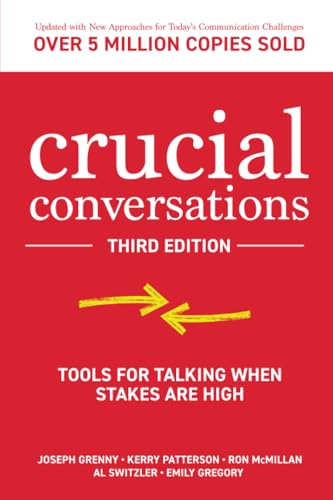
The definitive playbook for the exact moment this article is about: holding a hard position when the stakes are high and the power is uneven — without the conversation going sideways.
View on Amazon