
When a machine can produce anything in seconds, the one thing it cannot manufacture is the evidence that a human cared. And in a world drowning in instant, that evidence is quietly becoming the most valuable thing a business can offer.
We are living through the great flattening. Templates build the website. Generators write the copy. Algorithms design the logo, draft the contract, compose the jingle. The cost of producing something that looks competent has fallen, almost overnight, to nearly zero. This was supposed to be liberation. In many ways it is. But it has also produced a strange and unforeseen consequence: when everyone can make everything, nothing feels made at all.
And so a paradox emerges from the machinery. The more effortless creation becomes, the more we hunger for the trace of effort. The hand — slow, deliberate, fallible — returns not as nostalgia but as a signal. In an economy of the instant, deliberateness is the new scarcity.
The Flood of the Frictionless
Consider what happens to a market when the barrier to entry collapses. A decade ago, a polished website implied resources, seriousness, a team. Today it implies a subscription. The signal that once separated the committed from the casual has been drowned in a flood of frictionless sameness — ten thousand businesses wearing the same template, speaking in the same generated voice, indistinguishable at a glance.
This is not a complaint about technology. It is an observation about how value behaves when supply becomes infinite. Economics is unsentimental here: when two things cannot be told apart, the only remaining axis of competition is price, and price competition is a race whose finish line is zero. The frictionless flood does not lift all boats. It commoditizes them.
Insight
When the cost of "good enough" falls to zero, "good enough" stops being an advantage and becomes the trap. The moment everyone can produce it, no one can charge for it.
Why Identical Destroys Premium
There is a reason luxury has always resisted mechanization. A thing that is perfectly reproducible carries no story, and a thing without a story competes only on function. But human beings do not buy on function alone — they buy on meaning, on trust, on the sense that a choice reflects something about themselves. Strip away the maker, and you strip away the meaning.
This is the value blindspot that catches so many businesses in the age of automation. They optimize for output — more, faster, cheaper — and in doing so they optimize away the very thing that let them charge a premium. The identical destroys the premium not because identical is bad, but because identical is invisible. It gives the buyer nothing to remember and no reason to choose one over another.
The Hand as Signal
Here is where the paradox pays off. In a flood of the automatic, the mark of the hand becomes legible again — and it reads as something the machine can never fake: stakes. To make something by hand is to spend the one resource that cannot be scaled or subscribed to, which is a human being's finite, deliberate attention. The fingerprint on the clay, the line drawn rather than generated, the code written rather than assembled — each is proof that someone chose to care when they could have chosen to click.
Consider three makers, in three utterly different trades, all trading on the same signal.
In a market where anyone can spin up a website in an afternoon, Knight Logics does the almost defiant thing: it hand-codes them. Its founder frames the studio as building real systems "instead of inflated proposals" — a deliberate refusal of the template economy. The hand-coding is not just a method; it is the entire positioning. It says this was built, not generated.
In construction, where the fastest bid often wins, Shiro Builders Group operates as a family-owned design-build studio that hands clients a detailed, itemized estimate — "no guesses." In a trade infamous for vague quotes and shortcuts, the meticulous hand is the differentiator. Precision becomes the pitch.
And in cosmetics, where mass production promises flawless uniformity, Om Made builds a handmade line where natural variation is not a defect to hide but the proof of authenticity to celebrate. The imperfection is the premium — the visible evidence that a person, not a machine, made this.
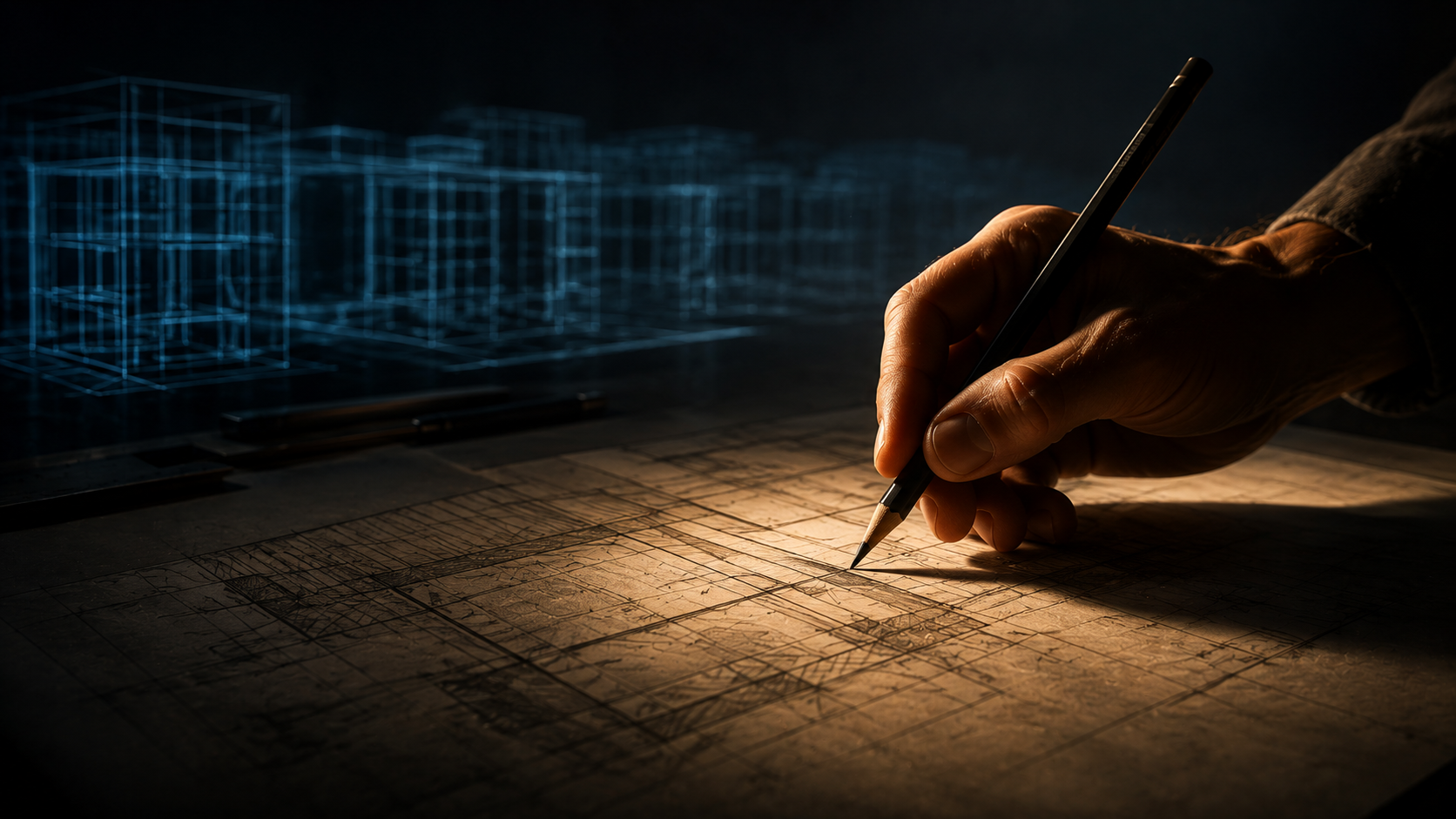
Anyone can generate a thousand. Someone chose to draw one.
Code, concrete, cosmetics. Three trades that share nothing in common except the discovery that, in an automated age, the hand is a story the machine cannot tell. Each has turned deliberateness into a moat — the same principle that lets a business command an ethical premium through genuine scarcity.
Where to Insert Friction on Purpose
The lesson is not that automation is the enemy. That would be a fool's war, and a losing one. The lesson is more surgical: automate the invisible, and hand-craft the visible. Let the machine handle the parts of your business the customer never sees or values — the scheduling, the invoicing, the backend plumbing — and reserve your finite human attention for the moments that carry the meaning.
Insight
Ask of every task: does the customer feel the hand here? If yes, protect it from automation at all costs. If no, automate it ruthlessly and reinvest the time into the parts that do. That is the hidden architecture of value in the age of AI.
This requires a kind of discipline that runs against every efficiency instinct of the moment. It means deliberately keeping some things slow. It means resisting the seductive economics of scaling everything, because some things lose all their worth the instant they are scaled. The businesses that will thrive are not the ones that automate the most — they are the ones that automate wisely, preserving the human signature exactly where it is felt. When the choice is genuinely hard, a clear framework for deciding is worth more than instinct, and the counsel of those who built enduring things by hand — the kind you can consult among history's great makers — is worth more still.
The Return of the Maker
We assumed the machine age would make the human hand obsolete. Instead it is making it precious. The more perfectly and cheaply a thing can be produced, the more we are drawn to the one that bears the mark of a person who chose to make it well. This is not sentiment. It is the oldest logic of value, resurfacing in a new economy: what is rare commands a premium, and in a world of infinite instant output, the rarest thing left is care made visible.
The machine can make anything. It cannot make it matter. That remains, stubbornly and profitably, the work of the hand — and the businesses that remember this will own the one advantage no algorithm can copy.