
There's a difference between an actor playing Socrates and a voice emerging from the text itself. One performs. The other remembers.
Six months ago, we launched Corpify Legends — AI conversations with history's greatest minds. It was a persona experiment: give GPT a system prompt, tell it "you are Benjamin Franklin," and see what happens. People loved it. The conversations were fun, occasionally profound, and always entertaining.
But something bothered us. Every response sounded like GPT wearing a costume. Franklin would say something vaguely wise, but it never felt like him. The wit wasn't sharp enough. The references were too generic. The voice was an approximation — close, but hollow.
So we did what any obsessive builder would do. We went to the source.
The Cosplay Problem
Here's what most "talk to Einstein" or "chat with Lincoln" AI products actually are: a large language model with a one-paragraph system prompt that says "You are Albert Einstein. You speak thoughtfully about physics and philosophy."
That's it. That's the whole trick.
The model has no access to Einstein's actual papers. It can't quote specific passages from his letters to Bohr. It doesn't know the exact phrasing he used in his 1905 annus mirabilis papers. It's performing a general impression of Einstein, assembled from whatever fragments exist in its training data.
This is cosplay. A costume draped over a general-purpose language model. And for casual entertainment, it works fine. But it produces responses that are interchangeable — swap "Einstein" for "Tesla" in the system prompt and you'll get responses of similar depth and specificity. Because there's nothing actually specific underneath.
The moment a user asks a pointed question — "What did you write about the nature of light in your own words?" — the illusion fractures. The model improvises. It hallucinates a quote that sounds plausible but never existed. And the user, unless they're a historian, never knows the difference.
We wanted something that couldn't be faked.
What 5,048 Passages Actually Means
We went to Project Gutenberg, university archives, and public domain collections. We pulled the actual writings — not summaries, not biographies, not Wikipedia entries. The primary texts themselves.
Then we chunked them into searchable passages and loaded them into dedicated MySQL FULLTEXT tables. One table per mind. Here's what lives in our database right now:
Benjamin Franklin — 1,161 passages
Sources: The Autobiography, Poor Richard's Almanack, The Way to Wealth, personal letters, essays on electricity, diplomacy, and moral perfection.
Leonardo da Vinci — 1,236 passages
Sources: Notebooks on painting, anatomy, engineering, flight, water dynamics. Treatises on art and science. Observations on light, shadow, and perspective.
Ralph Waldo Emerson — 1,128 passages
Sources: Essays: First Series, Essays: Second Series, The Conduct of Life, Representative Men, journals, lectures on self-reliance, nature, and the oversoul.
Socrates (via Plato) — 1,194 passages
Sources: The Republic, The Apology, The Symposium, Phaedrus, Meno, Crito, and the complete Socratic dialogues.
Marcus Aurelius — 329 passages
Sources: Meditations, complete — every book, every reflection, every private thought he wrote for himself and never intended to publish.
Total: 5,048 passages of actual human thought, spanning 2,400 years of intellectual history. Not summaries. Not interpretations. The words themselves.
The Mechanism: Retrieval, Not Invention
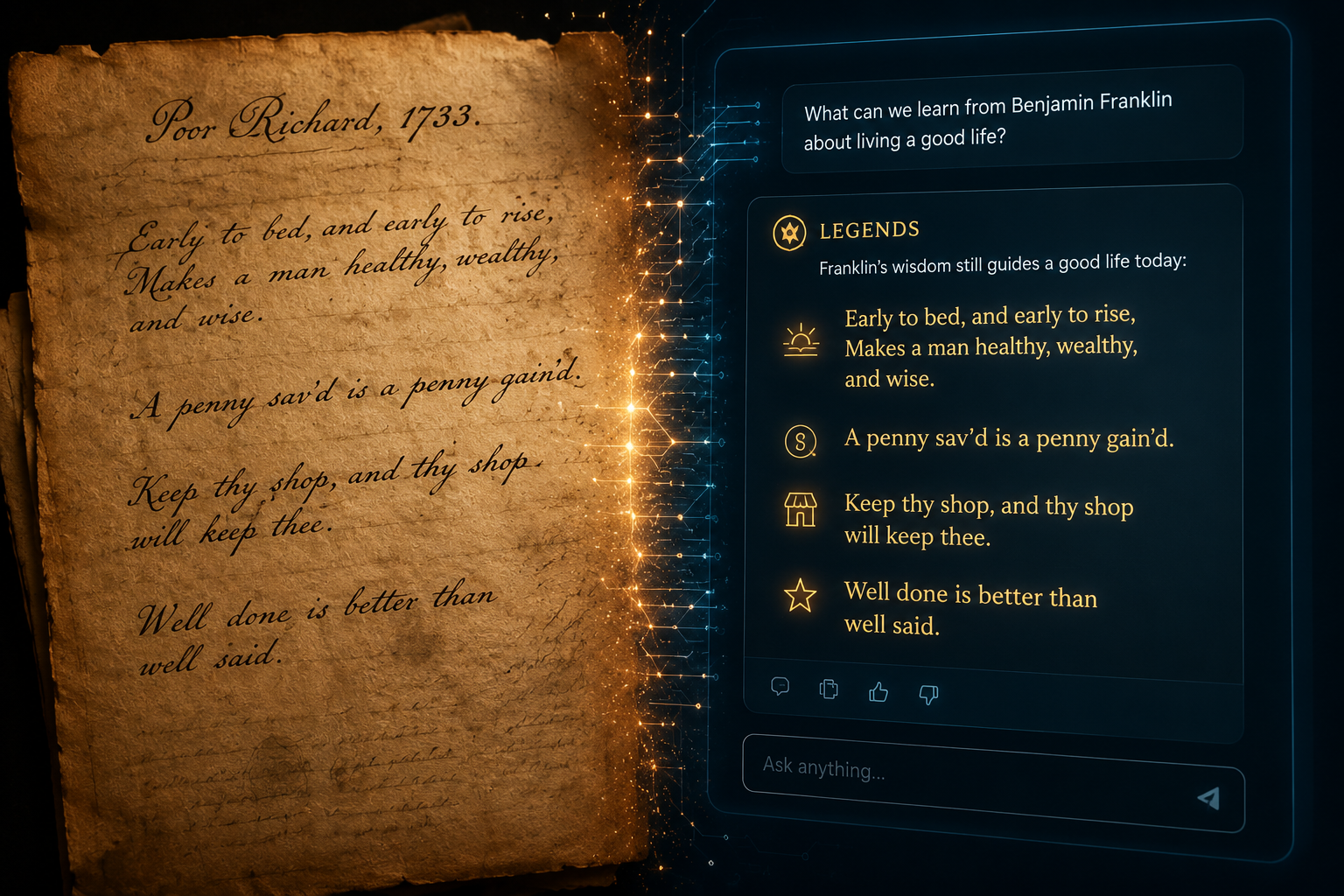
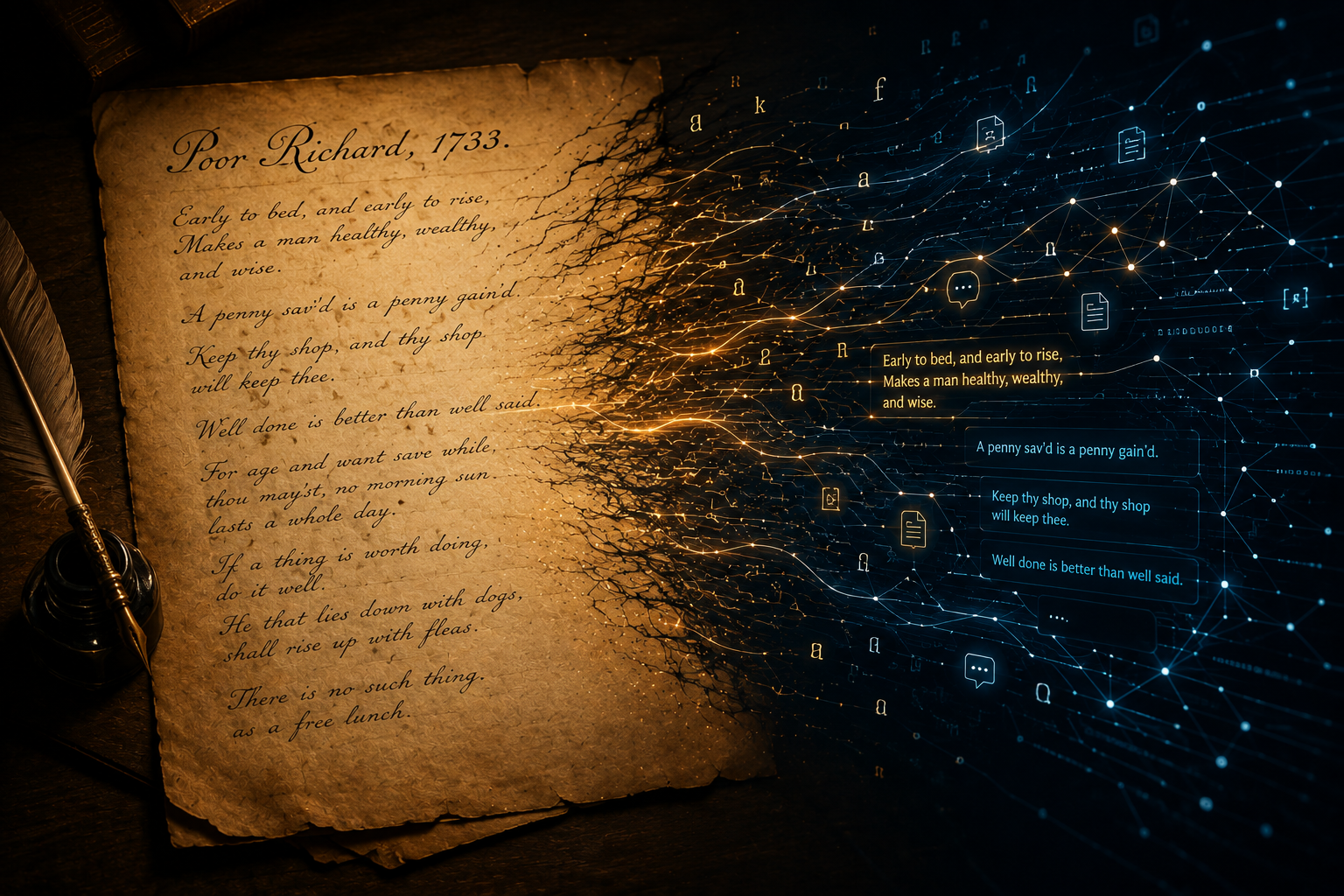
From parchment to conversation — the same words, a new medium
When you send a message to Benjamin Franklin on Corpify, here's what actually happens:
Step 1: Keyword extraction. Your message is parsed. Stop words are removed. The semantic intent is distilled into search terms.
Step 2: FULLTEXT retrieval. Those keywords hit Franklin's dedicated knowledge table — 1,161 passages of his actual writing. The database returns the top 3 most relevant passages, ranked by relevance score.
Step 3: Injection. Those real passages are fed into the conversation as context, labeled "YOUR OWN WRITINGS." The AI doesn't just know it's supposed to be Franklin — it has Franklin's actual words in front of it, right now, for this specific question.
Step 4: Grounded response. The AI responds using the retrieved text as its foundation. It can quote directly. It can paraphrase with the actual rhythm and vocabulary of the source. It can connect ideas from different passages in ways that feel genuinely Franklinian — because they are.
This is called Retrieval-Augmented Generation — RAG. But the acronym undersells what's happening. The AI isn't generating from nothing. It's generating from the text. The difference is the difference between an actor improvising Shakespeare and an actor who has the script in front of them.
What Happens When You Ask Franklin About Your Startup
Ask a persona-only Franklin "How should I think about failure?" and you'll get something like: "Ah, failure is the greatest teacher, my friend. I myself failed many times before succeeding." Generic. Could be any motivational poster.
Ask our Franklin the same question, and the system retrieves this passage from his Autobiography:
Retrieved Passage
"I had been religiously educated as a Presbyterian; and tho' some of the dogmas of that persuasion, such as the eternal decrees of God, election, reprobation, etc., appeared to me unintelligible, others doubtful, and I early absented myself from the public assemblies of the sect, Sunday being my studying day, I never was without some religious principles. I never doubted, for instance, the existence of the Deity; that he made the world, and govern'd it by his Providence..."
And Franklin responds not with platitudes about failure, but with the actual mechanism he used: his system of moral virtues, his habit of daily self-examination, his pragmatic approach to imperfection. Because the system found the relevant passage. The response has texture — the specificity of someone who actually lived it and wrote it down.
Ask Emerson about conformity and he'll pull from "Self-Reliance." Ask Socrates about justice and he'll draw from The Republic. Ask Marcus Aurelius about anger and he'll reference the very passage in Meditations where he wrestles with it privately, never expecting anyone to read his words.
You're not chatting with a costume. You're chatting with a library that talks back.
The Uncanny Valley of Authenticity
Something strange happens when you ground AI in primary sources. The responses develop qualities that no system prompt can produce:
Genuine wit. Franklin's humor wasn't generic wisdom — it was pointed, economic, often self-deprecating. Poor Richard's Almanack is full of lines like "Three may keep a secret, if two of them are dead." When the RAG system retrieves these, the AI's responses inherit that sharpness. It can't help it. The source material is sharp.
Contradictions. Real thinkers contradict themselves. Emerson wrote "A foolish consistency is the hobgoblin of little minds" — and then spent years being remarkably consistent. When the system retrieves passages that tension each other, the AI produces responses with genuine complexity. It doesn't flatten the thinker into a brand.
Specificity of reference. Da Vinci doesn't give you generic advice about observation. He tells you about watching water flow around obstacles, about how light behaves differently on curved versus flat surfaces, about the exact proportion of a human face. Because his notebooks are that specific, and the system retrieves them.
This is what cosplay can't replicate. You can prompt an AI to "be witty like Franklin" — but you can't make it retrieve the exact passage where Franklin describes tricking his brother's apprentices into vegetarianism to save money on food, then spending the savings on books. That level of specificity requires the source text to exist in the system.
Five Minds, Five Knowledge Architectures
Each legend required a different approach to chunking and indexing. You can't treat a Socratic dialogue the same way you treat Aurelius's private meditations.
Franklin writes in anecdotes. His passages are chunked by story — each one self-contained, with a clear beginning and a punchline or moral. The FULLTEXT index is heavy on keywords related to money, virtue, industry, and human nature.
Da Vinci writes in observations. His notebooks jump between topics within paragraphs. We chunked by conceptual unit — one observation per passage, even if the original page contained five. Topics span anatomy, engineering, painting, and natural philosophy.
Emerson writes in movements. His essays build like symphonies — theme, variation, crescendo. We chunked by paragraph clusters that preserve the arc of an argument. Keywords center on self-reliance, nature, intellect, and the soul.
Socrates (via Plato) speaks in dialogue. The chunking preserves the exchange — question and response together, so the AI can mirror the Socratic method of teaching through questions rather than declarations.
Aurelius writes in fragments. The Meditations are already perfectly chunked — short, intense reflections meant for himself. Each one stands alone. We indexed them almost as-is, with minimal processing.
Five minds. Five different relationships with language. Five different retrieval architectures, each designed to honor how that particular human actually thought and wrote.
Why This Matters Beyond the Demo
Here's the philosophical implication that keeps us up at night:
Preserved thought can now participate in new conversations.
Emerson's essays have sat in libraries for 170 years. You could read them — and millions have. But you couldn't ask them a question. You couldn't say "Ralph, I'm stuck between two paths and I don't know which one requires more courage" and have the text respond with the specific passage from The Conduct of Life where he wrestles with exactly that tension.
That's new. That's never been possible before in human history.
Marcus Aurelius wrote the Meditations for himself, never intending publication. For 1,800 years, readers have been eavesdropping on his private thoughts. Now, for the first time, you can respond to them. You can say "I'm struggling with the same thing" and the system finds the passage where he struggles with it too.
This isn't resurrection. These aren't the people. But it's something adjacent — a new form of intellectual relationship with the preserved dead. Their words, finding new contexts. Their ideas, responding to questions they never heard.
We built this because we believe AI should augment human thought, not replace it. And the deepest augmentation isn't generating new text — it's making old text alive again. Connecting a solopreneur in 2026 with the specific passage where Franklin describes building an empire alone, through industry and frugality and relentless self-improvement.
The model provides the interface. The writings provide the soul.
Try It Yourself
Five minds are waiting: Benjamin Franklin, Leonardo da Vinci, Ralph Waldo Emerson, Socrates, and Marcus Aurelius. Ask them anything. The responses are grounded in their actual writings — not hallucinated, not approximated. Retrieved.
What Comes Next
We're watching conversations now. Patterns are emerging — the questions people ask, the passages that resonate, the moments where retrieved text creates genuine surprise. Every conversation teaches us something about what people actually want from historical minds.
The Legends hub also includes eight additional figures — Carnegie, Rockefeller, Ford, Morgan, Chanel, Edison, Tesla, and Disney — running on personality prompts without dedicated RAG. The difference in response quality is noticeable. They're good. The RAG-powered five are something else entirely.
The gap between "AI pretending to be someone" and "AI with access to everything that person wrote" isn't a feature difference. It's a category difference. One is entertainment. The other is something we don't quite have a word for yet.
Maybe the closest word is conversation. Real conversation. With real thought. Preserved across centuries, finally able to speak back.