
In 1980, a scientist set out to answer a question as old as humanity itself: in a world of self-interested players, does it actually pay to be good? He didn't ask a philosopher. He ran a tournament. He invited some of the sharpest minds alive to submit strategies — clever ones, ruthless ones, elaborate traps — and pitted them against each other over hundreds of rounds. The winner was four lines long. It was the simplest entry in the entire contest. Its name was Tit for Tat, and what it revealed about trust, cooperation, and why decent people quietly come out ahead is the single most useful thing a person in business can understand.
Because it turns out the question "should I be good, or should I be shrewd?" rests on a false choice. The math has an answer, and the answer has teeth.
The Tournament That Answered an Ancient Question
The scientist was Robert Axelrod, and the game was the repeated Prisoner's Dilemma — two players, each round choosing to cooperate or betray, playing again and again. In a single round, betrayal is tempting: you gain at the other's expense and walk away. But Axelrod's players met over and over, and memory changes everything.
The submissions poured in, many of them intricate — strategies that probed, feinted, and tried to exploit. The one that won, submitted by Anatol Rapoport, was almost embarrassingly simple. It cooperated on the first move, and after that, it simply did whatever the other player had done the round before. Cooperate, and it cooperated. Betray, and it betrayed once — then forgave the moment you returned. That was the whole thing.
Axelrod, stunned, ran the tournament again — this time telling every entrant that Tit for Tat had won, and inviting them to design something to beat it. It won again. The simplest, most transparent, most cooperative strategy dominated the ruthless and the clever. From that result, Axelrod distilled four properties of any winning strategy in a repeated game. Read them as a business philosophy, because that's exactly what they are.
Rule 1 — Be Nice: Cooperate First
Nearly every high-scoring strategy shared one trait: it never betrayed first. The aggressive strategies that opened by defecting tended to poison their own environment — they ran out of anyone willing to cooperate with them and collapsed. Niceness wasn't sentimentality. It was structurally superior.
In business, this is the discipline of extending trust and value before you demand them — opening with generosity, doing the win-win move rather than trying to win against the other side. It's why the businesses people trust almost on contact tend to be the ones that gave before they asked (trust, once earned, is the asset that stops people from ever shopping around again). Cooperate first. It's not naïve. It's the opening move of the strategy that beats everyone.
Rule 2 — Have Teeth: Retaliate
Here is where most gentle people fail, and where Tit for Tat is merciless in its wisdom. Being nice is not the same as being a pushover. When the other player betrayed, Tit for Tat responded — immediately, proportionately, without hesitation. Not out of spite. As information. The retaliation tells the other party a single clean fact: exploitation has a cost.
Emerson said it a century and a half before the computers confirmed it: "Your goodness must have some edge to it — else it is none." A strategy that always cooperated, no matter how badly it was treated, got exploited into oblivion. Goodness without teeth doesn't just lose — mathematically, it stops being goodness at all and becomes an invitation to be used. In business this is the clean "no," the boundary held, the client you decline because they drain more than they bring. It's learning that your weakest relationship becomes the ceiling on what you earn, and that the hardest, most decisive moments — the five conversations every solo operator must learn to hold — are exactly where the edge either exists or doesn't.

The whole strategy in one image: an open hand — generous, offered first — with an edge. Goodness that can defend itself is the only kind that lasts.
Rule 3 — Forgive Fast
The moment the other player returned to cooperation, Tit for Tat returned too. It carried no grudge. This is subtler than it sounds and just as vital as the teeth: strategies that punished forever, that met one betrayal with endless retaliation, spiraled into mutual destruction where both sides lost everything. Forgiveness broke the spiral and restored the mutual gain.
Forgiveness here is not weakness — it's the refusal to let one bad round destroy a profitable relationship. In business, it's declining to make a client pay for a month over a single mistake, resetting quickly after a rough patch, letting a good partner back in once they've corrected course. The grudge feels righteous, but it's expensive. The player who forgives fast keeps the door open to every future round of cooperation — and in a game that repeats, those future rounds are where all the value lives.
Rule 4 — Be Legible
Tit for Tat won partly because everyone could understand it. Its logic was so transparent that opponents quickly learned a simple lesson: cooperating with this player pays, betraying it costs. Predictability, it turns out, is a strategic asset — the opposite of the cunning, unreadable operator we're taught to admire.
In a repeated game, reputation is just memory, and memory is the whole game. Being the person whose word is reliable, whose terms are clear, whose behavior is knowable, means others can safely choose to cooperate with you — which is precisely why some businesses are trusted on sight while others must argue for every inch. Legibility is why making trust itself the product is such a durable strategy, and why the clients who know exactly what to expect are the ones who stay. Be knowable. It's how the whole system learns that you're safe to build with.
Insight
Nice, retaliatory, forgiving, clear. Science went hunting for optimal selfishness and came back with the Golden Rule — with teeth. Be good first, respond honestly when crossed, forgive the moment they correct, and stay reliable enough that people learn cooperation pays. That's not a moral. It's the winning move.
Why This Is the Deepest Business Truth There Is
Sit with what actually happened in that tournament. We built machines to be perfectly selfish, set them loose to maximize their own gain with no morality programmed in — and cooperation emerged anyway, not because anyone imposed it, but because it won. That means cooperation isn't a fragile veneer we paint over a selfish animal. It's the oldest, most-tested structure in the living world — the same pattern that governs sharing bats, cleaner fish, and every human society that ever held together.
And it reframes good and evil in a way worth carrying. Betrayal is parasitic: it works in a single round, but it consumes the very fabric it needs to survive, and it collapses over time. Cooperation is generative: it creates the fabric — the trust, the relationships, the reputation — on which everything, including business, is built (it is, quite literally, how value comes into being in the first place). This is why building on trust and mutual gain never feels like rowing against the current. You're building with the grain of the universe — and you're never really doing it alone, because a durable enterprise is a system of cooperating relationships, not a series of conquests.
Run Your Business Like Tit for Tat
So here is the operating system, four rules deep and forty years proven. Extend trust and generosity first. Respond honestly — not resentfully — the moment someone abuses it. Forgive the instant they correct course. And stay clear, reliable, and knowable, so everyone you deal with learns that cooperating with you is the smart move. It isn't softness, and it isn't ruthlessness. It's the rare and powerful combination that wins the only game that matters — the one that repeats. Structure the whole venture around relationships that come back, not wins you take once (the right returning customers are worth more than any pile of one-offs, and a plan built on repeat cooperation compounds where a plan built on extraction burns out). When you want to see this played across a lifetime, study the builders who lasted — their strategies are one conversation away.
Stop trying to win against people. Become the one it always pays to cooperate with. The simplest strategy in the world beat every clever trap thrown at it — and it did so by being good, having teeth, forgiving fast, and being impossible to misread. You could do a great deal worse than to run your business, and your life, the same way.
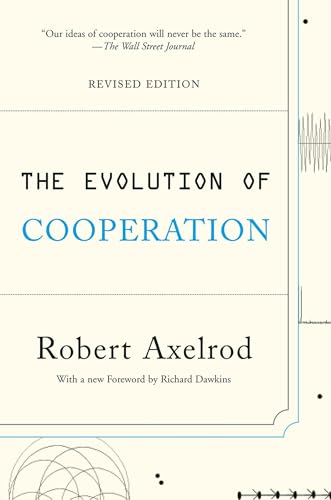
The book behind this entire essay — Axelrod's own account of the tournament, the four rules, and how cooperation emerges among the selfish. Rigorous, surprisingly readable, and quietly one of the most hopeful books ever written about how the world works.
View on Amazon