
Every idea you try to remember is an idea you are no longer free to have. Memory is not storage — it is a cost, paid in the exact currency you need most: attention.
There is a particular kind of tiredness that has nothing to do with work and everything to do with holding. The dentist appointment you must not forget. The brilliant idea from the shower you are afraid to lose. The follow-up email, the half-formed strategy, the name of the person you were supposed to call. None of these are heavy on their own. Together, they form a low, constant hum — a tax levied on every waking hour, charged against the one resource a solopreneur cannot outsource: a clear mind.
The Cognitive Tax
Psychologists have a name for the reason unfinished tasks nag at us: the Zeigarnik effect. An open loop occupies working memory until it is closed — or until it is trusted to a system outside your head. This is the hidden mechanism behind that hum. Your brain, lacking anywhere safe to put a thought, keeps it in the foreground, rehearsing it so it won't be lost. Multiply that by a hundred open loops and you have the default mental state of most ambitious people: busy, cluttered, and strangely unable to think deeply about anything.
The irony is sharp. The more you try to remember, the less you can think. Memory and cognition compete for the same limited space. This is the same reason focused execution beats frantic activity — the mind does its best work when it is not also acting as a filing cabinet.
Insight
You do not have a memory problem. You have a trust problem. The moment your mind believes a thought is safely captured elsewhere, it lets go — and thinking returns.
Capture Before Organize
Here is the discipline that changes everything, and it is almost embarrassingly simple: capture first, organize later. The single greatest failure of every note-taking system is that people try to file a thought at the exact moment they have it. But filing requires judgment, and judgment requires time, and time is precisely what you don't have when an idea strikes mid-conversation or mid-walk. So the idea goes uncaptured — and is lost.
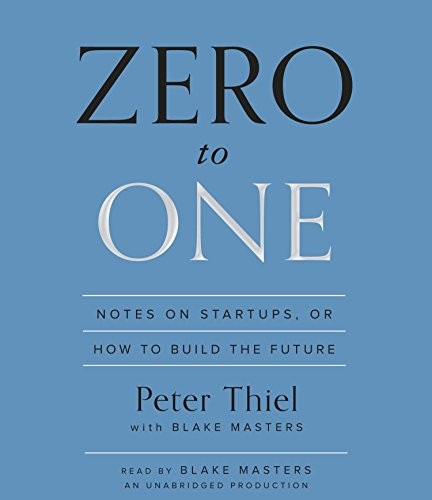
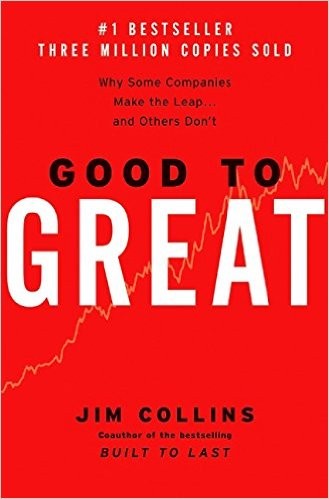
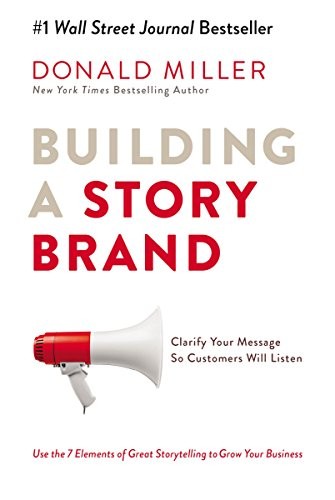
A second brain is not a beautiful, organized library. It is a fast, frictionless inbox that you trust completely. The organizing happens later, on your terms. The capturing happens instantly, or it does not happen at all. This is the entire game, and the two greatest guides to it are these:
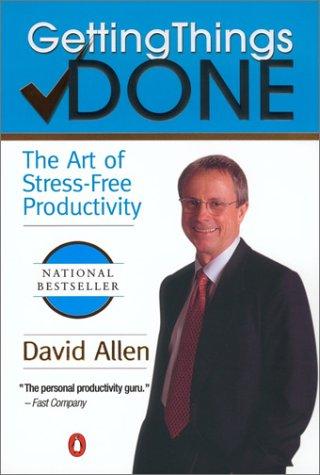
The book that coined it: your mind is for having ideas, not holding them. The original system for a clear head.
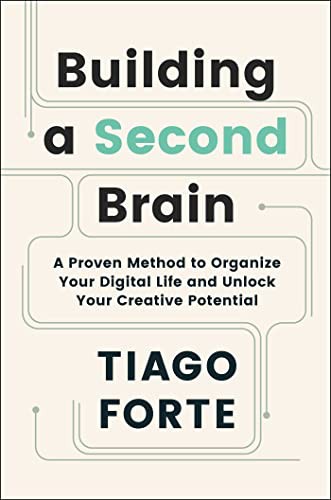
Tiago Forte's complete method for capturing what matters and turning scattered notes into a body of work that compounds.
The Analog Layer
There is something the research keeps confirming and the productivity influencers keep ignoring: writing by hand changes how a thought lands. The slowness is the point. When you write longhand, you cannot transcribe everything, so your brain is forced to summarize, to decide what matters — and that act of compression is thinking itself. A notebook is not a nostalgic accessory. It is a cognitive tool that a keyboard cannot replicate.
The notebook you'll actually use is the one that makes capture effortless — numbered pages, an index, paper that invites the pen:
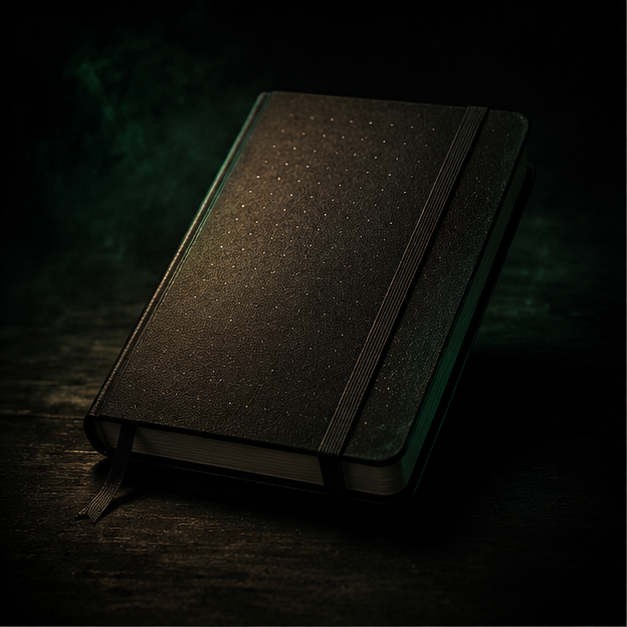
Numbered pages and an index built in — the analog layer that anchors a thought the instant you have it. Writing by hand makes ideas stick.
And the pen matters more than you'd admit. Friction is the enemy of capture, and a pen you enjoy is a pen you reach for before the thought escapes:
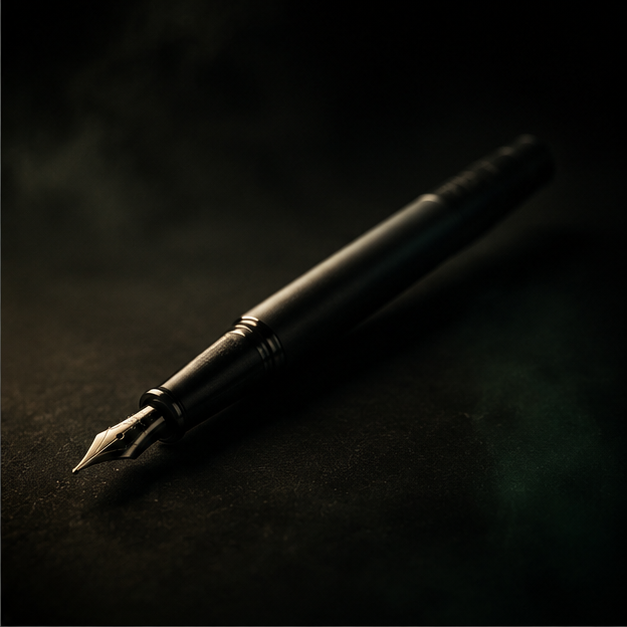
Friction kills capture. A pen you actually enjoy using is a pen you'll reach for before the idea escapes.
The Digital Layer
Paper anchors. But paper does not search, does not sync, and eventually runs out. The second half of a second brain is a digital layer — a place where handwriting becomes permanent, findable, and infinite. For years this meant surrendering the feel of paper for the utility of a screen. No longer. E-ink tablets have closed the gap: the tactile calm of writing by hand, with the searchability of a database.
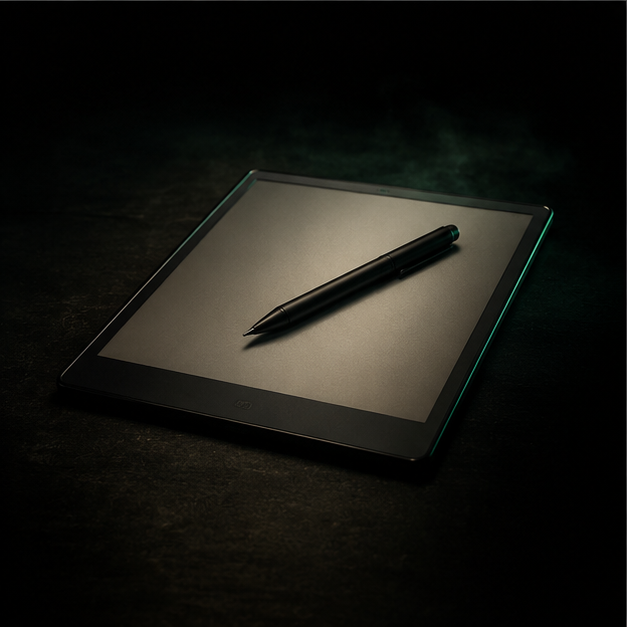
The digital layer: handwriting that is searchable, syncable, and infinite. Paper that never runs out and never gets lost.
The Discipline of Trust
None of this works unless you trust it. A capture system you second-guess is worse than no system at all, because it adds a layer of anxiety on top of the original loop. The goal is not a perfect archive — it is the earned confidence to let go. When you know, without checking, that every commitment and every spark is somewhere you'll find it, your mind finally does what it was built to do: not store, but think.
This is the same principle that governs a well-run one-person business. You don't scale by holding everything in your head; you scale by building systems you trust enough to forget. If that idea resonates, it's the backbone of the entire one-person operating manual — and it starts here, with the humble act of writing something down and believing you'll see it again.
Empty your head onto paper and into a system. Then go have the ideas only an unburdened mind can reach. That is not organization. That is freedom.